

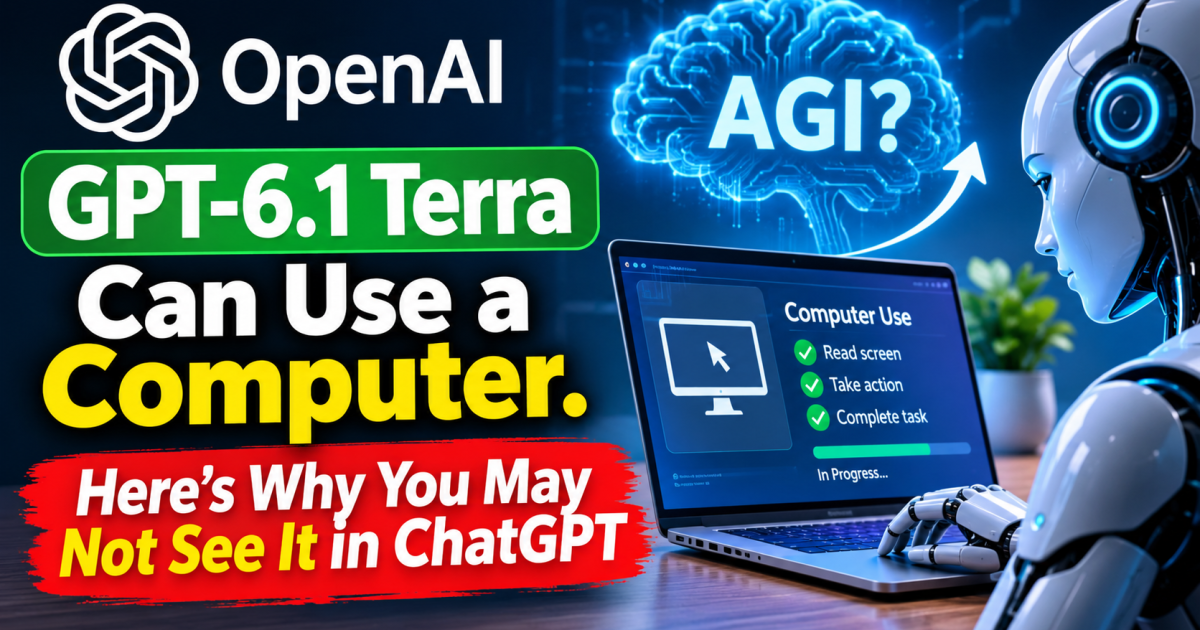
OpenAI has introduced an AI model designed to do more than answer questions. It can interpret what appears on a computer screen, interact with applications and carry out tasks that would otherwise require a person to move between different tools.
There is a catch, though. If you open the regular ChatGPT chat interface looking for this capability, you may not find it there.
The model is called GPT-6.1 Terra, and OpenAI announced it on October 26, 2026. It is available through ChatGPT Work and Codex, rather than the regular Chat experience.
That distinction matters, particularly if you use AI for your business. It also raises a bigger question: as AI moves from generating answers to taking actions, are we getting closer to artificial general intelligence, or AGI?
Here’s what OpenAI has actually introduced, what it means for everyday users and why computer-using AI deserves attention beyond another model announcement.
What Is GPT-6.1 Terra?
GPT-6.1 Terra is an OpenAI model designed for visual reasoning, computer use and writing. Rather than relying exclusively on text instructions and responses, it can interpret screens and interact with supported applications to complete tasks.
In its official announcement, OpenAI describes applications ranging from filling out forms and interpreting technical drawings to editing videos and handling computer-based work.
Consider the difference between asking an AI to explain how to complete a form and having an AI system interact with the form itself.
The first approach gives you instructions. The second can potentially carry out some of the steps for you.
That does not mean the AI can operate every application flawlessly or complete every task without supervision. Its capabilities depend on the available tools, the task and the environment in which it operates.
Nevertheless, the shift from generating instructions to acting on them is important. It changes how people might use AI in their daily work.
Key Takeaway
- OpenAI announced GPT-6.1 Terra on October 26, 2026, with capabilities spanning visual reasoning, computer use and writing.
- The model is available through ChatGPT Work and Codex, rather than the regular ChatGPT chat interface.
- Computer-using AI can potentially help complete tasks inside supported applications instead of merely explaining how to perform them.
- Computer use is relevant to the development of more capable AI agents, but it does not prove that AGI has arrived.
- For small businesses, reliability, access permissions, security and cost matter as much as a model’s advertised capabilities.
Why You May Not See It in Regular ChatGPT
OpenAI’s announcement and model release notes distinguish GPT-6.1 Terra from the model experience available in the regular ChatGPT chat interface.
As of October 29, 2026, GPT-6.1 Terra is rolling out through ChatGPT Work and Codex. Developers can also access it through the OpenAI API using the model identifier gpt-6.1-terra.
In other words, hearing about a new OpenAI model does not automatically mean you can select it in your usual ChatGPT conversation.
OpenAI says Terra is available to eligible Plus, Pro, Enterprise and Edu users in ChatGPT Work and Codex. Access can depend on the product, account or workspace arrangements, and the relevant setup requirements.
API access is a separate route for developers, and API usage is billed separately from ChatGPT subscriptions.
There is also a cost consideration. OpenAI lists standard API pricing at $1 per million input tokens and $5 per million output tokens, with cached input priced lower. These are API rates, not the price of a ChatGPT subscription.
The broader lesson is simple: an AI model’s capabilities, the product through which you access it and the permissions available to it are three different things.
What Can Computer-Using AI Actually Do?
Computer use allows an AI system to interact with a software environment instead of stopping after it generates an answer.
For example, imagine that you run an online store and need to prepare several product listings.
A conventional chatbot could help write product descriptions, suggest titles and organise the information you provide. A computer-using AI could potentially go further by interacting with supported software to enter information or perform other steps in the workflow.
Other potential applications include:
- Administrative work: Reading information from documents and entering it into supported business applications.
- Website management: Assisting with repetitive tasks in supported interfaces, subject to access permissions and the available tools.
- Marketing: Organising campaign assets, reviewing visual materials and helping with routine production workflows.
- Research and reporting: Moving information between tools as part of a larger task.
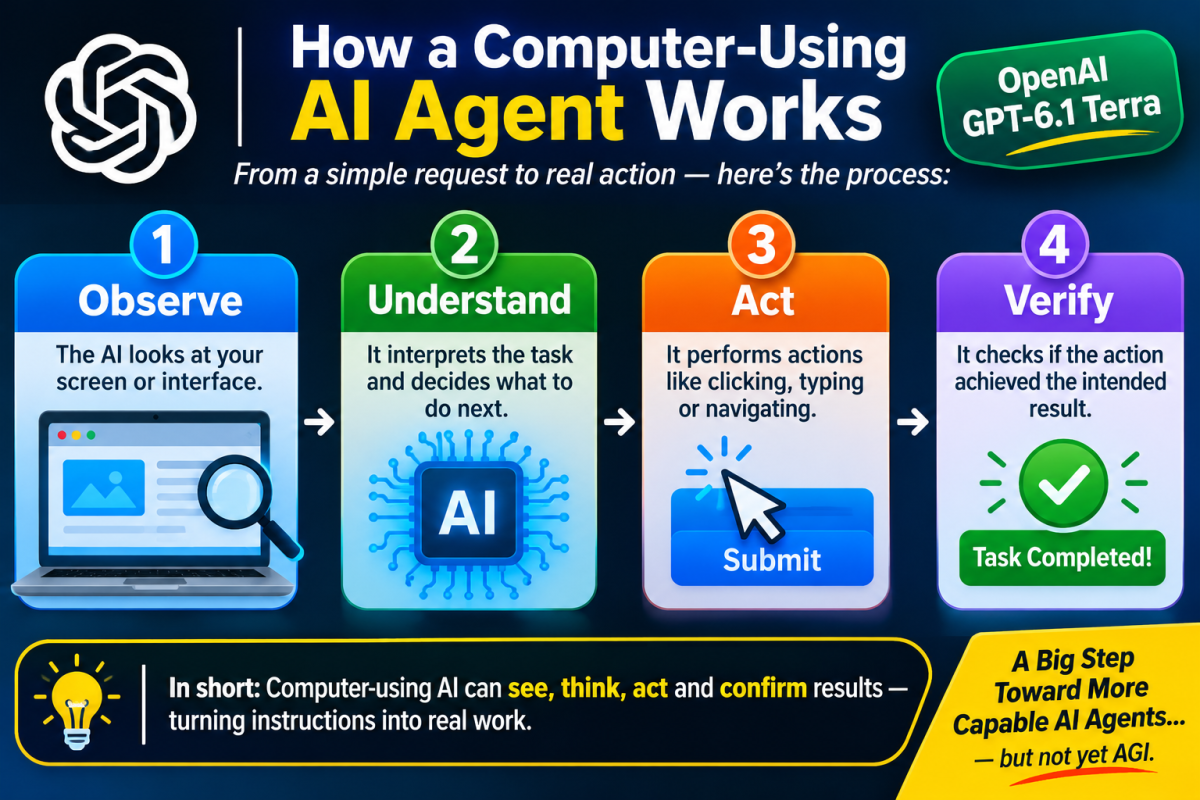
These are examples of possible applications, not a guarantee that Terra can complete every workflow reliably or without human involvement.
OpenAI reports improvements in computer-use performance and task efficiency compared with its earlier Terra model. Those results are based on the company’s published evaluations, so they should be understood in the context of the benchmarks and testing conditions used.
For small businesses, the important question is not simply whether an AI can click a button. It is whether the system can complete a useful task accurately, consistently and at a cost that makes sense.
Is This a Step Toward AGI?
This is where the announcement becomes more interesting than a routine product update.
AGI stands for artificial general intelligence. Although researchers and technology companies use the term in different ways, it generally describes AI with broad abilities to learn, reason and apply knowledge across many different tasks, including unfamiliar situations.
OpenAI’s own Charter defines AGI in terms of highly autonomous systems that outperform humans at most economically valuable work.
Stanford University’s Human-Centered Artificial Intelligence institute also highlights an important complication: there is no universally accepted definition or test that conclusively establishes when a system has achieved AGI.
So where does computer use fit into this discussion?
Consider how people currently use many AI assistants. We ask a question, receive an answer and then perform the work ourselves. More capable AI agents can connect reasoning with action, using tools to pursue a goal across multiple steps.
That ability is relevant to the development of more general-purpose AI. A system that can interpret a screen, select an action, assess the result and continue toward a goal has to do more than generate a plausible paragraph.
It must deal with an environment that can change while it is working.
However, being able to use a computer is not the same as achieving AGI.
A system might perform well at particular computer-based tasks while still struggling with unfamiliar problems, making mistakes during long workflows or failing to generalise its abilities to other domains.
Computer use is therefore one capability worth examining in the broader AGI debate, not proof that AGI has arrived.
Three Questions That Matter More Than the AGI Label
Rather than deciding whether every new model is approaching AGI based on a headline, it is more useful to examine what the system can actually do.
1. Can it handle unfamiliar tasks?
Performing a task that resembles something encountered during training is different from adapting to a genuinely unfamiliar situation.
Broad generalisation is an important part of the AGI question. We should therefore look beyond demonstrations of individual tasks and ask how well a system handles new problems.
2. Can it complete long tasks reliably?
A model might perform one action correctly but make a mistake several steps later. The longer a workflow becomes, the more opportunities there are for errors, missed instructions and unexpected situations.
Reliability across an extended sequence of actions is therefore an important measure of practical usefulness.
3. Can it recognise its own limitations?
An AI agent needs to handle uncertainty appropriately. If it encounters an unexpected screen, lacks permission or cannot complete an action, it should communicate the problem rather than pretend the task succeeded.
These questions do not provide a definitive AGI test. They do, however, offer a more useful way to evaluate progress than relying on impressive demonstrations alone.
What This Means for Small-Business Owners
For people running websites, online stores or digital businesses, the immediate significance of computer-using AI is practical rather than philosophical.
AI tools have already become useful for drafting content, generating code, preparing marketing materials and researching business ideas. The next opportunity is to connect those capabilities to the applications in which the work actually happens.
For example, I have previously explored building a WordPress theme with ChatGPT and using Claude AI to build apps. Those experiences illustrate how AI can contribute to real projects rather than merely produce answers in a conversation.
You can read more about those projects in my articles on building a WordPress theme with ChatGPT and using Claude AI to build three apps.
Computer-use capabilities point toward a further development: AI systems that can potentially help carry work through the software used to complete it.
That could eventually reduce some repetitive administrative tasks and make certain workflows easier to manage. But the benefits will depend on the reliability of the systems, the applications they support and the cost of using them.
There are also security considerations. Giving an AI system access to applications or business data can introduce risks if permissions are too broad or if the system acts on incorrect instructions.
Business owners should use appropriate access controls, review consequential actions and avoid giving an AI agent unrestricted access to sensitive accounts simply because it can perform tasks automatically.
If you use ChatGPT for business, my earlier article on what happens when a ChatGPT account is hacked provides related security context.
Does GPT-6.1 Terra Mean AGI Is Near?
Not on the evidence of computer use alone.
GPT-6.1 Terra demonstrates OpenAI’s continued work on models that combine visual understanding with the ability to interact with software. That is a meaningful development for AI-assisted work, particularly when tasks involve several steps and multiple applications.
But a model’s ability to perform computer-based tasks does not establish that it can match or exceed human abilities across the full range of economically valuable work.
There is also no universally agreed threshold that tells us exactly when AGI has been achieved. Claims about how close we are must therefore be assessed against the capabilities demonstrated, the limitations that remain and the definition being used.
The more useful question is whether AI systems are becoming better at handling a wider range of tasks with less supervision while remaining reliable in unfamiliar situations.
GPT-6.1 Terra is relevant to that discussion. It is not, by itself, an answer to the AGI question.
The bottom line: AI is moving beyond generating answers toward helping execute tasks. That shift could change how people work with software, but whether it leads to AGI remains an open question. For now, it is more useful to judge these systems by what they can reliably accomplish than by the labels attached to them.























Conversation (0)