

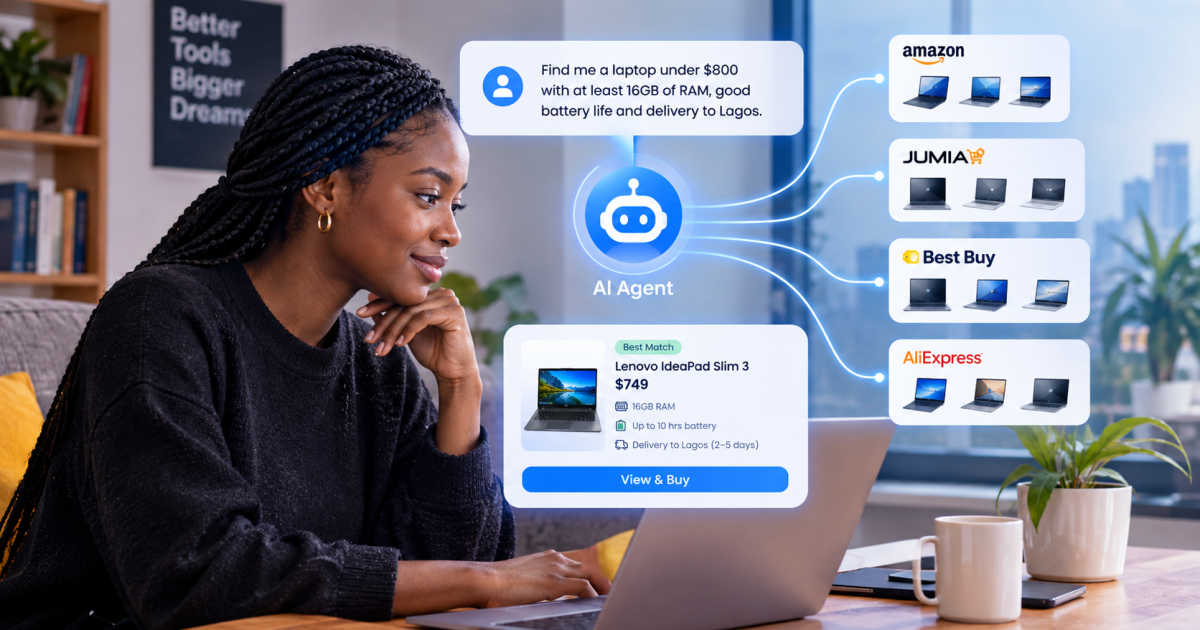
What if you stopped searching for products yourself?
Instead of opening Google, comparing several websites, reading reviews and deciding which seller to trust, you simply told an AI agent what you wanted and let it do the research.
Okay imagine telling an AI agent: “Find me a laptop under $800, with at least 16GB of RAM, good battery life and delivery to my location.”
That is increasingly becoming possible.
AI shopping agents are moving beyond answering questions and recommending products. The technology is being built to search product information, compare options, help shoppers make decisions and, in some cases, take part in the purchase itself.
OpenAI has expanded product discovery in ChatGPT through its Agentic Commerce Protocol, while Google is building agentic shopping around its Universal Commerce Protocol and Universal Cart.
These developments point toward a different kind of online shopping experience, one in which AI can sit between the customer and the websites selling the products. OpenAI and Google have both described their respective approaches to this shift.
And that raises a much bigger question for the web:
If an AI agent becomes the middleman between people and websites, what happens to the websites?
AI shopping is moving beyond recommendations
There is nothing particularly new about using AI to recommend a product.
Shopping websites have used recommendation engines for years. Search engines have also become increasingly good at understanding what someone wants and displaying relevant products.
The difference with agentic commerce is the role of the AI.
A conventional search engine might return pages of results for you to investigate.
An AI shopping agent can instead work through the request as a task. It can search available product information, compare relevant attributes, narrow the options and help you decide what to buy.
OpenAI’s current shopping research experience, for example, can use merchant product data supplied through its Agentic Commerce Protocol alongside publicly available product information and other retail sources. Products can then be compared using information such as price, features and reviews.
That changes the role of AI from answering a shopping question to helping carry out the shopping process.
The AI agent could become the new middleman
For years, the online shopping journey has looked roughly like this:
Search → website → comparison → decision → purchase
Agentic commerce introduces another possible route:
AI agent → multiple sources → comparison → recommendation → purchase
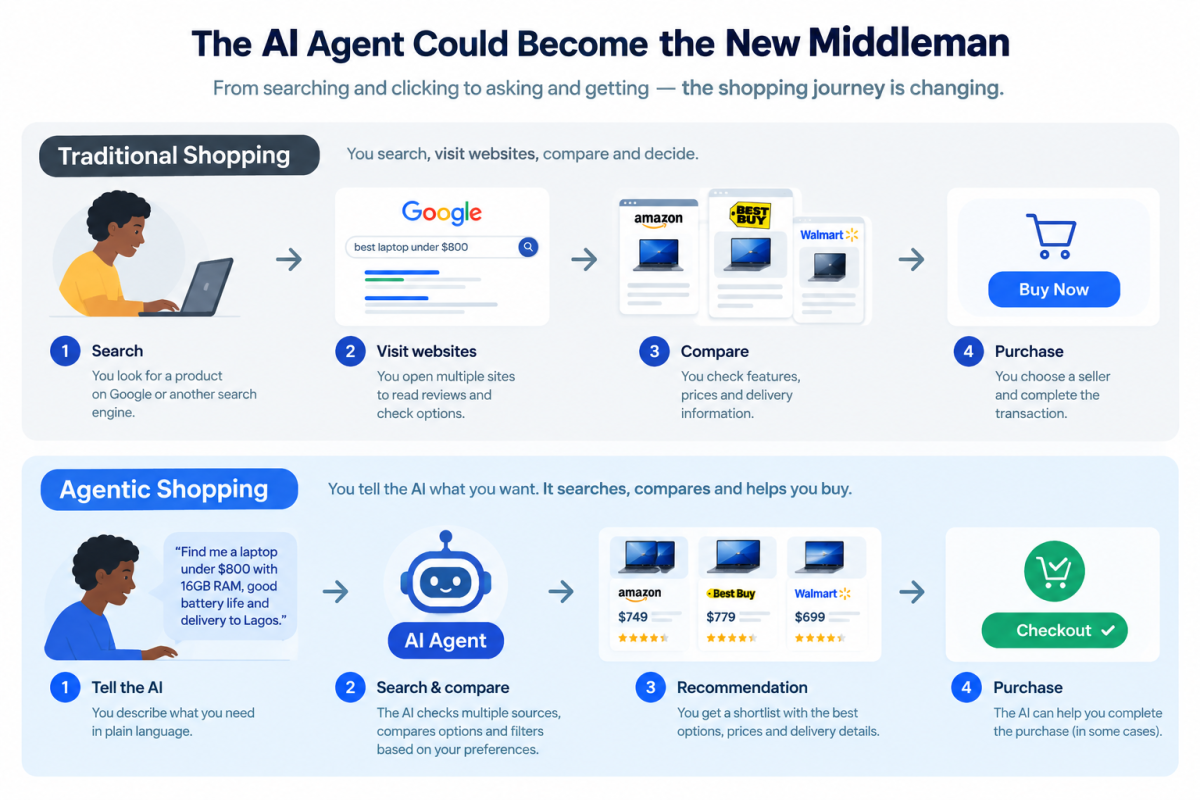
The difference may look small from the consumer’s perspective, but it could be significant for businesses.
Google’s Universal Cart is designed to let shoppers add products across Google experiences and continue toward checkout, while its Universal Commerce Protocol provides a common way for agents and commerce systems to interact across the shopping journey.
OpenAI has taken a similar direction with its Agentic Commerce Protocol, which is designed to connect people, AI agents and businesses during product discovery and purchasing.
The technology is still developing, and not every shopper will suddenly hand over their entire purchasing process to an AI.
But the infrastructure is being built.
And banks are already worried about what could go wrong
The convenience comes with a difficult problem: an AI agent can potentially do more than display information.
On September 22, 2026, major banks including NatWest, Bank of America, ING, Capital One, Commonwealth Bank of Australia and ASB Bank warned about potential risks from AI shopping agents.
According to Reuters, the banks raised concerns around scams, fraud, privacy and the handling of sensitive financial information. They also questioned what happens when an AI agent makes a decision that does not reflect the consumer’s interests or when something goes wrong during an AI-assisted transaction.
That creates questions that traditional search did not have to solve:
- Who is responsible when an AI agent makes the wrong purchase?
- How can a consumer tell why a particular seller or product was selected?
- What happens if an AI agent is manipulated by misleading information?
- How much payment or personal information should an agent be allowed to access?
- What protections apply when an automated system initiates a transaction?
These are not reasons to dismiss agentic commerce. They are signs that the technology is moving into an area where trust, authentication and consumer protection matter as much as convenience.
The bigger problem for websites may be the missing click

There is another consequence that could matter even more to publishers and online businesses.
The AI may use your website without sending the user to it.
Consider a product review website.
Today, a shopper might search Google for a laptop, click a review, read the article, visit an affiliate retailer and eventually make a purchase.
The publisher can potentially earn from advertising, affiliate commissions or the reader’s return visit.
But an AI agent could instead gather information from several sources and present the shopper with a condensed recommendation.
The information from your website may influence the decision while the person never sees your page.
That is a very different relationship between content and traffic.
What happens to Google Search?
It would be too early to say that AI agents will replace Google Search.
In fact, Google is incorporating agentic commerce directly into its own ecosystem.
Its Universal Cart is designed to work across Google surfaces such as Search and Gemini, while Google’s broader Universal Commerce Protocol is intended to give AI agents and commerce systems a common way to communicate.
Google has also described agentic shopping as part of its broader direction for AI-powered commerce.
So the more useful question is not whether search disappears.
It is whether the search result remains the final destination.
A shopper may increasingly ask an AI system to perform the comparison instead of opening ten search results and doing the work manually.
That could reduce the importance of some traditional search journeys even while search itself remains part of the process.
Affiliate websites have another problem to solve
Affiliate marketing is built around a relatively simple model:
Content → click → retailer → commission
Agentic commerce could introduce a different model:
Content → AI interpretation → recommendation → transaction
That does not mean affiliate marketing is finished.
It does mean that producing another generic product list may become less valuable if AI systems can already collect basic specifications and prices from many sources.
What becomes more difficult to replace is information that adds something genuinely different.
That could include:
- first-hand product testing
- original photographs or demonstrations
- unique comparisons
- original research and data
- expert analysis
- documented personal experience
- information that is difficult to obtain elsewhere
In other words, the pressure may move from “Can I create another page targeting this keyword?” toward “What information does my page provide that an AI cannot easily get everywhere else?”
The website may not disappear. It may become invisible.
This is probably the most important idea in the entire shift.
A website does not have to disappear to lose direct human traffic.
It can remain an important source of information while becoming less visible to the person making the final decision.
Google has already described this emerging environment in terms of an “invisible shelf,” where products need to be discoverable by AI agents as well as by people browsing traditional storefronts.
That creates a strange possibility for the future of the web.
A business could become more important to an AI system while becoming less visible to the human customer.
The customer sees the recommendation.
The AI sees the underlying product information.
The website supplies the data.
And the transaction happens somewhere in between.
What does this mean for small businesses in Nigeria?
The shift is not limited to Amazon-sized retailers or companies in Silicon Valley.
A Nigerian business selling products online already has to compete across Google, social media, marketplaces, WhatsApp and other digital channels.
AI shopping introduces another potential layer of competition: being understandable and discoverable to AI systems.
Imagine a customer asking an AI agent to find a particular product that can be delivered in Lagos within two days.
The agent needs useful information about the seller, product, price, availability, delivery and payment process.
A business with incomplete product descriptions, outdated prices or unclear delivery information may have difficulty participating in that kind of automated shopping journey.
This is why agentic commerce matters even to businesses that have no plans to build an AI agent of their own.
The important question may eventually become:
Can AI systems understand what my business sells, where I operate and whether customers can trust me?
Does SEO still matter when AI becomes the middleman?
Yes, but the definition of visibility is expanding.
Traditional SEO is heavily focused on earning visibility in search results and turning that visibility into a click.
AI-mediated discovery introduces another layer.
Your content may need to be useful to the human reader while also being clear enough for automated systems to understand and process.
That makes several fundamentals even more important:
- Accurate information: Keep important facts, prices, specifications and business details current.
- Original content: Provide information that is not simply a rewritten version of what everyone else publishes.
- First-hand experience: Where appropriate, show what you actually tested, used or observed.
- Clear structure: Organise important information so both people and machines can understand it.
- Trust signals: Make authorship, business identity, contact information and relevant policies easy to find.
- Technical accessibility: Make sure important information can be accessed and processed by the systems that need it.
OpenAI’s current commerce documentation already includes structured product-data requirements for merchants seeking product discovery in ChatGPT. Google is similarly building standards intended to connect agents, merchants and commerce systems.
That suggests an important change in how we should think about SEO.
Search optimisation may increasingly be about discovery, not just clicks.
What website owners should start doing now
No website owner needs to rebuild an entire business around AI agents today.
But there are practical steps worth taking.
1. Make your important information easy to understand
Do not hide essential information behind vague descriptions or unnecessarily complicated pages.
Product specifications, prices, availability, shipping information and business details should be clear and consistent.
2. Publish something original
If ten other websites already provide the same specifications, copying those specifications into another article gives an AI system little reason to treat your page as a distinctive source.
Original testing, experience, research, data and analysis give your content a clearer identity.
3. Think beyond Google traffic
Search traffic remains important, but relying completely on one discovery channel creates unnecessary risk.
Build direct audiences, email lists, communities, social distribution and brand recognition alongside search.
4. Pay attention to AI discovery
The way AI systems discover and use websites is still evolving. Keep an eye on how major platforms expose merchant and publisher information and what access they provide to businesses.
FaithfulBiz has already looked at another side of this change in how to know if ChatGPT cites your website. The question now goes a step further: not simply whether an AI mentions your website, but whether AI systems can use what your website provides when making decisions for users.
5. Do not ignore AI-agent security
Agentic systems create new security considerations because they can potentially access accounts, information and transactions.
For website owners building or integrating AI agents, security cannot be an afterthought. FaithfulBiz’s AI agent privacy and security checklist covers some of the issues businesses should already be thinking about.
The next fight may be for AI visibility
The web has spent decades optimising for human attention.
Search engines changed that by becoming the gateway between people and websites.
AI agents could introduce another layer by becoming the gateway between people and search, websites, products and eventually transactions.
That does not mean websites are going away.
It means the path from a person’s question to a business may become much less visible.
Today, a company can often see the visitor arrive from Google.
In an agentic shopping world, the customer may arrive after an AI has already searched, compared and filtered the available options.
The website may still make the sale. The customer just might not be the one who found it first.




















Conversation (0)