


Dangote Cement has delivered one of the most striking long-term share-price gains on the Nigerian Exchange. The company listed on the Nigerian Stock Exchange on October 26, 2010, at ₦135 per share. By September 11, 2026, DANGCEM was trading at ₦1,034 per share.
That means the share price alone gained about 666% in naira terms.
But that is only part of the story.
A long-term Dangote Cement shareholder also received a 1-for-10 bonus share issue and years of cash dividends. At the same time, the naira depreciated substantially against the US dollar.
So what did a ₦135,000 investment in Dangote Cement actually become?
Key Takeaway: A ₦135,000 investment used to buy 1,000 Dangote Cement shares at the ₦135 listing price would represent 1,100 shares after the company’s 1-for-10 bonus issue. At ₦1,034 per share on September 11, 2026, those shares would be worth about ₦1.137 million. Adding the cumulative cash dividends from 2011 through 2025 gives approximately ₦1.398 million before taxes, transaction costs and any dividend reinvestment. The dollar comparison tells a different story, but it must be distinguished from the investor’s full total return.
The Numbers at a Glance
| Metric | 2010 | September 2026 |
|---|---|---|
| Dangote Cement share price | ₦135 | ₦1,034 |
| Original investment | ₦135,000 | — |
| Original shares | 1,000 | — |
| Bonus shares | — | 100 |
| Shares held after bonus | — | 1,100 |
| Current value of shares | — | ₦1,137,400 |
| Cumulative cash dividends* | — | ₦260,850 |
| Share value + cash dividends* | — | ₦1,398,250 |
*Illustrative calculation assumes the investor held the shares through the relevant record dates, received the stated cash dividends, retained the 1-for-10 bonus shares and did not reinvest dividends. It excludes taxes, transaction costs and the time value of dividend cash.
When Did Dangote Cement List?
Dangote Cement’s shares were listed on the Nigerian Stock Exchange on October 26, 2010, following the merger with Benue Cement Company Plc. The company was later one of the first companies admitted to the Premium Board of the NGX.
The original listing price was ₦135 per share.
That gives us a straightforward starting point for measuring what a long-term investment could have delivered.
For this analysis, we use a hypothetical investment of 1,000 shares:
| Calculation | Amount |
|---|---|
| 1,000 shares × ₦135 | ₦135,000 |
| Listing price | ₦135 |
| Investment date | October 26, 2010 |
What Happened to the ₦135 Share Price?
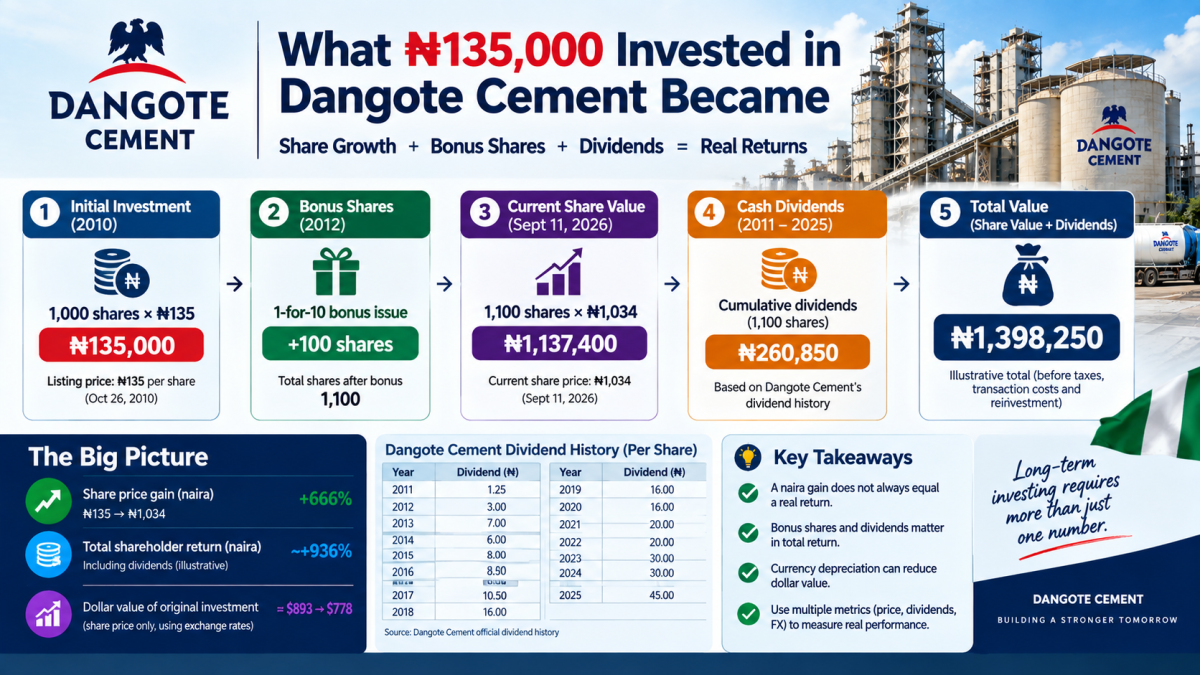
Dangote Cement’s share price has risen from ₦135 at listing to ₦1,034 as of September 11, 2026.
That represents a price increase of approximately:
(₦1,034 − ₦135) ÷ ₦135 × 100 = 666%
In simple terms, the quoted share price is now about 7.66 times its 2010 listing price.
If you looked only at that number, the story would appear spectacular.
But a long-term shareholder did not simply own one share forever. Dangote Cement also distributed bonus shares and cash dividends, which means a proper investment analysis has to go beyond the headline share-price gain.
The 1-for-10 Bonus Share Changed the Calculation
In 2012, Dangote Cement awarded shareholders a 1-for-10 bonus share issue.
For our hypothetical investor who originally owned 1,000 shares, that meant receiving another 100 shares.
| Position | Shares |
|---|---|
| Original holding | 1,000 |
| 1-for-10 bonus shares | 100 |
| Total holding | 1,100 |
At ₦1,034 per share, 1,100 shares would therefore be worth:
1,100 × ₦1,034 = ₦1,137,400
That is already higher than the ₦1,034,000 figure you would get by simply multiplying the current price by the original 1,000 shares.
The bonus shares are therefore important when discussing what an actual long-term shareholder received.
Then There Were the Dividends
This is the other major part of the calculation that a simple share-price comparison misses.
Dangote Cement’s official dividend history records cash distributions over the period, including:
- ₦1.25 per share for 2011,
- ₦3 for 2012,
- ₦7 for 2013,
- ₦6 for 2014,
- ₦8 for 2015,
- ₦8.50 for 2016,
- ₦10.50 for 2017,
- ₦16 annually from 2018 through 2020,
- ₦20 in 2021 and 2022,
- ₦30 in 2023 and 2024, and ₦45 for 2025.
For the hypothetical 1,000-share investor, the 2011 dividend applies to the original 1,000 shares. After the 2012 bonus issue, the investor would hold 1,100 shares for subsequent dividends, assuming the shares were retained throughout.
Under that simplified assumption, the cumulative cash dividends from 2011 through 2025 amount to approximately ₦260,850.
Combined with the current market value of the 1,100 shares:
₦1,137,400 + ₦260,850 = ₦1,398,250
That does not mean ₦1,398,250 is the exact total return an investor would have earned. Dividends were paid at different points in time, and the calculation assumes they were retained as cash rather than reinvested. Taxes, brokerage charges and other transaction costs are also excluded.
But it demonstrates why describing the investment simply as “₦135,000 became ₦1,034,000” is incomplete.
What Happens When You Convert the Investment to Dollars?
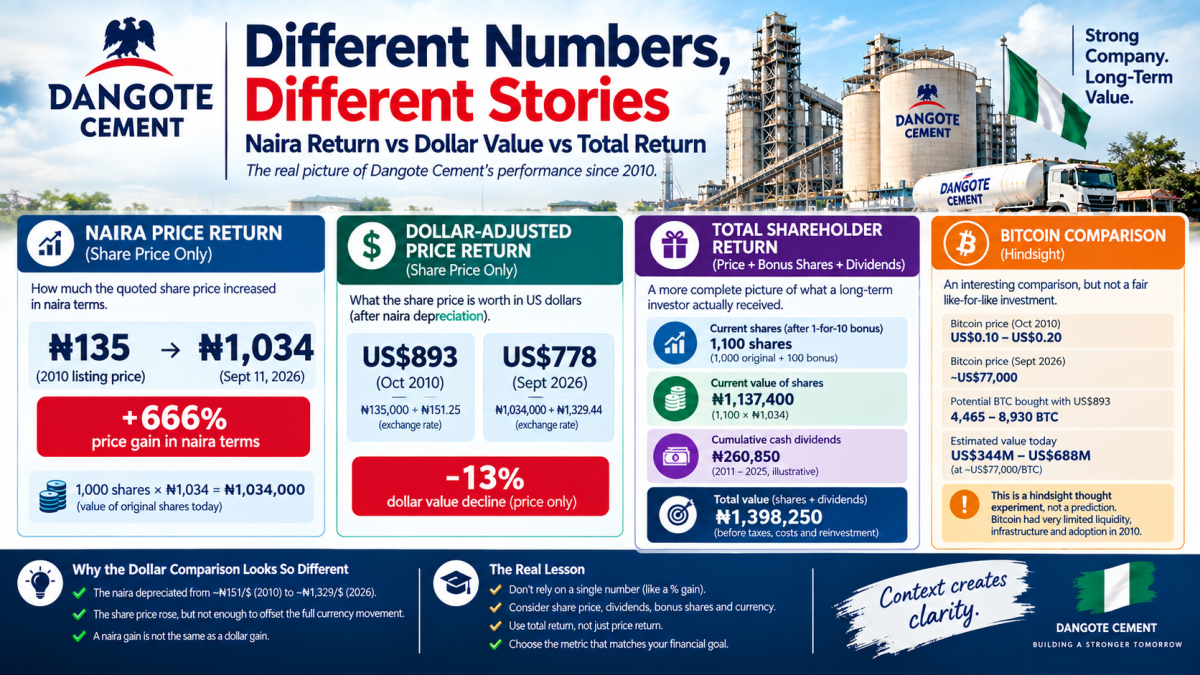
This is where the original headline becomes much more interesting.
The Central Bank of Nigeria reported an average official exchange rate of about ₦151.25 per US dollar in October 2010.
At that exchange rate, the original ₦135,000 investment was approximately:
₦135,000 ÷ ₦151.25 ≈ US$893
For the simple price-only comparison, the current ₦1,034,000 value of the original 1,000 shares would be converted using a September 2026 exchange rate. Using approximately ₦1,329.44 per US dollar, the calculation is:
₦1,034,000 ÷ ₦1,329.44 ≈ US$778
So the share-price-only comparison changes from roughly US$893 to roughly US$778.
That is a decline of about 13% in dollar terms.
However, that is a currency-adjusted price comparison, not the complete return earned by a shareholder.
Why the Dollar Comparison Looks So Different
The reason is simple: the naira and the Dangote Cement share price moved in opposite directions by very different magnitudes.
From October 2010 to September 2026, the official exchange rate moved from roughly ₦151 per dollar to more than ₦1,300 per dollar.
That means a naira asset had to rise dramatically just to maintain the same dollar-equivalent value.
Dangote Cement’s share price did rise dramatically — from ₦135 to ₦1,034 — but the simple price gain was not enough to offset the full currency movement when measured in dollars.
That does not make Dangote Cement a “bad investment.” It simply shows that nominal naira return and foreign-currency return are different measurements.
But Is the Dollar Comparison Fair to a Dangote Cement Investor?
Only if we clearly define what is being compared.
If the question is:
“Did the Dangote Cement share price itself preserve its 2010 dollar value?”
The answer, based on this price-only calculation, is no.
But if the question is:
“Did an investor who bought Dangote Cement in 2010 actually lose money?”
The answer cannot be determined from the share price alone.
The investor also received bonus shares and cash dividends.
This distinction is critical because investment performance is normally assessed using total return, not merely the change in the quoted share price.
Three Different Ways to Measure the Investment
| Measure | What It Includes | What It Tells You |
|---|---|---|
| Price return | Share-price change only | How much DANGCEM’s quoted price increased |
| Cash total return | Share value + dividends + bonus shares | A better approximation of what a shareholder received |
| Reinvested total return | Share value + dividends reinvested | The most complete long-term investment-growth measure |
The third measure is the one investors would ideally use when comparing long-term investments, because dividends can themselves generate additional returns when reinvested.
This article does not assume dividend reinvestment, so it should not be presented as a precise total-return or internal-rate-of-return calculation.
What About Bitcoin?
Bitcoin makes for a fascinating hindsight comparison, but it should not be confused with a like-for-like investment analysis.
In October 2010, Bitcoin was generally trading in the region of US$0.10 to US$0.20. Today, Bitcoin is trading around US$77,000.
If someone had hypothetically converted the original roughly US$893 into Bitcoin at US$0.10, they would have acquired about 8,930 BTC. At US$0.20, the same money would have bought about 4,465 BTC.
At approximately US$77,000 per BTC, that theoretical holding would be worth hundreds of millions of dollars.
But this calculation should be treated as a hindsight thought experiment, not an investment recommendation.
Bitcoin in 2010 had extremely limited liquidity, infrastructure and market adoption compared with today. It was also an exceptionally speculative asset whose survival and future value were impossible to know with certainty.
The fact that Bitcoin subsequently produced an extraordinary return does not mean a rational investor in 2010 could have known that outcome.
The Real Lesson Isn’t “You Should Have Bought Bitcoin”
The useful lesson is much narrower.
Long-term investment returns should be measured using the currency and return framework that actually matters to the investor.
A Nigerian investor may care primarily about naira purchasing power. Someone saving for a dollar-denominated education, property purchase or foreign investment may care about the US-dollar value of their portfolio.
Neither perspective is automatically the “correct” one.
What matters is understanding the difference.
And for a stock such as Dangote Cement, there is another crucial distinction: share-price appreciation is not the same thing as total shareholder return.
What a ₦135,000 Dangote Cement Investment Could Represent Today
| Component | Illustrative Value |
|---|---|
| Initial investment in 2010 | ₦135,000 |
| Original shares | 1,000 |
| Bonus shares | 100 |
| Shares held after bonus | 1,100 |
| Current share value at ₦1,034 | ₦1,137,400 |
| Cumulative cash dividends, 2011–2025 | ₦260,850 |
| Share value + cumulative dividends | ₦1,398,250 |
Again, this is an illustrative holding-period calculation, not a formal total shareholder return index. It assumes the investor held the shares continuously, received the relevant dividends and kept the dividend cash rather than reinvesting it.
Frequently Asked Questions
How much has Dangote Cement’s share price increased since 2010?
Dangote Cement’s share price rose from ₦135 at its October 26, 2010 listing to ₦1,034 on September 11, 2026. That represents a price gain of approximately 666% in naira terms.
How much would ₦135,000 invested in Dangote Cement in 2010 be worth today?
Using 1,000 shares purchased at ₦135 and the September 11, 2026 price of ₦1,034, the original shares would be worth ₦1,034,000. After accounting for the company’s 1-for-10 bonus issue, the holding would be 1,100 shares worth ₦1,137,400. Adding the illustrative cumulative cash dividends from 2011 through 2025 brings the combined figure to approximately ₦1,398,250, before taxes, costs and dividend reinvestment.
Did Dangote Cement investors receive bonus shares?
Yes. Dangote Cement’s official shareholder records show a 1-for-10 bonus share issue declared in 2012. An investor holding 1,000 shares would therefore have received 100 additional shares, assuming eligibility on the relevant record date.
How much dividend has Dangote Cement paid since 2010?
Dangote Cement has paid regular cash dividends for many years. Its official dividend history records payments from 2010 onward, including ₦45 per share for the 2025 financial year. The company’s 2025 investor presentation also reported cumulative dividends of more than ₦3.3 trillion paid over the preceding 15 years.
Was Dangote Cement a loss in dollar terms?
On a simple share-price-only basis, yes: the original ₦135,000 was approximately US$893 at the October 2010 exchange rate, while the ₦1,034,000 value of the original 1,000 shares was roughly US$778 using the September 2026 exchange rate used in this analysis. But that is not the same as saying the shareholder’s total investment return was a dollar loss because it excludes bonus shares and dividends.
Does this mean Nigerian stocks are bad investments?
No. It means investors should decide what return they are trying to measure. A Nigerian stock can produce a strong naira total return while producing a weaker dollar return, particularly when the naira depreciates sharply. Dividends, bonus shares, company fundamentals and reinvestment also matter.
Is Bitcoin a better investment than Dangote Cement?
Historical returns alone cannot answer that question. Bitcoin’s return since 2010 has been extraordinary, but comparing today’s Bitcoin value with its extremely low early-market price is a hindsight exercise. Dangote Cement and Bitcoin have also had completely different risk profiles, liquidity conditions and investment characteristics.
The Bottom Line
Dangote Cement’s story is more complicated — and more interesting — than a 666% return headline suggests.
The company’s share price increased from ₦135 in 2010 to ₦1,034 in September 2026, producing a roughly 666% price gain in naira terms.
But an actual long-term shareholder also received a 1-for-10 bonus issue and substantial cash dividends. For our illustrative 1,000-share investment, the current shares would be worth about ₦1.137 million, while cumulative dividends could add another ₦260,850 if retained as cash.
At the same time, the naira’s depreciation means the dollar value of the share-price gain looks far less impressive.
The real lesson is therefore not that Dangote Cement “failed” or that Bitcoin was obviously the better choice.
It is that investment returns need context.
When analysing a long-term Nigerian stock, look at the share price, dividends, bonus shares, currency movements and — ideally — total shareholder return rather than relying on a single percentage.
That is a much more useful way to judge what your money actually accomplished over 16 years.
Important: This article is for general information and is not investment advice. The illustrative calculations exclude taxes, brokerage fees, other transaction costs, dividend reinvestment and the time value of cash dividends. Historical performance does not guarantee future results.





















Join the discussion Tap to open the comment form +