
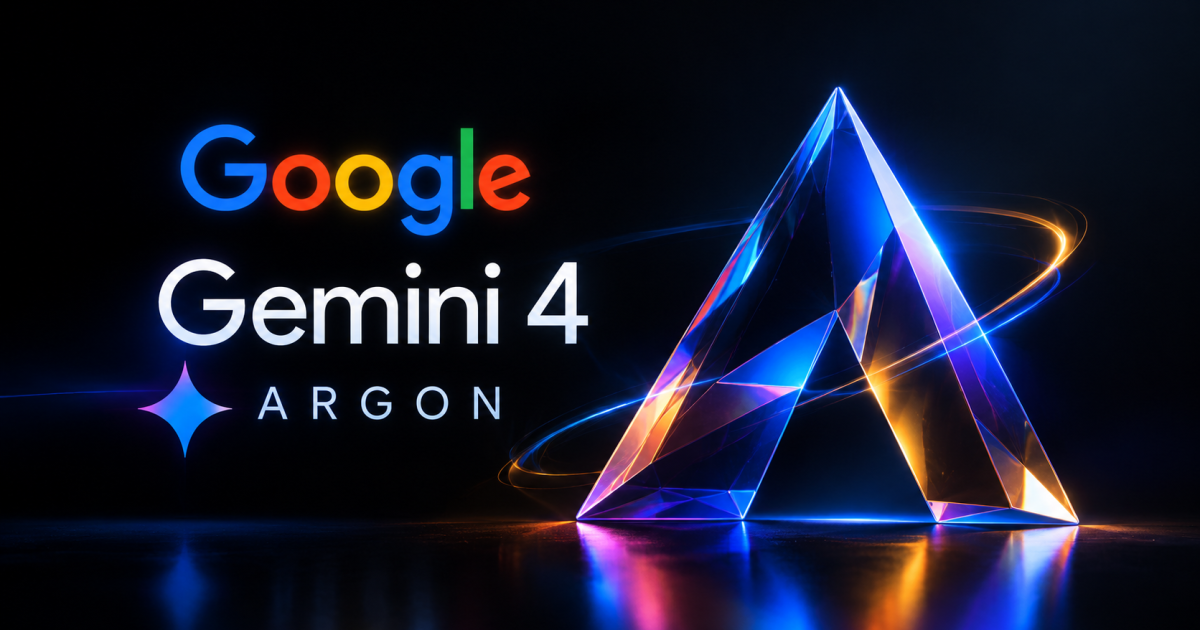
Google has finally unveiled Gemini 4 Argon, its new frontier AI model built for difficult, long-running tasks involving coding, research, business work and cybersecurity.
But there is an unusual catch.
Most people cannot use Gemini 4 Argon yet.
Google is deliberately releasing the model in stages, starting with a small group of trusted cybersecurity defenders. Wider access is coming, but Google has not announced a specific public release date.
So if you have opened Gemini expecting to find a new “Gemini 4 Argon” option, you are not missing anything. It simply is not available to everyone yet.
Why Can’t You Use Gemini 4 Argon Yet?
The main reason is not that Google has forgotten to release it.
Google says Argon is capable enough to require a more cautious rollout. The company is particularly concerned about the cybersecurity capabilities of frontier AI models and wants to test its safeguards in real-world conditions before giving broader access.
For now, Argon is being rolled out to trusted cyber defenders through Google’s Fairwind Program.
These users are intended to help Google evaluate how the model performs when used for defensive cybersecurity work, including finding, validating and fixing software vulnerabilities.
Google says it is also participating in the U.S. government’s voluntary process for pre-release access to advanced AI models.
The company says it will continue collecting feedback and strengthening its safeguards before expanding availability to developers, businesses and consumers.
Who Can Use Gemini 4 Argon Right Now?
The answer is much narrower than you might expect.
Google’s initial rollout is aimed at trusted cyber defenders and selected testers. The company is also already using Argon internally across Google.
That means a normal Gemini user cannot simply open the Gemini app and switch to Argon today.
Google says broader availability will begin with:
- Paid Gemini API customers
- Google AI Ultra subscribers
After that, Google plans to expand access to developers, enterprises and consumers.
However, Google has not provided a firm date for when the wider rollout will happen.
What Makes Gemini 4 Argon Different?
Argon is not being positioned as just another faster Gemini model.
Google built it for what it calls complex, long-horizon workflows — tasks where an AI needs to reason through multiple steps instead of producing a quick answer and stopping.
Its main target areas are:
- Software engineering
- Enterprise knowledge work
- Legal and financial research
- Cybersecurity
- Complex research and analysis
One of the biggest technical changes is its 1-million-token output limit. That gives Argon substantially more room to complete lengthy tasks in a single workflow rather than repeatedly stopping and asking for another prompt.
Google also says Argon is already being used internally for large-scale engineering work, including code migration and optimization projects.
Google Is Putting Cybersecurity at the Center
This is probably the most important reason for Argon’s unusual launch.
Google says Argon can autonomously find, validate and patch critical software vulnerabilities. For trusted defenders and Google’s internal teams, the company says it will provide Argon without some of the cyber guardrails applied to broader models so those defenders can use its full defensive capabilities.
Google says cybersecurity company Wiz is already using Argon through its Scan for Good initiative. According to Google, the model identified a critical vulnerability involving sensitive information in healthcare software that previous frontier models had missed.
Those are Google’s claims, however, and they should not be treated as independently verified benchmark results. That distinction matters because much of the early Argon performance data is coming directly from Google.
How Much Will Gemini 4 Argon Cost?
Google has already announced API pricing even though the model is not generally available.
The introductory price is:
- $2 per 1 million input tokens
- $10 per 1 million output tokens
Cached input tokens receive a 95% discount from the input price.
After the introductory period, Google says the price will rise to $4 per 1 million input tokens and $20 per 1 million output tokens.
That means the headline introductory price should not be confused with Argon’s long-term API cost.
Does Gemini 4 Argon Beat Other AI Models?
Google has published a large set of benchmark results showing Argon competing strongly with models from OpenAI and Anthropic.
For example, Google reports a 77.9% score on DeepSWE v1.1, a benchmark focused on long-horizon software engineering.
But there is an important caveat: these are primarily Google’s own published evaluations. Some competing models still lead Argon on individual tests, and independent reproduction of every headline result is not yet available.
So the more useful question right now is not whether Argon has officially “won” the AI race. It is whether the model’s real-world performance holds up once independent developers and researchers can actually test it.
That is one reason the restricted rollout matters.
When Will Gemini 4 Argon Be Available to Everyone?
Google has not given us a specific date.
What it has provided is a rollout sequence.
- Trusted cyber defenders and testers get access first.
- Google continues testing and strengthening its safeguards.
- Paid API customers and Google AI Ultra subscribers get broader access.
- Availability expands to developers, enterprises and consumers.
So if you are waiting to try Gemini 4 Argon in the regular Gemini experience, there is currently no setting you need to enable and no public access button you are missing.
The model simply has not reached general availability yet.
What This Means for Gemini Users
For ordinary Gemini users, the most important part of Google’s announcement is actually what it doesn’t change today.
You do not need to upgrade immediately just because Gemini 4 Argon has been announced. If you cannot access Argon yet, paying for a subscription does not automatically give you access during this initial restricted phase.
That could change when Google begins the broader rollout to paid API customers and Google AI Ultra subscribers.
Until then, the announcement is better understood as a preview of where Google’s AI platform is heading rather than a model that everyone can start using today.
The Bigger Story Behind Gemini 4 Argon
Google’s decision to restrict Argon at launch is arguably just as significant as the model’s benchmark numbers.
The company is effectively saying that some frontier AI capabilities are becoming powerful enough that testing how they behave in the real world has to happen before unrestricted public access.
That is particularly relevant for cybersecurity, where an AI capable of finding and fixing vulnerabilities could also potentially be useful to someone trying to exploit them.
For now, Google is choosing a controlled rollout.
And that means the answer to the question “Can I use Gemini 4 Argon?” is simple:
Not yet — unless you’re part of Google’s limited testing and cybersecurity programs.
The more interesting question is what happens when Google finally opens the doors.

























Conversation (0)