


Micro1’s job board includes roles for writers, journalists, filmmakers, photographers, audiovisual producers and 3D artists.
The jobs pay anywhere from $15 to $90 an hour across the seven openings I checked, although the rates, requirements and locations vary considerably.
What makes these opportunities interesting is the type of work behind the job titles. A writer may be evaluating AI-generated text. A filmmaker may be reviewing footage of a robotic arm. A journalist may be checking sources and public records. A photographer may be judging visual quality.
These are professional skills being used inside AI projects.
I went through the seven roles to see what Micro1 is actually asking these professionals to do, who can apply and where the advertised rates need some context.
Job details checked: October 2, 2026.
Why Micro1 needs people with specialist skills
Micro1’s expert programme connects professionals with projects involving AI training and evaluation. Its expert network covers areas such as engineering, finance, healthcare, legal work and other specialist fields.
The idea is fairly straightforward. AI systems can produce text, interpret images and process video, but those outputs still need to be evaluated against real-world standards. Someone with professional experience in a particular field can provide the judgement needed for that work.
That helps explain why a company working on AI projects would need people who have spent years learning how to write, report, edit video, assess images or create 3D content.
Key Takeaway: AI-related work is broader than building models or writing code. Some projects need people who can evaluate information, recognise quality and apply professional knowledge to AI-generated data.
1. Content Writer & Editor
Micro1’s Content Writer & Editor role is advertised at $20 to $70 per hour as a remote contractor position.
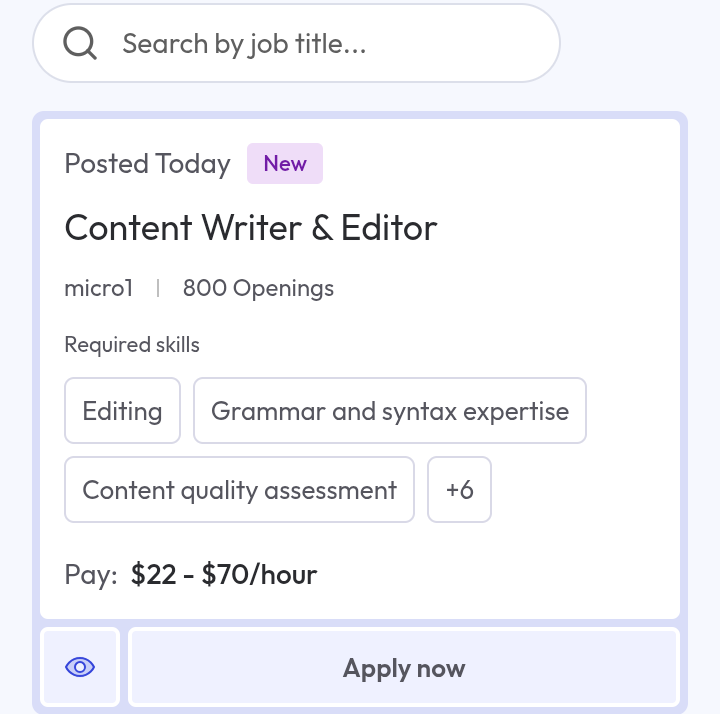
The work includes evaluating writing for clarity, coherence and accuracy, editing documents for grammar, structure and tone, and identifying low-quality AI-generated writing. Contributors may also produce written analysis and recommendations related to AI training data.
Micro1 is looking for strong English skills, writing or editing experience and the ability to distinguish between human and AI-generated text. A background in English, linguistics or teaching English is listed as preferred.
There is also a location detail that matters. The role currently mentions availability in Australia and Asia Pacific time zones for project coverage, so the word “remote” should not be read as “available everywhere.”
See the current Micro1 opportunities
2. Filmmaker
For filmmakers, the connection to AI work is much more visual.
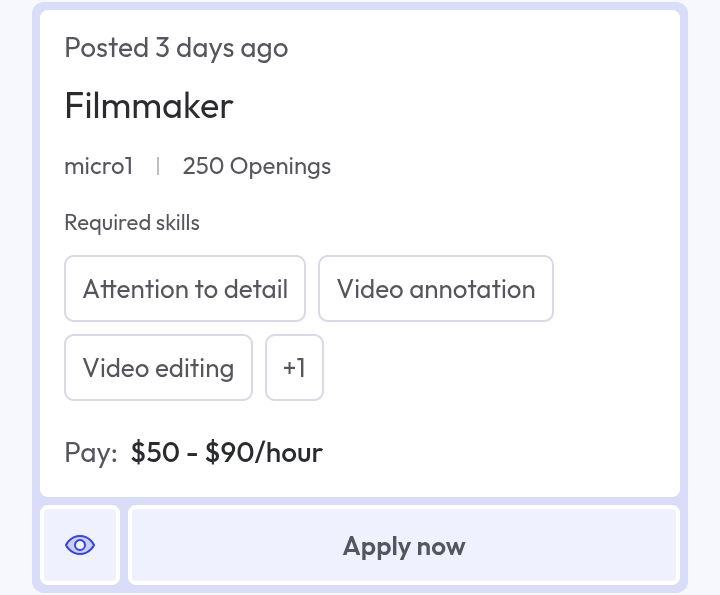
The Filmmaker opportunity is advertised at $50 to $90 per hour. The project involves reviewing footage of robotic arms and annotating video sessions according to specific grading guidelines.
The person doing the work needs to notice details such as whether an action was completed correctly, what happened during a sequence and where an error occurred. Micro1 lists filmmaking, cinematography, video production, editing and visual attention to detail among the relevant skills.
AI experience is preferred, but the role places substantial value on the professional ability to understand and assess video.
3. Video Editor
The Video Editor (AI Video Annotation) role also pays $50 to $90 per hour.
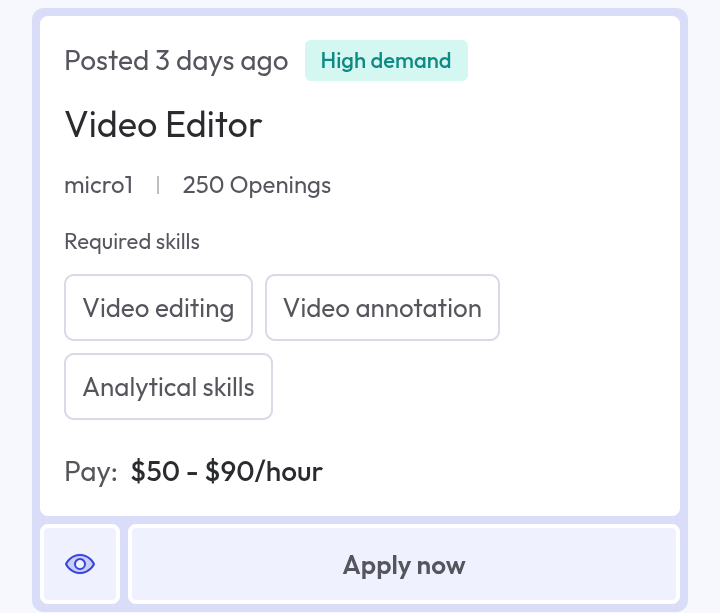
Here, the editor reviews robotic-arm footage and labels actions, events, transitions, outcomes and errors. The work can require frame-by-frame analysis and the use of dedicated annotation tools.
Micro1 says previous AI or robotics experience is not required. The useful background can come from video editing or another field that develops strong visual judgement.
The location requirement is more specific than the title might suggest. The listing names North America, Latin America, Europe, the UK and Oceania. Anyone outside those regions should check the opening before applying.
4. Photographer
A photographer can also find a place in this type of work.
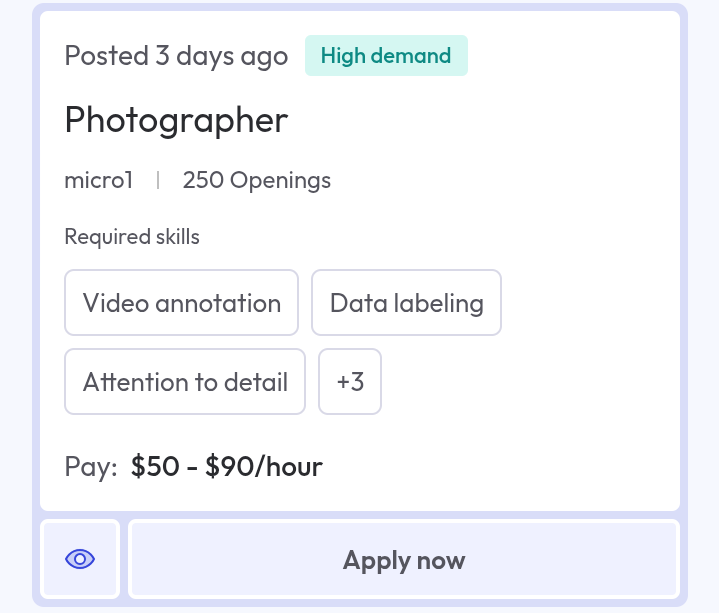
Micro1’s Photographer role is advertised at $50 to $90 per hour. The work involves reviewing robotic-arm footage, applying video annotation and data-labelling skills, and assessing visual and photographic quality.
The role specifically values the ability to spot visual details and judge images according to project requirements. No previous AI background is required according to the listing.
The named regions are North America, Latin America, Europe, the UK and Oceania. Africa is not among the regions specified in that particular opening.
5. Reporters & Correspondents
This is one of the clearest examples of professional experience being transferred into AI-related work.
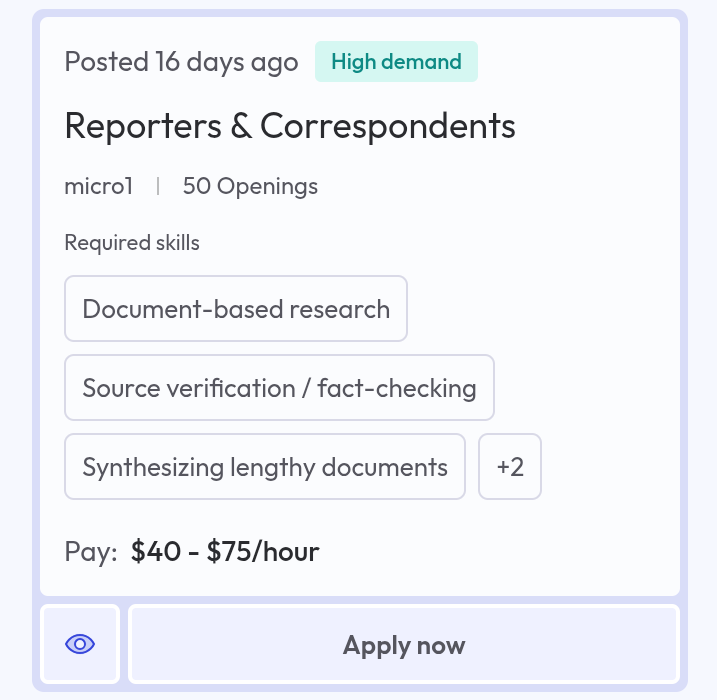
The Reporters & Correspondents role is advertised at $40 to $75 per hour.
The work involves analysing public records and reports, verifying sources, working through lengthy documents, producing concise material and maintaining research and citation trails.
Micro1 asks for at least four years of reporting or correspondent experience at a recognised outlet. Experience with document-heavy reporting and source validation is also part of the requirements.
That makes this very different from a general freelance writing opportunity. The professional reporting background is central to the role.
6. Audiovisual Producer
Micro1 is also looking for people with experience across both video and audio.
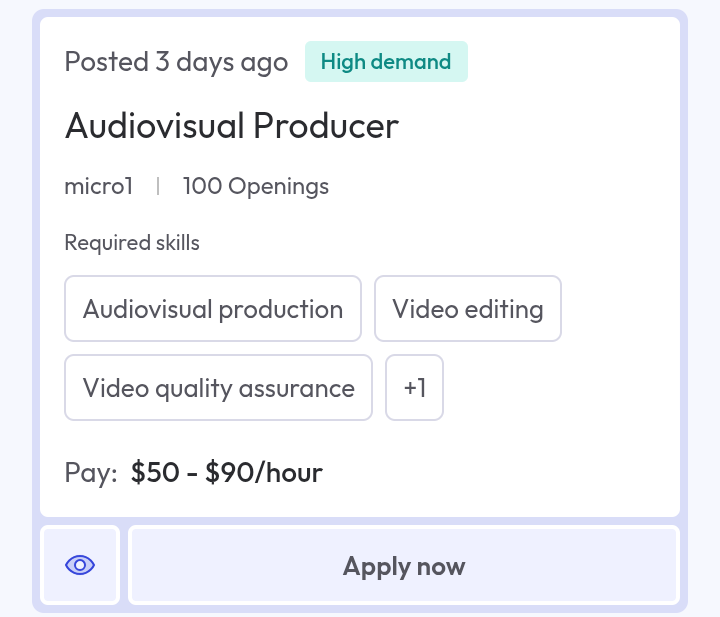
The Audiovisual Producer position is advertised at $50 to $90 per hour for a remote contractor role.
The work includes reviewing and annotating audiovisual material, assessing visual and audio quality, classifying sections of content and identifying errors or unusual events.
The requirements include audiovisual, video, film or media-production experience, an understanding of video and audio fundamentals, familiarity with editing tools and strong attention to detail. Micro1 does not require previous AI or data-annotation experience for this role.
7. 3D Animator / CGI Artist
People working in 3D and CGI have another route into this kind of project.
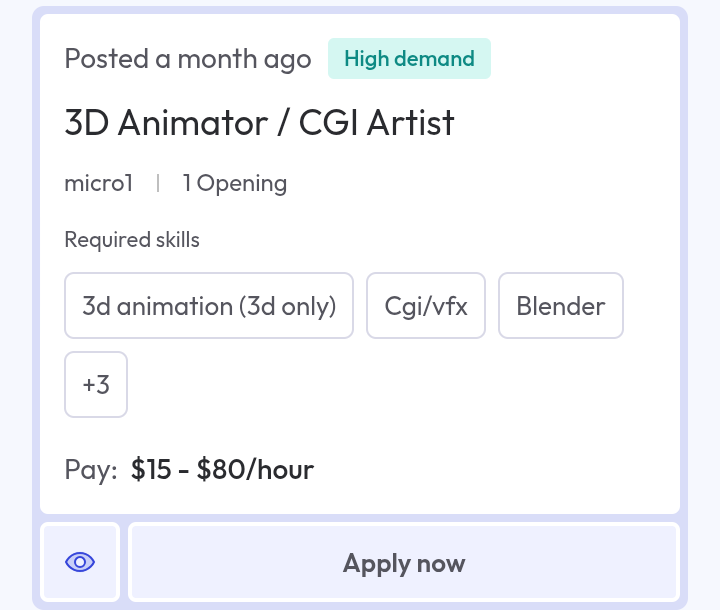
The 3D Animator / CGI Artist opportunity is advertised at $15 to $80 per hour.
The requirements include experience with 3D animation, CGI or VFX and software such as Blender, Maya or Cinema 4D. Knowledge of rigging and character movement is also relevant.
The work is connected to video-data annotation, bringing specialised 3D knowledge into an AI project.
Key Takeaway: The interesting part of these listings is not simply the hourly rate. It is the range of professional backgrounds being used for AI work, from journalism and editing to photography, filmmaking and 3D animation.
The advertised rate is not the same as guaranteed income
The figures above are the rates shown on the individual Micro1 listings when they were checked. They should not be treated as guaranteed earnings.
These are contractor opportunities. Applicants still have to meet the requirements and pass the company’s selection and onboarding process. Micro1’s expert programme also makes clear that being certified does not mean a person is automatically placed on a project. Opportunities depend on the match between an expert’s skills and available project requirements.
That distinction matters when a job advert says $50, $70 or $90 an hour. The number describes the advertised rate for that particular opportunity. It does not mean someone applying today will immediately receive that rate for a fixed number of hours every week.
What this means if you’re outside the US
Micro1’s network can include professionals from different parts of the world, but individual projects can have their own geographic or time-zone restrictions.
The seven roles above show why checking the individual job page matters. Some specify particular regions, while others have time-zone requirements or different eligibility conditions.
If you’re applying from Nigeria, India or another country, don’t stop at the word “remote”. Look at the location requirements attached to the specific project.
How to find a Micro1 opportunity that fits you
The useful starting point is not the highest number in the pay range. Start with the skill you already have and then look for a project that needs it.
A journalist should look for research, reporting or source-verification work. A video editor can look at annotation projects. A photographer can examine opportunities involving visual assessment. Someone working in 3D can search for projects where animation or CGI knowledge is relevant.
Check the Micro1 referral jobs page for the opportunities available when you apply. Job availability and requirements can change, so the individual listing should be treated as the final reference.
If you’re interested in other ways people are using AI skills to earn online, FaithfulBiz also has a guide on how to get paid from AI side hustles in Nigeria.
The bigger opportunity may be the skill you already have
AI is creating demand around more than model development. There is work involved in evaluating outputs, checking information, annotating data and deciding whether something meets a professional standard.
Micro1’s current job board gives a useful snapshot of that market. The opportunities are not interchangeable, and some are limited by geography or professional experience, but they show how existing skills can fit into AI projects.
If you already have a serious skill in writing, journalism, video, photography, audiovisual production or 3D work, it may be worth checking whether an AI company needs that expertise before deciding that you need to learn an entirely new field.
Publication date note:
Because job availability, rates and eligibility can change, retain:
Job details checked: October 2, 2026.




















Conversation (0)