
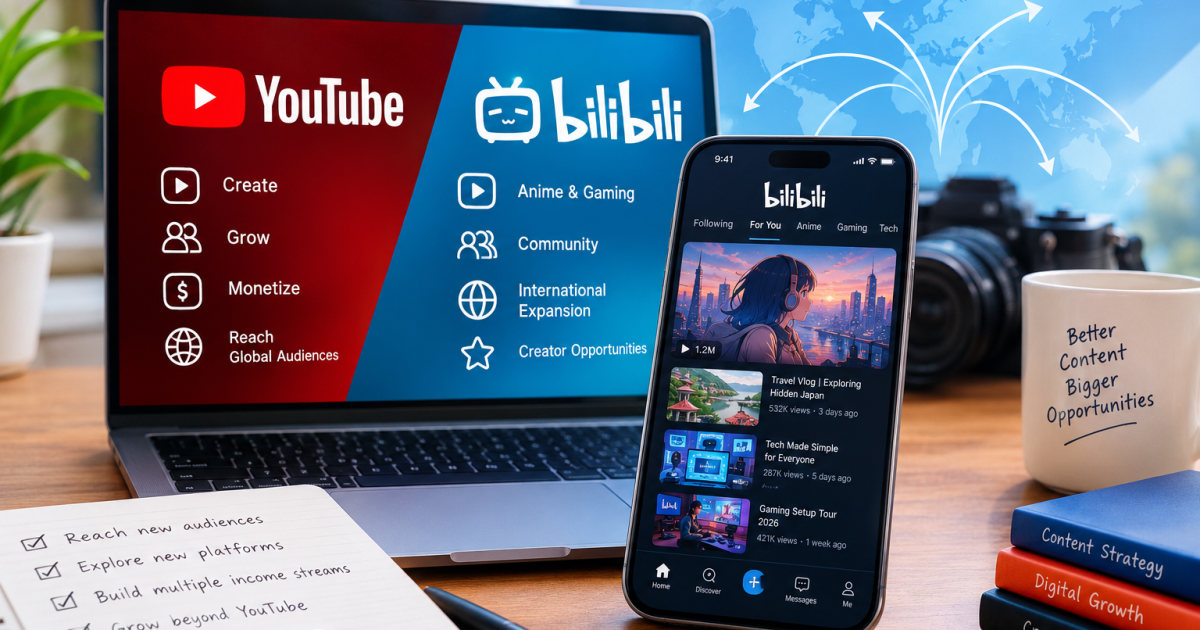
For years, Bilibili was mostly a name you would encounter when looking into China’s anime, gaming and online creator culture. That is changing.
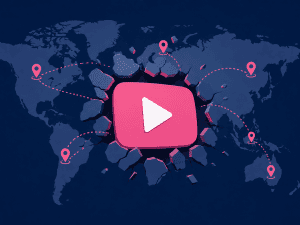
In August 2026, Bilibili relaunched its international app, made sign-up easier for overseas users and began publicly pushing a much bigger international creator strategy. The company is also working toward an English-language web experience and has been recruiting staff in markets outside China.
That does not mean YouTube suddenly has a new global replacement. But it does mean something interesting is happening in the creator economy: a platform with hundreds of millions of users is making a more deliberate attempt to attract creators from outside its home market.
For YouTube creators, the important question is not whether Bilibili will “kill” YouTube. It is whether having another serious distribution platform could change how creators build audiences and make money online.
Bilibili is much bigger than its international reputation suggests
Bilibili is still far less familiar to many people outside China than YouTube, TikTok or Instagram. That can make its international expansion look like a small platform trying to break into a market already dominated by much larger competitors.
The numbers tell a different story.
In the third quarter of 2025, Bilibili reported 376 million monthly active users and 117 million daily active users. Users spent an average of 112 minutes per day on the platform. Those figures refer to Bilibili’s main platform and are overwhelmingly driven by its established Chinese user base, so they should not be interpreted as 376 million international users.
Still, the scale matters. Bilibili is not starting its international push with an empty platform and hoping people will arrive. It already has a large audience, an established creator ecosystem and a substantial library of content.
The company itself describes Bilibili as a community built around users, creators and original content, while its content has expanded well beyond the anime and gaming categories that originally made the platform famous.
What changed in 2026?
The important development is not simply that Bilibili can be accessed outside China. It has been accessible internationally in different forms for years.
The difference is that Bilibili now appears to be making international creators a much more deliberate part of its strategy.
In August 2026, Bilibili’s creator account announced the global launch of its international app, initially on Android, with easier sign-ups and broader localization. Reporting around the launch also identified plans for an English-language website and overseas hiring in cities including Los Angeles, London, Mexico City, São Paulo, Istanbul and Tokyo.
That is a very different proposition from simply making a Chinese platform available to people in other countries.
Bilibili is trying to build the infrastructure around an international creator ecosystem.
So why should a YouTube creator care?
This is where the story becomes more interesting.
A YouTube creator does not necessarily need another platform because YouTube has stopped working. The bigger reason to pay attention is that relying entirely on one platform leaves creators dependent on that platform’s algorithms, policies, monetization rules and audience distribution.
That is not unique to YouTube. Every major creator platform has the same problem.
But the more credible platforms there are, the more options creators have for distributing the work they already produce.
Think of it this way: a creator who publishes a useful 10-minute technology video does not necessarily need to make a completely different video for every platform. The same underlying research can potentially be adapted for YouTube, Bilibili, a website, social media and an email audience.
The real asset is therefore not the platform. It is the creator’s content, expertise and relationship with the audience.
Bilibili could become another distribution channel
This may be the most practical way to look at Bilibili right now.
Rather than asking whether you should leave YouTube and move to Bilibili, ask whether some of your existing content could reach a second audience there.
That distinction matters.
A creator who already spends hours researching, scripting, recording and editing a video has already paid most of the production cost. If the finished content can be adapted for another platform without creating an unreasonable amount of extra work, the economics are different from starting an entirely new channel from scratch.
This is particularly relevant for creators working in areas such as technology, gaming, animation, education and other subjects that already have communities on Bilibili.
It also fits with the direction Bilibili is taking. The company has been promoting tools and support for international creators, including an overseas creator platform with an English interface, upload tools and translation features.
If that infrastructure becomes mature enough, cross-posting could become considerably easier than it has been in the past.
But Bilibili is not YouTube with a Chinese logo
This is where creators need to be careful.
Bilibili has its own culture, audience expectations and community features. Its roots in anime, comics, gaming and highly engaged online communities still influence the platform.
That means simply taking a YouTube video, changing the title and uploading it somewhere else does not guarantee the same results.
A video that performs well on YouTube because it matches that platform’s search behaviour or recommendation system may not automatically find an audience on Bilibili.
The platform’s community culture matters too. Bilibili has long been known for its danmaku-style comments, where viewers can post comments that appear across the video itself. That creates a different viewing experience from the traditional YouTube comments section.
For creators, this means localization is about more than translating words. The content has to make sense to the audience you are trying to reach.
And the money question is still not settled
This is probably the part that has generated the most excitement around Bilibili’s international expansion.
You may have seen reports claiming that Bilibili could pay international creators around $0.70 per 1,000 views.
I would be careful with that number.
Bilibili has not published a universal international creator rate saying that every eligible creator will receive $0.70 for every 1,000 views. The figure has been repeated in media coverage, but it should not be treated as a guaranteed RPM.
Bilibili does have established ways for creators to earn on its existing ecosystem. Its filings describe monetization through branded content, fan support, live-streaming gifts, merchandise and other creator-related commercial opportunities.
But the international creator programme is a different question.
As of the current expansion, Bilibili is still developing parts of the international monetization infrastructure. Its international creator materials have discussed revenue sharing, virtual gifting and a brand marketplace, but the exact rules and payment structure for international creators are not something I would build an income projection around yet.
That distinction is important for anyone considering Bilibili primarily because they heard it pays more than YouTube.
Do not build a creator business around a payout figure that the platform itself has not published as a standard international rate.
What about YouTube’s 2027 monetization changes?
There is another reason Bilibili is suddenly getting attention from creators.
YouTube has announced changes to its Partner Programme that take effect on February 1, 2027.
For new creators seeking ad and YouTube Premium revenue sharing, YouTube says the entry requirement will become 1,000 subscribers plus either 8,000 qualified public watch hours over the previous 365 days or 20 million qualified Shorts views over the previous 90 days.
Existing YouTube Partner Programme creators are not removed from the programme simply because they do not meet those new entry thresholds.
There is also a separate change for existing YPP creators who want to receive Shorts ad and YouTube Premium revenue from the Shorts Creator Pool: starting February 1, 2027, they will need 10 million qualified Shorts views in the previous 90 days for that monthly Shorts revenue sharing.
That is a meaningful change for some creators, but it should not be exaggerated into “YouTube is no longer monetizing small creators.” Fan-funding features, YouTube Shopping and Creator Partnerships have separate eligibility requirements that YouTube says are not changing with these updates.
If you already create videos with AI, I have also written about the other side of this equation: what I learned about YouTube monetization after using AI on two channels.
The bigger point is that YouTube is continuing to change the rules around how creators earn. That makes the idea of having additional distribution channels more interesting, even if those channels are nowhere near replacing YouTube.
What this means for creators in Nigeria and elsewhere
For creators in Nigeria, the international expansion is worth watching, but I would not treat Bilibili as an established new income stream yet.
There are several separate questions:
- Can you access the international service from your country?
- Can you publish consistently without regional restrictions?
- Will your type of content find an audience there?
- Which creator monetization programmes will eventually be available in your market?
- How will international creators actually receive payments?
Those questions are more important than a headline about how many millions of users Bilibili has.
The international app makes the first part of that equation easier than it used to be. The other parts still need to prove themselves.
That is why I would approach Bilibili differently from a normal “make money online” opportunity. If you already have a YouTube channel, your existing videos are the asset. Bilibili can be tested as another place to distribute them, rather than becoming a reason to abandon what you have already built.
Should YouTube creators start paying attention to Bilibili?
Yes, but paying attention is not the same as moving your business there.
Bilibili’s international push is still developing, and some of the most important pieces of the creator economy are not fully established yet. At the same time, the company has already shown that it wants international creators, international audiences and a more localized product.
That combination makes the platform worth watching.
If you are already producing videos, the sensible experiment is relatively simple: keep building on YouTube, test selected content on Bilibili where the platform is available to you, and watch what happens.
Do not judge the opportunity solely by views. Look at whether the right people are watching, whether they return, whether they engage and whether the platform eventually gives creators reliable ways to turn that attention into revenue.
And most importantly, do not build your entire creator business around any single platform.
YouTube can change its monetization rules. Bilibili can change its international strategy. TikTok can change its algorithm. The part a creator can actually control is the content, expertise, brand and audience relationship built around those platforms.
That may ultimately be the most interesting thing about Bilibili’s expansion. Its biggest impact on YouTube creators may not be forcing them to choose between two platforms. It may encourage more creators to stop thinking of one platform as the entire business.













Conversation (0)