
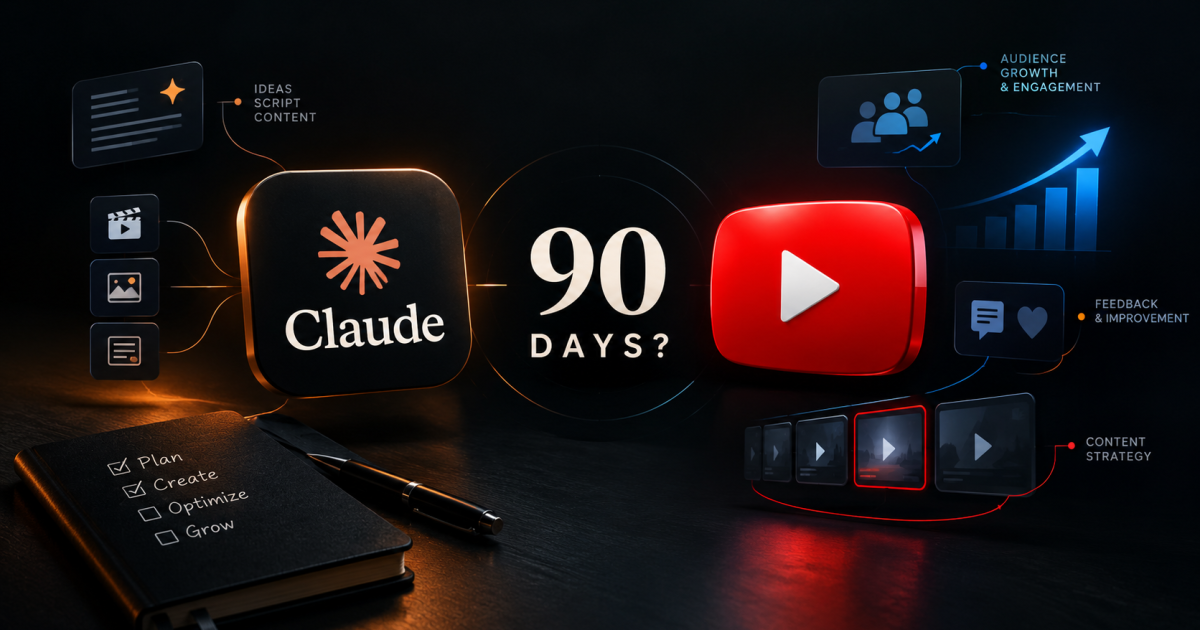
I recently came across a viral claim that Claude can turn a brand-new YouTube channel into a “money machine” in 90 days using six prompts.
The prompts themselves are interesting. They cover niche selection, channel branding, video ideas, scripting, upload optimization and community building.
But after looking at what the workflow actually asks Claude to do — and comparing it with how YouTube currently explains recommendations, monetization and channel growth — I think something important is missing.
My takeaway: Claude can help you build a much more efficient YouTube workflow, but it cannot remove the part that matters most: finding what viewers actually want, publishing it, studying the response and changing your strategy based on what you learn.
What the viral Claude formula actually does
The original six prompts essentially turn Claude into a production assistant:
- Find a niche: Claude evaluates skills, interests, audience potential, video formats, RPM and faceless viability.
- Build the channel: It creates channel names, descriptions, an About section and a one-sentence promise.
- Plan the first 10 videos: It generates titles, hooks, estimated search potential and suggested video lengths.
- Write the scripts: It produces 8–12 minute scripts with hooks, sections, retention moments and calls to action.
- Optimize uploads: It generates titles, descriptions, tags, thumbnail concepts and other publishing recommendations.
- Build community: It creates polls, questions, behind-the-scenes posts and other community content.
I can see why this is attractive. One AI assistant appears to handle almost the entire process from a blank channel to a publishing schedule.
But there is a weakness: most of the workflow is about producing. Very little of it is about investigating or learning.

The “90-day” promise needs some caution
This is the first thing I would change.
There is nothing wrong with setting a 90-day experiment for a new channel. In fact, I think that is a useful timeframe for testing a strategy.
The problem is presenting 90 days as though it leads predictably to monetization.
For full YouTube Partner Program revenue sharing, YouTube currently requires a channel to reach 1,000 subscribers and either 4,000 valid public watch hours in the previous 12 months or 10 million valid public Shorts views within 90 days. Reaching those numbers does not automatically guarantee acceptance; YouTube still reviews the channel against its monetization policies. YouTube’s current YPP eligibility guidance explains the requirements.
There is also another reason not to treat the 90-day claim as a fixed formula: YouTube has announced changes to the requirements for new creators applying for ads and Premium revenue sharing from February 1, 2027.
So I would treat “90 days” as a testing period, not a promised path to income.
Prompt 1: Find the content gap before choosing the niche
Scope: Use this before committing to a niche. The goal is to find an underserved audience problem rather than simply chasing a high-RPM category.
Act as a YouTube content strategist and research analyst. I want to build a channel around [topic]. Instead of simply recommending the highest-RPM niches, identify specific content gaps where viewers have questions, problems or interests that existing channels are not serving well.
Analyse: audience demand, existing competitors, common content formats, recurring viewer questions, underserved subtopics, opportunities for a new creator to differentiate, faceless vs. personality-led viability, monetization options and the risks of entering the niche.
Give me 5 specific content-gap opportunities. For each one, explain who the viewer is, what they want, what existing videos appear to be missing and what type of videos I could make to serve that gap.
Do not recommend a niche simply because its RPM is high. Prioritize audience need, differentiation and realistic content opportunities.
This is much closer to how I would use Claude at the beginning.
If you’re already researching AI video opportunities, the same principle applies to finding video content gaps in AI search: look for unanswered or poorly answered questions instead of assuming the biggest keyword is automatically the best opportunity.

Prompt 2: Define the viewer before the channel identity
Scope: Use this after identifying a promising content gap. It forces the channel identity to grow from a specific viewer rather than from a random name and logo.
Based on this content gap: [paste your chosen opportunity], define the exact viewer I should build the channel for.
Describe their likely knowledge level, problems, goals, search behaviour, frustrations, reasons they would click a video, reasons they might leave a video and what would make them return for another video.
Then create 3 possible channel positioning statements. Each should clearly explain who the channel helps, what problem it solves and why someone should choose it over similar channels.
Finally, give me 3 channel names that fit the positioning. Avoid generic AI-generated names, unnecessary buzzwords and names that could make the channel difficult to expand later.
I prefer doing this before the branding exercise because a channel should have a reason to exist before it has a name.
Prompt 3: Build a connected first 10 videos
Scope: Use this to create the initial content system. The objective isn’t ten unrelated ideas; it is a group of videos that gives the audience a reason to watch another video.
Using this channel positioning: [paste positioning], build my first 10 YouTube videos.
Do not give me 10 unrelated topics. Create a connected content plan where videos can naturally lead viewers to other videos on the channel.
For each video provide: working title, target viewer, specific problem or curiosity being addressed, primary angle, opening hook, why the viewer would click, suggested format, approximate length based on the amount of information needed, and which other video it should connect to.
Prioritize ideas based on audience need and differentiation rather than simply generating popular keywords.
This is where the original prompt list is useful, but I would make the ideas form a system instead of treating every upload as an isolated search opportunity.
Prompt 4: Research the video before asking Claude to write it
Scope: Use this immediately before scripting. It gives Claude evidence and an angle to work from instead of asking it to invent an entire video from its own general knowledge.
I want to make this video: [topic/title]. Before writing the script, help me research it.
Identify the main claims I need to verify, useful primary or authoritative sources, important facts that have changed recently, competing viewpoints, common misconceptions and questions viewers are likely to have.
Separate confirmed information from assumptions or claims that require verification. Then suggest 3 possible angles that could make the video more useful or distinctive than a generic explanation of the topic.
Do not write the final script yet. Stop after the research, verification checklist and angle recommendations.
This is one of the biggest changes I would make to the original workflow.
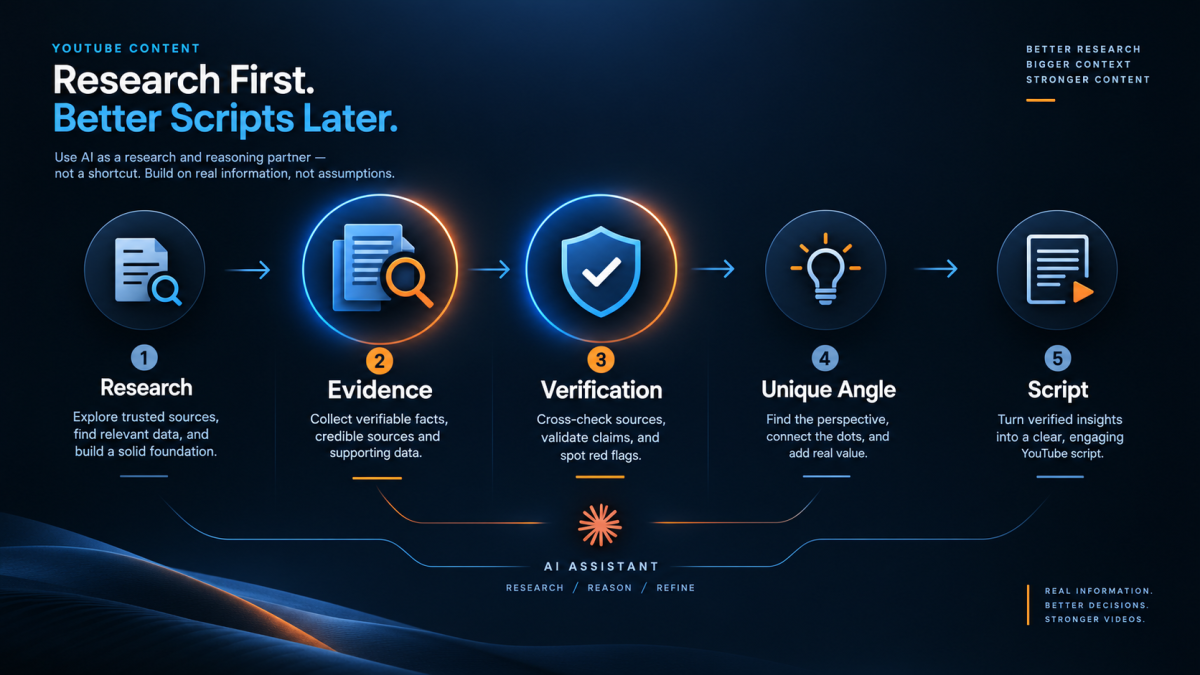
My second takeaway: The strongest use of AI in a YouTube workflow may not be generating more content. It may be helping you investigate a topic, challenge your assumptions and find a better angle before you publish.
Prompt 5: Package the video instead of obsessing over tags
Scope: Use this after the video is genuinely useful and the core idea is clear. The goal is to improve the way the video is presented, not to manufacture clicks.
Help me package this YouTube video: [paste topic, angle and short summary].
Create 5 accurate title options using different curiosity angles without clickbait. For each title, explain what viewer expectation it creates.
Write a concise description that clearly explains what the viewer will learn and naturally includes important terminology.
Give me 3 thumbnail concepts. For each one, describe the visual hierarchy, main subject, short text if needed and the curiosity gap it creates.
Then identify the strongest title + thumbnail combination and explain why they work together.
Do not recommend tactics simply because they are supposed to “beat the YouTube algorithm.” Focus on accurately communicating the value of the video to the right viewer.
I would also remove the obsession with generating 15 tags from the original prompt.
YouTube says tags can be useful for things such as common spelling mistakes, but they are not considered essential for discovery. YouTube’s guidance on tags makes that distinction fairly clear.
The bigger packaging questions are whether the right viewer understands the video, wants to click it and remains satisfied after clicking.
Prompt 6: Make Claude analyse what happened after publishing
Scope: Use this after publishing. This is the feedback loop missing from most viral prompt lists.
Here are the results from my latest YouTube video:
Title: [title]
Topic: [topic]
Impressions: [number]
Impressions click-through rate: [percentage]
Views: [number]
Average view duration: [time]
Average percentage viewed: [percentage]
Audience retention observations: [paste observations]
Traffic sources: [paste data]
Comments or recurring viewer questions: [paste examples]Analyse what these results may be telling me.
Separate strong signals from weak or inconclusive signals. Identify where the video may have underperformed, what appears to have worked, what I should test next and what I should avoid concluding from this single video.
Then recommend my next 5 video ideas based on the evidence. Explain how each idea connects to what the audience has already shown interest in.
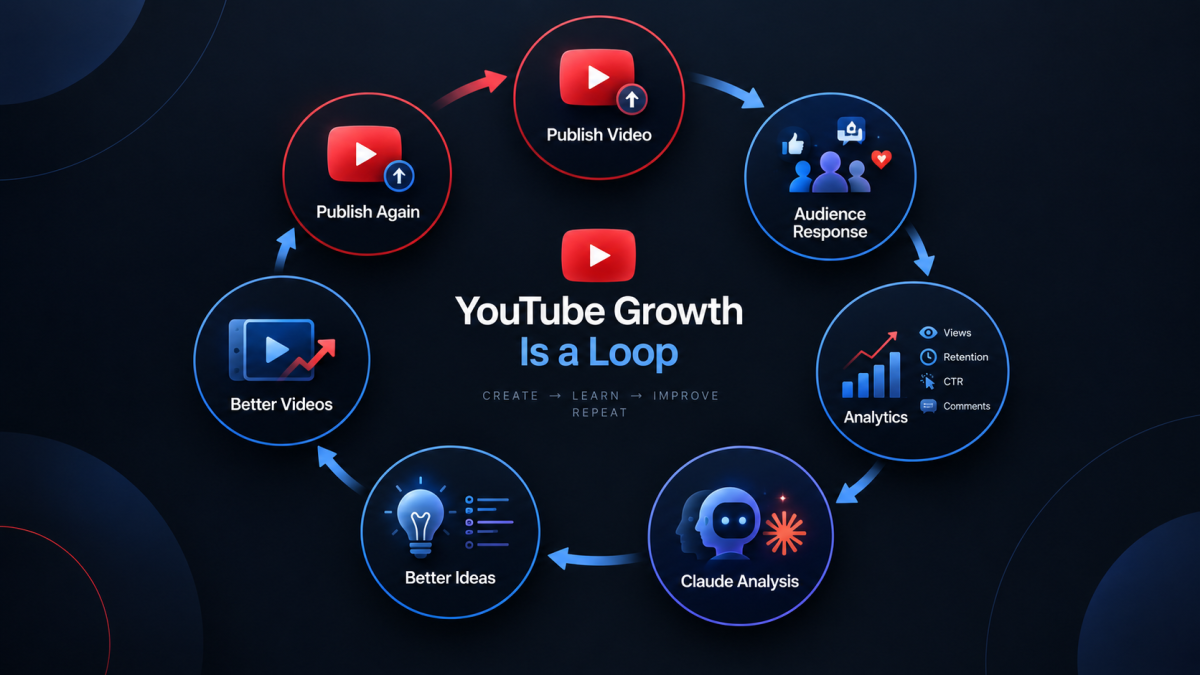
This changes Claude from a content generator into something closer to a strategy assistant.
What about AI-generated or faceless channels?
This part also needs more nuance than the viral post gives it.
Using AI does not automatically make a channel ineligible for monetization, and being faceless is not itself the problem. The important question is what the channel actually publishes.
YouTube’s monetization policies focus on whether content provides original value and avoids mass-produced, repetitive or otherwise inauthentic publishing. YouTube’s monetization policy guidance is the better reference point than blanket claims that “AI channels cannot be monetized.”
That means an AI-assisted channel can still require real editorial judgment: original research, useful explanations, meaningful commentary, distinctive storytelling or some other reason for viewers to choose it.
What I would actually test for 90 days
If I were starting the channel, I would treat the 90 days as an experiment rather than a money-making deadline.
- Days 1–15: Research the audience, content gaps and positioning.
- Days 16–30: Build a connected first batch of videos and establish the production workflow.
- Days 31–60: Publish consistently while studying clicks, retention, comments and traffic sources.
- Days 61–90: Double down on the topics and formats producing the strongest audience response and drop weak assumptions.
The important part is what happens between those stages. Every upload should teach you something about the next one.
My take
The viral Claude formula isn’t useless. In fact, several of its ideas are good starting points.
What I would reject is the implication that six prompts can turn YouTube into a predictable 90-day income machine.
AI can make research, planning, scripting and production dramatically faster. But YouTube growth still depends on whether people actually want what you publish and whether your videos satisfy them after they click.
So if I were using Claude to build a channel today, my workflow would be simple:
Find the gap → understand the viewer → build connected videos → research properly → package honestly → publish → study the response → improve the next video.
That feedback loop is the part I think most viral “AI will build your YouTube channel” prompt lists leave out.





















Conversation (0)