
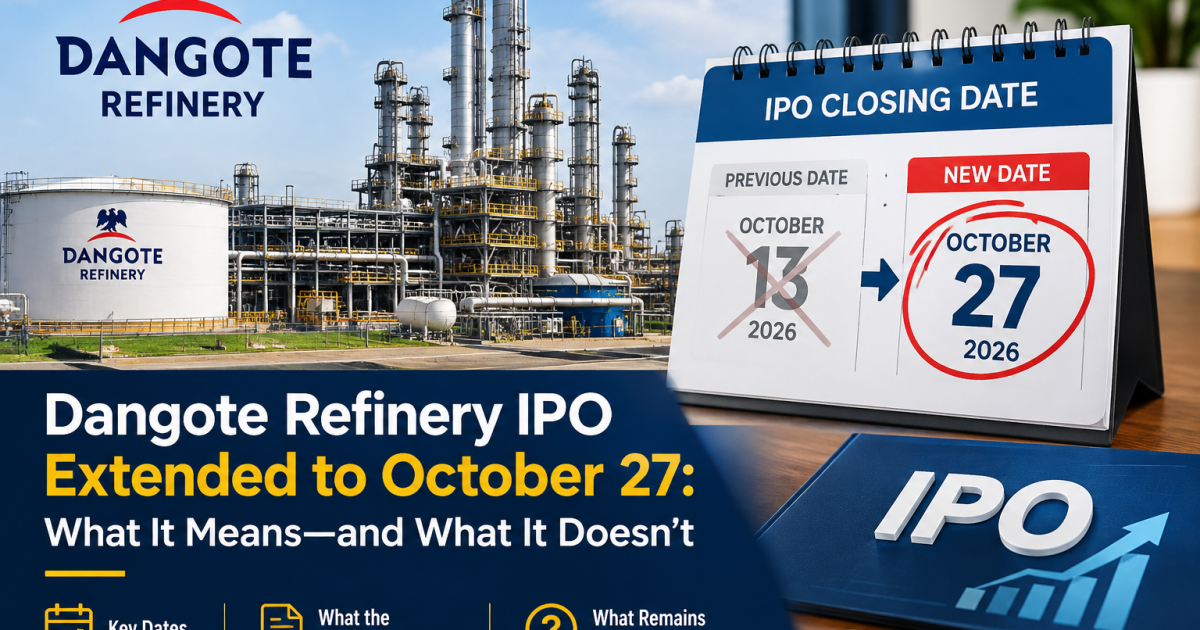
As of October 14, 2026, Dangote Refinery’s initial public offering (IPO) has an extended closing date of October 27, following approval from Nigeria’s Securities and Exchange Commission (SEC). But what does the extension actually tell us, and what conclusions would be premature?
When Dangote Refinery announced the extension on October 12, reactions quickly spread across social media. Some people questioned whether the offer had attracted enough investors, while others speculated about the company’s reasons for keeping the subscription window open longer.
Those questions are understandable. The offer involves billions of shares and a potential fundraising amount of approximately ₦2.15 trillion.
However, there is an important distinction between what a company officially announces and what people infer from that announcement.
The extension is confirmed. Its implications for the final subscription figures, allotment and subsequent trading require separate evidence.
Here is what the official announcement establishes, what remains unconfirmed and what Nigerians should understand before drawing conclusions about the Dangote Refinery IPO.
Reporting cutoff: October 14, 2026. Information about future offer milestones reflects the published timetable as of this date and may change.
What Changed in the Dangote Refinery IPO?
Dangote Petroleum Refinery and Petrochemicals FZE opened its IPO for subscription on September 14, 2026. The offer was initially scheduled to close on October 13.
On October 12, the company announced that the SEC had approved an extension, moving the closing date to Tuesday, October 27, 2026.
According to the company’s official notice, the extension is intended to support market-access initiatives across African jurisdictions, expand distribution channels, facilitate cross-border participation and give prospective investors additional time to complete account-opening, identity-verification and regulatory requirements.
The company also said it had received strong interest from eligible investors across Africa and other jurisdictions.
These are the reasons the issuer has publicly given. They should be distinguished from additional explanations circulating on social media.
The extension does not, by itself, establish that the IPO has failed, that the company has already received all the money it seeks, or that its shares will rise after listing.
The important point: The deadline changed, but the final subscription and allotment outcomes cannot be established from that change alone.
Source: Official Dangote Refinery IPO extension notice.
Does an IPO Extension Mean the Offer Is Undersubscribed?
No. An extension alone does not prove that an IPO is undersubscribed.
To understand why, it helps to separate three things:
- The offer period: The time during which eligible investors can submit applications under the offer terms.
- Subscription demand: The applications received relative to the shares available under the offer.
- Allotment: The process through which shares are allocated to applicants after the offer closes.
A company can extend an offer for reasons connected with investor access, distribution arrangements or administrative requirements. The extension itself does not reveal the final subscription figures.
In Dangote Refinery’s case, the company has specifically identified cross-border participation, distribution channels and additional time for verification as reasons for the extension.
It would therefore be premature to conclude that the offer is undersubscribed simply because the closing date changed.
The opposite conclusion would also require evidence. The extension alone does not establish the final level of demand.
What about claims that the SEC would not approve an extension if subscriptions were insufficient?
That claim should not be repeated as a confirmed regulatory rule without supporting documentation.
The SEC approved the extension, but that approval does not, by itself, disclose the final subscription level or prove that a particular fundraising threshold has been met.
To establish those details, readers would need a relevant regulatory provision, an official disclosure or another reliable source that directly addresses the claim.
For now, the most defensible explanation is straightforward: the offer has been extended, and the company has publicly stated why.
Why Does Dangote Refinery Want More Investors?
The company’s announcement refers to expanding participation across African jurisdictions and giving more eligible investors an opportunity to participate in the offer.
That objective raises an interesting financial concept: liquidity.
In financial markets, liquidity generally refers to how easily an asset can be bought or sold without causing a substantial change in its price.
Imagine that someone owns shares in a company and wants to sell them.
The seller needs a buyer willing to purchase those shares at an acceptable price. If there are enough interested buyers and sellers, transactions may be easier to complete.
If there are very few participants, finding a suitable buyer may be more difficult.
A larger pool of shareholders can potentially contribute to wider market participation. However, shareholder numbers alone do not determine how liquid a stock will be.
Trading activity, the number of shares available for trading, investor behaviour, market-making arrangements where applicable and other market conditions also matter.
This distinction is important when considering Dangote Refinery’s IPO.
Although the company has stated that it wants to broaden participation, the extension notice does not establish that increasing secondary-market liquidity is its primary objective.
It would therefore be inaccurate to present liquidity as the confirmed reason for the extension.
Does greater liquidity mean a higher share price?
Not necessarily.
Liquidity and price performance are different concepts.
A stock can attract substantial trading activity while its price falls. It can also rise in price during a period of relatively limited trading.
The market price ultimately reflects buying and selling activity and the prices at which participants are willing to transact.
Consequently, even if Dangote Refinery attracts a large number of shareholders, that would not guarantee that its shares would rise after listing.
What Happens After the IPO Closes?
Another source of confusion is the difference between applying for shares and trading shares on the stock market.
They are separate stages.
Under the revised timetable published on October 12, the main milestones are as follows.
| IPO milestone | Published date |
|---|---|
| Application period closes | October 27, 2026 |
| Collation of returns | November 3, 2026 |
| Submission of the proposed basis of allotment to the SEC | November 10, 2026 |
| Scheduled allotment date, subject to SEC no-objection | November 17, 2026 |
| Scheduled transfer of net offer proceeds and publication of allotment announcement | One business day after allotment |
| Scheduled return of surplus or rejected application money | Five business days after allotment |
| Scheduled crediting of successful applicants’ CSCS accounts | Fifteen business days after allotment |
| Scheduled listing and commencement of trading | Fifteen business days after allotment |
These dates come from the company’s official extension notice.
There is an important qualification: the company describes the timetable as indicative and says the dates may be adjusted if the relevant milestones are not achieved as anticipated.
The November 17 date is therefore a scheduled allotment date, not a guarantee that every procedural step will occur exactly as planned. The subsequent settlement and trading milestones depend on the offer process and the applicable timetable.
Readers should check the issuer’s official announcements for any changes.
What is allotment?
Allotment is the process of determining how many shares successful applicants receive under the offer terms.
Applying for a particular number of shares does not automatically guarantee that the applicant will receive that entire amount.
Where an applicant is not allotted all the shares requested, the treatment of any surplus application money depends on the offer terms and the applicable allotment arrangements.
The timetable also distinguishes the transfer of net offer proceeds to the company from the return of surplus or rejected application money.
This is why the application, allotment, refund, settlement and listing stages should not be treated as a single event.
For readers who need the background to the offer itself, our existing guide, Dangote Refinery IPO 2026: Price, Dates, Minimum Investment & How to Apply, explains the original offer terms and application process.
Is the IPO Money Automatically Available to the Company When Someone Applies?
Not necessarily. The handling of application money must be understood through the actual offer arrangements, not assumptions about how an IPO works.
In Dangote Refinery’s published timetable, the transfer of net offer proceeds to the company is scheduled for one business day after the allotment date.
The timetable separately identifies the return of surplus or rejected application money.
That sequence is useful because it distinguishes the application period from the later processing of the offer.
However, the timetable alone is not a complete description of every operational detail governing the funds. For precise information about how subscription money is received, held, processed and transferred, readers should consult the approved prospectus and the relevant offer documentation.
The claim that an IPO extension automatically means a company is using applicants’ money to fund its operations is not established by the extension itself.
Equally, readers should not assume that every claim about an offer’s fund-handling arrangements is accurate simply because it appears in a social media explanation.
The appropriate approach is to check the official documents.
The SEC has also warned prospective investors to use only designated and approved subscription channels, verify websites before providing personal or financial information, and avoid transferring funds to individuals or unauthorised entities claiming to handle IPO applications.
That warning is particularly relevant when a high-profile offer attracts widespread online discussion.
Will Dangote Refinery Shares Rise From ₦525 to ₦2,000?
The Facebook post that prompted this discussion suggested that the shares could rise from the IPO price of ₦525 to more than ₦2,000 after trading begins.
That is a price prediction, not a confirmed outcome.
As of October 14, 2026, the extension announcement does not establish that the shares will reach that price or provide a basis for treating it as an expected result.
It is also important to understand the difference between an IPO offer price and the market price after listing.
The IPO price is the price at which shares are offered to eligible applicants under the offer terms. Once trading begins, the market price may move above or below that level.
Several factors can influence the price, including investors’ expectations, company performance, market conditions, the availability of shares for trading and demand from buyers and sellers.
Even a widely anticipated listing does not guarantee a price increase.
For example, if buyers are willing to pay more than sellers are asking, the price may rise. If sellers are willing to accept lower prices and buyers are not prepared to pay more, the price may fall.
The actual outcome depends on market conditions.
Readers should therefore distinguish a person’s opinion about a future price from an official announcement or an established market result.
What Should Nigerians Verify Before Believing IPO Claims?
When a major company announces a public offer, social media can become a source of explanations, predictions and warnings.
Some posts may contain useful information. Others may combine accurate facts with unsupported conclusions.
A practical way to evaluate such claims is to ask five questions.
1. Is the claim supported by an official announcement?
For details about the extension, start with the issuer’s published notice and the SEC’s official information.
2. Does the source distinguish facts from opinions?
A statement that the closing date has changed is a verifiable fact. A claim that the shares will reach a particular price is a prediction.
They should not be treated as equivalent.
3. Are the figures properly sourced and dated?
Subscription totals, offer sizes and allotment information should be accompanied by a clear source and reporting date.
A figure repeated across several social media accounts is not necessarily independently verified.
4. Does the claim confuse subscription with trading?
Submitting an application, receiving an allotment and buying or selling shares after listing are different stages.
A post that treats them as interchangeable may give readers the wrong impression.
5. Is anyone promising guaranteed returns or a guaranteed allocation?
The SEC has warned against unauthorised solicitations and claims involving guaranteed allocations.
Verify the relevant platform or intermediary through official channels before providing personal information or transferring money.
The SEC’s official Dangote Refinery IPO notice provides important guidance on checking approved channels and avoiding unauthorised offers.
What the Dangote Refinery IPO Extension Actually Tells Us
As of October 14, 2026, the central facts are clear.
Dangote Refinery’s IPO closing date has been extended from October 13 to October 27 following SEC approval.
The company says the additional time will support wider participation across African markets, expand distribution channels and give prospective investors more time to complete the relevant requirements.
The revised timetable also sets out the scheduled stages for allotment, refunds, settlement and listing, although the company has cautioned that those dates are indicative.
What the extension does not establish on its own is whether the final offer will be undersubscribed or oversubscribed, whether the shares will rise after listing, or whether a particular future price target will be achieved.
Those questions require separate evidence.
The wider lesson is useful beyond this particular IPO: when a financial announcement generates strong reactions, distinguish the documented facts from the explanations people attach to them.
A company announcement can tell us what has changed and what the issuer says it intends to achieve. It does not automatically validate every conclusion circulating online.
For readers following the Dangote Refinery IPO, the most useful next step is to consult the official offer documents and published updates rather than relying on speculation about the extension.
This article is for general informational and educational purposes only. It is not financial or investment advice and does not recommend buying or avoiding any security. Readers should verify material information through official sources and seek guidance from a suitably qualified professional if they require personalised financial advice.



























Conversation (0)