

I came across another version of the “ChatGPT can help you make money online” formula: six prompts that supposedly take you from what you already know to a digital product you can sell.
I went through the workflow, and the prompts are actually useful.
But something bothered me.
The six prompts move from idea to product to sales without spending enough time on the question that should come first:
Does anyone actually want this product badly enough to pay for it?
That is the part I think gets lost when AI makes product creation look almost effortless.
Takeaway: ChatGPT can help you build the product. It cannot manufacture the reason someone should buy it.
The six prompts are useful, but the workflow is incomplete
The viral formula is straightforward:
Idea → Product → Structure → Content → Sales → Promotion
At first glance, that looks like everything you need.
But there is a gap between the idea and the product.
There is no serious validation step.
That matters more now because AI has made the production side of digital products much easier. You can ask ChatGPT for an ebook outline, generate chapters, create checklists, draft a sales page and even produce a month of promotional ideas in a relatively short time.
That creates a new problem.
If making a digital product is easy, simply having a digital product is no longer much of an advantage.
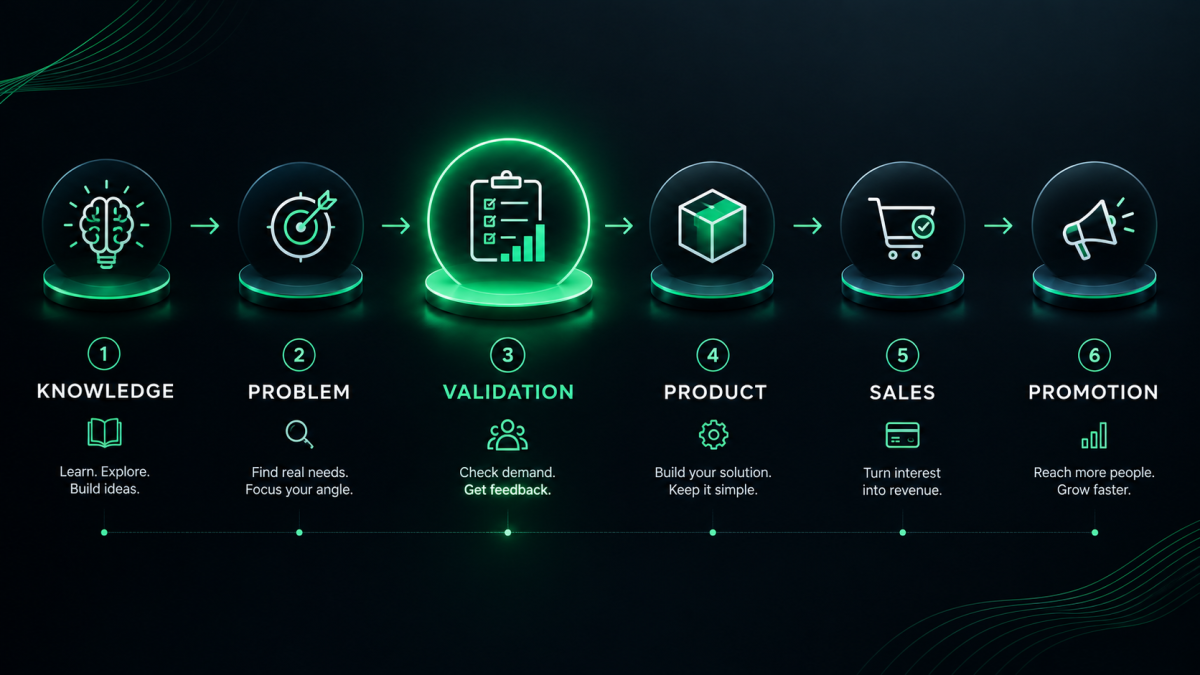
So I would change the workflow to:
Knowledge → Problem → Validation → Product → Sales → Promotion
That extra stage is the part I would add before touching the original six prompts.
1. Start with what you actually know
The first prompt asks ChatGPT to turn your skills, experience, knowledge and interests into potential product ideas.
Based on my skills, experience, knowledge, and interests, give me 10 digital product ideas I could create and sell online. For each idea, explain the target audience, the problem it solves, and why someone might want it.
There is nothing wrong with this prompt.
In fact, I like the fact that it starts with what you already know instead of asking ChatGPT to randomly generate “profitable digital products.”
But I would treat every answer as a hypothesis.
ChatGPT can tell you that a particular audience has a problem and that a guide, course or template could solve it. That does not prove that the audience considers the problem important enough to spend money solving.
That distinction becomes even more important when AI gives you ten convincing ideas in seconds.
2. Add the step the viral formula leaves out
This is the prompt I would add.
I am considering this digital product: [PRODUCT IDEA]. My target audience is [AUDIENCE]. Before I create it, pressure-test the idea. Identify the specific problem it solves, who is most likely to pay for the solution, what people might use instead, why they might not buy it, what assumptions I am making, and what evidence I should look for before building it. Do not try to convince me the idea is good. Look for reasons it may fail.
I prefer this approach because it forces the conversation in the opposite direction.
Instead of asking AI to make your idea sound good, you are asking it to find weaknesses.
That is a much better use of AI at this stage.
And you should not stop with ChatGPT’s answer. Look for real-world evidence too: questions people are asking, complaints, existing alternatives, reviews, communities, search behaviour, conversations with potential customers and, where possible, actual willingness to pay.
ChatGPT can help you think through the evidence. It cannot replace the evidence.
Takeaway: I would rather discover that a product idea is weak before spending two weeks building it than discover it after I have finished the ebook, designed the cover and published the sales page.

3. Turn the validated problem into a product
Once an idea survives that pressure test, the second original prompt becomes much more useful.
I want to create a digital product about [TOPIC]. Help me turn my knowledge into a valuable product. Suggest the best format, such as an ebook, guide, template, checklist, course, or toolkit, and explain exactly what it should include.
Notice that I would not automatically choose an ebook.
One of the easiest mistakes to make with AI is confusing more content with more value.
If someone needs a practical checklist, giving them a 70-page ebook may actually make the solution worse.
If they need a repeatable workflow, a toolkit or template might be more useful.
The best format is the one that helps the buyer reach the desired outcome with the least unnecessary friction.
4. Build the structure before asking AI to write everything
Now we get to the third prompt.
Create a complete structure for my digital product about [TOPIC]. Break it into clear sections or chapters and include the key information, examples, exercises, templates, and actionable steps that would make the product genuinely useful.
This is where I would slow down.
Do not immediately respond with, “Great, now write the entire product.”
Read the structure first.
Ask yourself whether every section helps solve the buyer’s actual problem.
Remove anything that exists only because ChatGPT thinks a product “should” have it.
Then add the things AI cannot know unless you give them to it: your own examples, mistakes, process, screenshots, lessons, observations, templates and decisions.
That is how you begin turning an AI-assisted product into your product.
5. Use ChatGPT for production, not authority
The fourth prompt handles the actual content creation.
Help me create the content for each section of my digital product. Make it practical, easy to understand, specific, and actionable. Avoid generic advice and include examples, frameworks, checklists, and step-by-step instructions wherever relevant.
This is probably where ChatGPT can save the most time.
It can help you expand an outline, rewrite explanations, create examples, organise information and turn rough notes into something much easier to work with.
But there is a major difference between AI-generated information and your knowledge packaged with AI assistance.
If somebody else can paste the same prompt into ChatGPT and receive almost the same product, the prompt itself is not your competitive advantage.
Your advantage is what you know, what you have tested, how you solve the problem and how well you package that experience for a specific person.
This is also why I think understanding AI skills beyond simply knowing what to prompt is becoming more important.

6. Write the sales page around the problem, not the AI
The fifth prompt is where the workflow moves from making the product to selling it.
Write a compelling sales page for my digital product. Include a strong headline, the problem it solves, who it is for, what is included, the key benefits, common objections, FAQs, and a clear call to action. Do not make unrealistic or guaranteed claims.
I particularly like the final instruction.
Digital-product content can quickly drift into exaggerated “make money while you sleep” territory, especially when the original idea is presented as a business opportunity.
I would avoid that.
A sales page should explain what the product helps someone do, not promise an outcome you cannot control.
There is a big difference between:
“This ebook will make you $10,000.”
and:
“This guide gives you a practical process for creating your first digital product.”
The second is much easier to defend.
7. Promotion comes last
The sixth prompt asks ChatGPT to create a 30-day promotion strategy.
Create a 30-day content strategy to promote my digital product on [PLATFORM]. Give me daily content ideas, hooks, captions, CTAs, and content formats designed to attract my target audience and naturally lead interested people toward the product.
Again, this is useful.
But I would put it at the end for a reason.
A 30-day content calendar cannot rescue a product that nobody wants.
Promotion should amplify a useful offer. It should not be used to compensate for the absence of one.
Takeaway: The easiest thing AI can help you create is more content. The harder and more valuable task is figuring out which problem deserves that content in the first place.
The six prompts are not the business
After looking at the complete workflow, this is where I land.
The six prompts are useful because they break a complicated project into manageable tasks:
Find an idea → choose a format → structure it → create it → sell it → promote it.
But that is a production workflow, not a business model.
The missing question is always the same:
Why would someone pay for this instead of ignoring it, searching for free information or using another solution?
That is why I would use the seven-step version instead:
1. Find what you know.
2. Identify the specific problem it can solve.
3. Pressure-test whether the problem is worth solving.
4. Choose the smallest useful product.
5. Use ChatGPT to structure and produce it.
6. Build the offer around the outcome.
7. Promote it where the audience already exists.
What ChatGPT changes, and what it doesn’t
There is a genuine opportunity here.
Someone who previously needed substantial time to turn their knowledge into a structured guide can now use AI to accelerate research, outlining, drafting, editing and packaging.
But the same capability is available to almost everyone else using the tool.
That means the competitive advantage moves elsewhere.
It moves toward specificity, experience, usefulness, trust, distribution and understanding the customer.
In other words, AI can lower the cost of producing the product without automatically increasing the value of the product.
That is the distinction I think gets lost in the viral six-prompt formula.
The prompt is only the beginning
If you already have knowledge that could genuinely help someone, these prompts are worth trying.
But I would change the order slightly.
Don’t rush from “I know something” to “ChatGPT, make me an ebook.”
Start with the problem.
Find out who has it.
Pressure-test whether they care about solving it.
Then use AI to help you package the solution.
Because the hard part was never getting ChatGPT to write the product.
The hard part is giving someone a good enough reason to want it.























Conversation (0)