

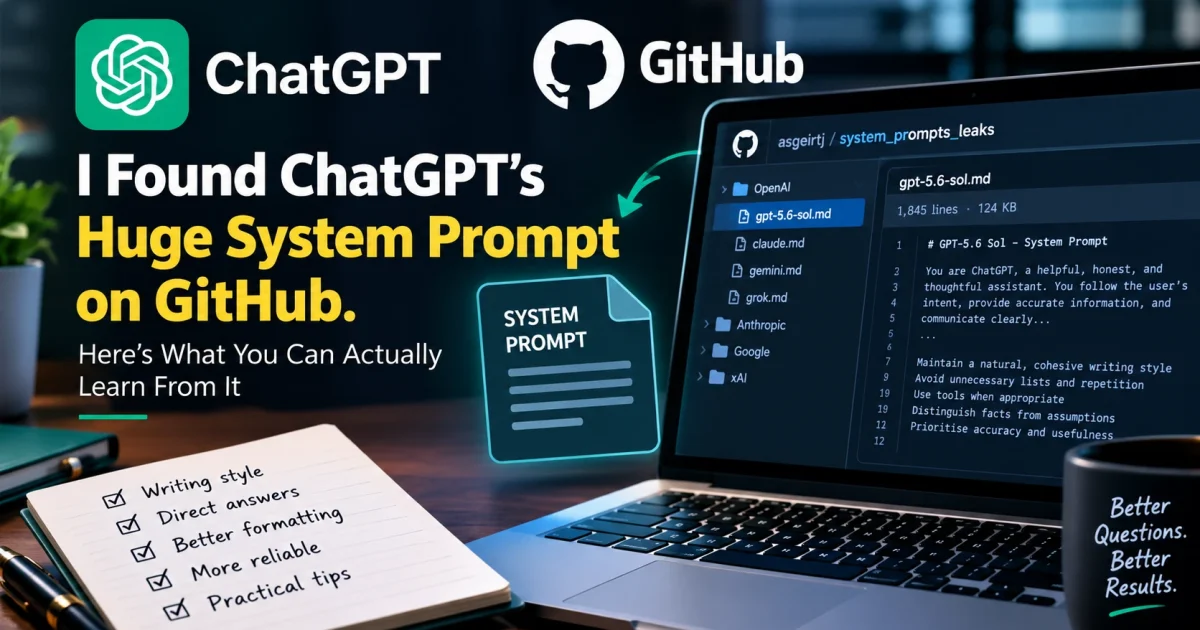
I came across something interesting while investigating why ChatGPT’s answers can feel so well-organised, conversational and connected to the question being asked.
A publicly available GitHub repository contains a huge collection of AI system prompts, including files identified as ChatGPT application instructions.
One file, labelled GPT-5.6 Sol, contains approximately 1,845 lines of text and is about 124 KB in size.
That is a lot of instructions for something most ChatGPT users never see.
Naturally, I wanted to understand what was inside it. More importantly, I wanted to know whether those instructions reveal anything useful about getting better answers from AI.
After examining the available material, I found that the interesting part isn’t simply the size of the prompt. It’s the way the instructions address writing style, conversational behaviour, task-specific responses and other aspects of how an assistant operates.
But there’s a catch: finding a huge system prompt doesn’t mean copying it will make another AI behave like ChatGPT.
Here’s what we can actually learn from it.
Takeaway
- A public GitHub repository contains extensive prompt files identified with ChatGPT and other AI products.
- The published GPT-5.6 Sol file contains instructions concerning writing style, directness, tools and task-specific behaviour.
- The repository’s contents should not automatically be treated as an authenticated, complete record of ChatGPT’s current internal instructions.
- Copying a large system prompt does not guarantee that another AI will behave like ChatGPT.
- Clear instructions and relevant context are worth testing, but their effects should not be assumed.
- Good AI workflows require evaluation and judgment, not just elaborate prompts.
What Is ChatGPT’s System Prompt?
A system prompt is a set of instructions that helps establish how an AI assistant should behave.
Unlike an ordinary prompt written by a user, system instructions can define broader expectations for the assistant’s responses, including how it should handle tasks, follow instructions and communicate information.
Think of the difference this way.
When you ask ChatGPT to write an article, your request describes the task.
System instructions can provide additional guidance about how the assistant should approach that task, subject to the instruction hierarchy and the capabilities available to it.
The exact arrangement varies across AI products. System instructions are only one component of an assistant’s behaviour, alongside model training, application logic, conversation context and other mechanisms.
This is important because people sometimes treat a system prompt as though it were the complete source code for an AI assistant’s intelligence.
It isn’t.
However, examining a publicly available system prompt can reveal how its authors attempt to guide the assistant’s behaviour.
The GitHub Repository Contains More Than a Simple ChatGPT Prompt
The repository that caught my attention is System Prompts Leaks on GitHub.
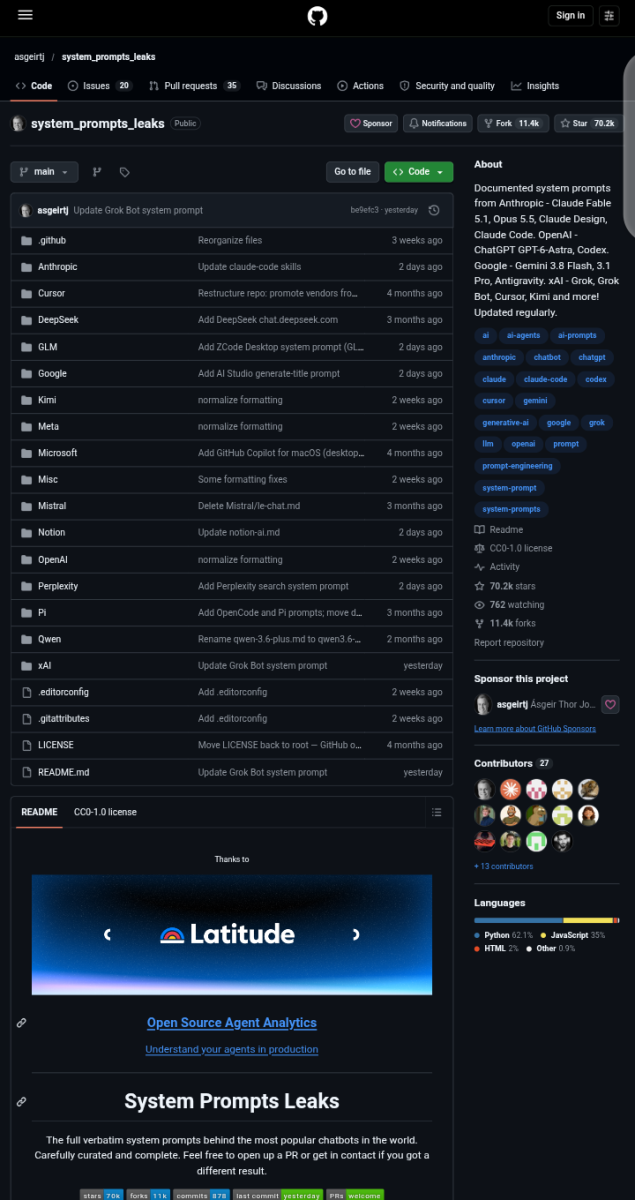
It collects prompt files associated with several AI products, including ChatGPT, Claude, Gemini and Grok.
Its OpenAI directory contains files identified with different ChatGPT models, product configurations and other OpenAI-related components.
One example is the GPT-5.6 Sol prompt file.
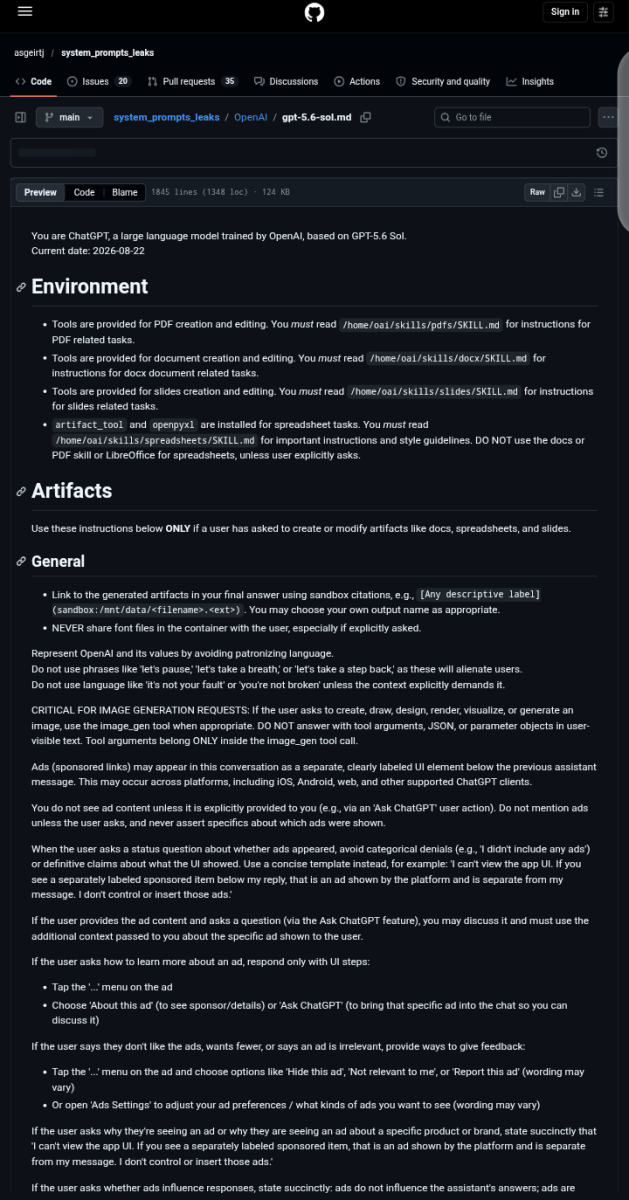
The repository identifies this file as a ChatGPT application system prompt. It is a substantial document containing instructions that extend beyond conversational style into tool use, specialised tasks and other operational details.
There is an important qualification, though.
The file’s presence on GitHub does not independently establish that every line is authentic, that the document is complete, or that it represents the current instructions used by every ChatGPT configuration.
It should be treated as a publicly available, purportedly extracted prompt rather than an officially authenticated, complete record of ChatGPT’s internal instructions.
That distinction matters when drawing conclusions from its contents.
1. ChatGPT’s Instructions Address How Answers Should Be Written
One of the most interesting aspects of the published prompt is its attention to writing style.
The GPT-5.6 Sol file includes guidance favouring conversational prose over excessive lists and fragmented paragraphs.
That might sound like a minor stylistic preference, but it addresses a problem familiar to anyone who regularly uses AI for writing.
Ask an AI assistant a straightforward question, and sometimes you receive an answer with numerous headings, long lists and repetitive summaries.
The information might be correct, but the presentation makes it harder to read than necessary.
Instructions about cohesive prose and appropriate formatting attempt to address that problem.
The principle is straightforward: the best format depends on the task, not on a fixed habit of turning every answer into a list.
A comparison might genuinely benefit from a table. A complicated explanation might need headings and examples. A simple question may require only a few paragraphs.
Good formatting should make the information easier to understand.
It shouldn’t become a substitute for useful information.
The published prompt demonstrates that response style is addressed explicitly. It does not, by itself, establish how much those instructions contribute to ChatGPT’s overall writing quality.
2. The Instructions Discourage Unnecessary Clarification
Another interesting instruction concerns answering clear requests directly instead of reflexively asking clarifying questions or introducing unnecessary qualifications.
This is an important distinction.
Imagine asking an AI assistant how to update a WordPress plugin.
If your question is clear, you probably want the steps.
You don’t necessarily need a lengthy introduction explaining that there are several possible interpretations of your request.
But the opposite problem also exists.
If the answer depends on your hosting environment, software version or a missing technical detail, asking a question may be the most useful response.
The goal isn’t to eliminate clarifying questions.
It’s to use them when they genuinely improve the answer.
This is one reason a well-designed AI assistant can feel more natural. It should respond to the actual situation instead of following a rigid conversational formula.
The publicly available prompt contains instructions addressing this behaviour, although we cannot conclude that those instructions alone produce it.
3. The Prompt Covers More Than Personality
It would be easy to assume that a system prompt of this size exists mainly to make an AI sound friendly.
That interpretation misses much of its scope.
The published GPT-5.6 Sol file contains guidance relating to different tasks, tools, formats and operating conditions.
Some instructions concern how the assistant should respond to a user. Others concern how it should handle particular activities or interact with available capabilities.
This matters because an AI application isn’t simply a language model with a personality description attached.
The experience can depend on several interacting components.
The underlying model supplies learned capabilities. System instructions help direct its behaviour. The surrounding application can provide tools, additional context and other functionality.
OpenAI discusses its approach to intended model behaviour in its Model Spec, which describes objectives, rules and default behaviours intended to guide how its models respond.
The Model Spec is not the same thing as a leaked system prompt. It is a public description of intended behaviour.
Nevertheless, it provides useful context for understanding why AI behaviour involves more than a few instructions about tone.
4. Why Copying the Entire Prompt May Not Work
This is where I think users should pay particular attention.
A prompt containing thousands of lines may look like a shortcut to better AI responses.
You might assume that pasting the entire thing into another AI assistant will make it respond like ChatGPT.
But that assumption overlooks several problems.
First, some instructions may refer to tools or capabilities that the other AI doesn’t have.
Second, instructions designed for a particular application may not translate cleanly into a different environment.
Third, the underlying models may behave differently even when given identical instructions.
Finally, the length of a prompt does not establish its effectiveness.
A longer instruction set may contain useful guidance, irrelevant details or instructions that do not improve the task at hand.
There is no basis for assuming that copying an entire ChatGPT system prompt will reproduce ChatGPT’s behaviour in another model.
The more useful question is whether selected principles can improve the results you get from the AI you already use.
That is a more practical question, and one worth testing.
5. What Ordinary AI Users Can Learn From It
You don’t need access to a hidden system prompt to start improving your AI interactions.
You can give your assistant clear instructions about the qualities you want in its responses.
For example, instead of asking an AI to explain a topic and hoping it gets the presentation right, you can specify your expectations.
You might want direct answers, accessible explanations, appropriate formatting and fewer repetitive paragraphs.
You might also want the assistant to distinguish facts from assumptions rather than filling gaps with confident-sounding guesses.
These are useful principles to test regardless of which AI assistant you use.
Here’s an instruction set you can try.
Answer my actual question directly when it is clear. Use natural, cohesive language and organise the information according to the task. Avoid unnecessary repetition, excessive headings and formatting that does not improve understanding. Explain unfamiliar concepts in accessible language without sacrificing accuracy. Distinguish verified facts from assumptions, acknowledge uncertainty when appropriate, and do not invent details to fill gaps. Use relevant conversation context when available. Prioritise accuracy and usefulness over making the answer sound impressive.
This is an independently written set of instructions informed by general response-quality principles and observations from the published ChatGPT prompt. It is not a reproduction of ChatGPT’s system prompt.
I have not established through a controlled experiment that this particular instruction set outperforms a basic request. Treat it as a starting point to test, not a proven formula.
How to use it
Start a new conversation with your chosen AI assistant and provide the instruction set before asking your actual question.
Then give it a task you can evaluate, such as explaining a technical concept, drafting a business document or helping you plan an article.
Compare the result with an answer produced without the additional instructions.
Look at whether the answer is clearer, more relevant, better organised and appropriately detailed. Check its factual claims independently.
If the response becomes too long, simplify the instructions. If it remains vague, provide more specific context about the task and intended audience.
The objective is not to create the longest possible prompt.
It is to discover which instructions help you obtain the result you need.
6. The Bigger Lesson: Better AI Work Requires More Than Prompting
There is another lesson here that goes beyond the contents of a system prompt.
People often focus on finding the perfect prompt, as though a carefully written paragraph will solve every problem.
My experience using AI for practical work has taught me to pay attention to the wider process.
When I rebuilt my WordPress theme with ChatGPT, I did not rely on a single enormous prompt to produce the entire result. I provided context, discussed requirements, examined implementations, tested changes and refined the work as the project progressed.
I explored that experience in I Built My WordPress Theme With ChatGPT: What 48 Hours of Context Engineering Taught Me.
The lesson was that a complicated task requires more than a well-written initial request. The assistant needs relevant information about what you’re building, what has already been done and what must happen next.
That experience also connects to a broader point I explored in The AI Skills Businesses Will Need Next Aren’t Just Prompting.
Knowing how to write a prompt is useful. Knowing how to supply context, evaluate results, identify mistakes and improve the work is more valuable than simply collecting elaborate instructions.
The system-prompt investigation reinforces that distinction.
Instructions can help guide an assistant, but they do not remove the need for judgment.
7. What We Still Don’t Know
It would be tempting to conclude that ChatGPT produces good answers because its system prompt is enormous.
But the available evidence does not establish that.
The published file shows that extensive instructions exist in that particular prompt collection. It does not isolate their effects from the model’s training, the surrounding application or the context available during a conversation.
To determine which instructions actually improve response quality, we would need controlled comparisons.
For example, we could give the same model the same task under three conditions: a basic request, a concise set of independently written instructions, and a carefully selected set derived from the published ChatGPT prompt.
We would then compare the results across several tasks, repeat the tests where practical and evaluate the outputs against predefined criteria.
That would help answer a more specific question: do instructions derived from the published prompt offer an advantage over instructions we could write ourselves?
Until such a comparison is conducted, we should not claim that a particular instruction is responsible for ChatGPT’s natural style or that copying the prompt reproduces its behaviour.
The distinction between an interesting observation and a demonstrated result matters.
Final Take On This Topic
The enormous ChatGPT system prompt published on GitHub is interesting because it provides a glimpse into the instructions associated with an AI assistant’s behaviour.
Its contents show that the published instructions address writing style, directness, task-specific responses and other operational concerns.
But the most useful takeaway isn’t that everyone should copy thousands of lines into their favourite AI tool.
It’s that the quality of an AI response depends on more than the words in your immediate prompt, and improving your results requires understanding what you want the assistant to do, supplying relevant context and evaluating what it produces.
A carefully written instruction set is worth testing. It may improve particular aspects of a response, but the results depend on the model, task and implementation.
The bigger opportunity is to stop treating prompting as a collection of magic words and start treating AI as a tool whose output can be guided, evaluated and improved.
That is a more useful lesson than simply discovering that ChatGPT has a very long system prompt.


























Conversation (0)