

GPT-6 Astra is impressive. That part is not really in dispute.
OpenAI’s newest model has posted extraordinary results across computer use, software engineering, cybersecurity, mathematics and agentic tasks. OpenAI also says Astra reaches a 99.9% score on ARC-AGI-3, one of the benchmarks designed to measure how well AI agents can learn and operate in unfamiliar environments. OpenAI’s own launch announcement presents that result as evidence of a major step forward in intelligence.
Then you look at the same benchmark from the organization that built it and find something that is much harder to explain in a headline.
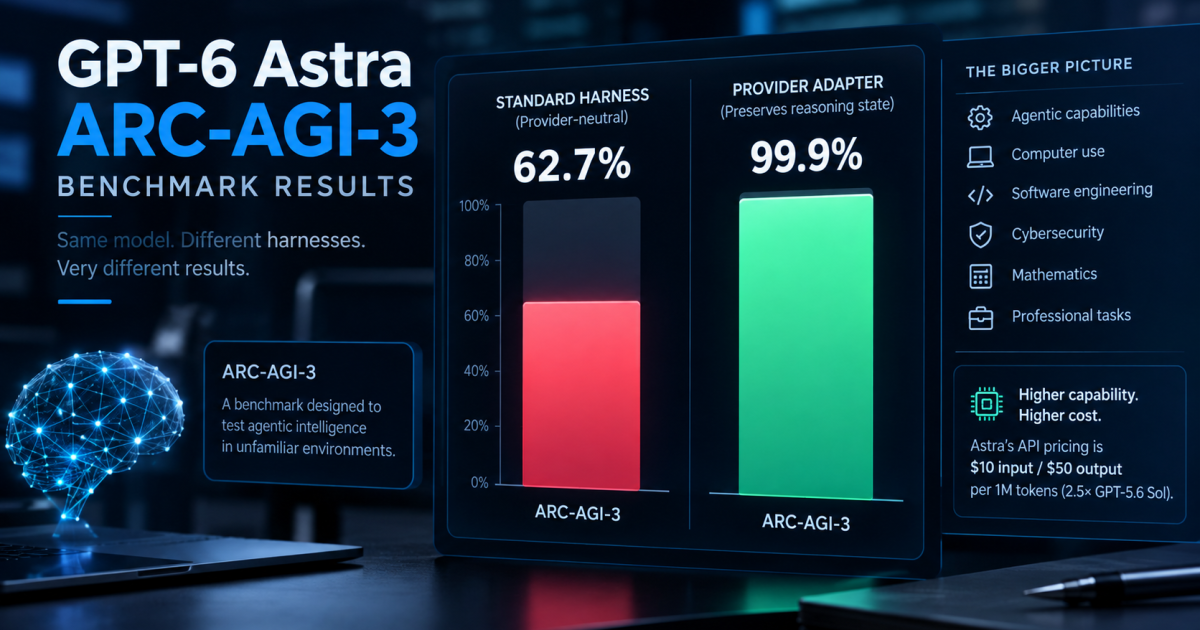
ARC Prize reports that Astra scored 62.7% using its Standard harness, while Astra reached 99.9% using a Provider Adapter that preserves the model’s opaque reasoning state between requests. Both results are real. The difference is the testing setup.
Key takeaway: The strongest case against declaring GPT-6 Astra “proven AGI” is not that Astra performed badly. It did not. The more important question is what exactly the benchmark is measuring when the model is allowed to retain provider-specific reasoning state. ARC Prize itself describes Astra’s results as state of the art, but that is not the same as saying AGI has been scientifically established.
What Is Actually Confirmed About GPT-6 Astra?
Before getting into the AGI argument, it is worth separating the confirmed facts from the conclusions being drawn from them.
| Measure | GPT-6 Astra result | What it tells us |
|---|---|---|
| ARC-AGI-3, Standard harness | 62.7% | Result using ARC Prize’s standard evaluation setup |
| ARC-AGI-3, Provider Adapter | 99.9% | Result using a provider-specific setup that preserves opaque reasoning state between requests |
| ARC-AGI-3 human action efficiency | Better than the median human on 96% of levels | Shows how efficiently Astra can act inside the benchmark environments |
| FrontierMath Tier 4 | 98% | One of the strongest mathematical results reported by OpenAI for Astra |
| ExploitBench | 100% | Shows the model’s very high cybersecurity capability on the reported evaluation |
That table is important because it shows why the AGI discussion cannot honestly be reduced to one number.
ARC Prize says Astra achieved state-of-the-art performance under both of its reported harness configurations. Under the Standard harness, Astra scored 62.7% on the Semi-Private portion of ARC-AGI-3. Under the Provider Adapter, it reached 99.9%. The Provider Adapter preserves opaque reasoning state and uses compaction for longer interactions, allowing Astra to reuse work from earlier parts of the task. ARC Prize’s own evaluation explains the difference in detail.
That is a much more interesting story than simply saying OpenAI exaggerated its score.
The 62.7% vs 99.9% Gap Is the Real Story
When OpenAI announced Astra, the number that spread fastest was 99.9% on ARC-AGI-3.
That number is not fabricated. ARC Prize itself reports it.
The part that deserves more attention is how Astra got there.
ARC Prize’s Standard harness is designed as a provider-neutral evaluation environment. In that setup, Astra scored 62.7%. The Provider Adapter gives Astra access to a different mechanism for preserving its internal reasoning state between requests. Under that configuration, the score rises to 99.9%.
That does not automatically make either result illegitimate. It does, however, demonstrate something important about evaluating modern AI agents: the system surrounding a model can materially affect what the model is capable of doing on a benchmark.
This is especially relevant for agentic AI. An agent is not simply a language model answering one prompt. It can involve memory, tools, context management, state preservation, browsing, computer interaction and other infrastructure. Once those pieces become part of the system being evaluated, the question becomes more complicated: are we measuring the raw model, or the model plus the machinery that allows it to work more effectively?
That is why the 62.7% result should not be presented as proof that Astra failed, and the 99.9% result should not be presented as proof that AGI has arrived.
Both numbers tell us something about the system.
ARC Prize Is Not Calling Astra AGI
This is perhaps the most important piece of context missing from many of the “AGI has arrived” headlines.
ARC Prize describes ARC-AGI-3 as a benchmark for agentic intelligence. The benchmark puts AI systems into unfamiliar environments and asks them to discover how those environments work, infer goals and take actions without being handed a step-by-step natural-language solution.
That makes it highly relevant to the AGI discussion. But relevance is not the same thing as proof.
ARC Prize’s own discussion of Astra does not say that achieving a high ARC-AGI-3 score proves a system has achieved AGI. In fact, the organization distinguishes progress on its benchmark from the much broader question of whether a system has reached artificial general intelligence.
That distinction matters because the word AGI does not have one universally accepted test that everyone agrees settles the question.
So when OpenAI president Greg Brockman talks about the “AGI era,” or Nvidia CEO Jensen Huang says “AGI has arrived,” those are significant statements from influential people. They are not equivalent to a scientific body certifying that a universally agreed AGI threshold has been crossed.
So, Did OpenAI Actually Claim AGI?
OpenAI has been much more direct about the possibility than a typical model launch would be.
At the Astra launch briefing, OpenAI president Greg Brockman said he personally believed OpenAI had reached AGI and ended the briefing with the phrase “Welcome to the AGI era.” Reporting from Axios’ coverage of the launch confirms that Brockman was making the claim while acknowledging that users would ultimately decide whether Astra met their definition of AGI.
Three days later, Nvidia CEO Jensen Huang was even more direct, posting that “AGI has arrived” while congratulating OpenAI on Astra. Huang also highlighted that Astra had been trained using more than 100,000 Nvidia Grace Blackwell systems and said another 400,000 GPUs were coming online. Reuters’ reporting on the Astra launch and Nvidia’s role provides additional context around the scale of the system and its commercial significance.
Those statements deserve attention, but they also need to be separated from the benchmark evidence.
Neither statement establishes a universally accepted definition of AGI and then demonstrates Astra against that definition.
Why the AGI Definition Matters More Than the Headline
There is a huge difference between saying that an AI system can perform an extraordinary range of economically useful tasks and saying that it has achieved artificial general intelligence.
Astra’s capabilities are clearly broad. OpenAI reports major improvements in computer use, browsing, software engineering, cybersecurity, science and professional work. The company’s Astra safety overview also says the model is the first OpenAI system broadly deployed to reach its Critical threshold for cybersecurity capability.
That is not a trivial improvement.
OpenAI says Astra can, with the appropriate tools and access, discover previously unknown security flaws and develop new exploitation techniques without a person guiding every individual step. That is one reason the launch comes with substantially stronger safety measures than previous models.
But an AI system becoming extremely capable at software engineering, mathematics, cybersecurity and computer use does not automatically answer every question associated with general intelligence.
- Can it reliably learn completely new domains without extensive scaffolding?
- Can it transfer knowledge between unrelated environments?
- Can it operate reliably over long periods without human correction?
- Can it understand ambiguous real-world situations at a level comparable with humans?
- Can it learn efficiently from relatively little information rather than relying on the enormous training infrastructure behind modern frontier models?
There is no single benchmark result in the Astra launch that settles all of those questions.
What the Independent Data Actually Says About Astra
The evidence does not support the idea that Astra is simply another incremental model.
ARC Prize describes its ARC-AGI-3 performance as state of the art and reports that Astra used fewer actions than the median human on 96% of the benchmark’s levels. That is a meaningful result because ARC-AGI-3 is specifically designed around agents learning to navigate unfamiliar environments.
Artificial Analysis also evaluates Astra separately from ARC-AGI-3 using its own Intelligence Index and other measurements. Its current comparison tools show Astra alongside GPT-5.6 Sol across intelligence, price, speed and task cost, rather than reducing the comparison to a single AGI score. Artificial Analysis’ current Astra comparison is useful here because it lets readers examine capability and cost together.
That is important because the earlier version of this story that circulated online treated Astra as if it had merely tied its predecessor on a composite intelligence score. The current data does not justify making that claim.
The more defensible conclusion is simpler: Astra represents a substantial advance in several important areas, but the size and meaning of that advance varies significantly depending on the benchmark, task and evaluation setup.
The Price Question Is Also More Complicated Than It Looks
There is another part of the Astra story worth keeping in perspective: cost.
OpenAI lists Astra’s API pricing at $10 per million input tokens and $50 per million output tokens. That is considerably more expensive on a token basis than GPT-5.6 Sol’s listed pricing.
But saying Astra is “2.5 times more expensive per task” would be misleading. Token prices are not the same thing as the total cost of completing a task. A model that uses fewer tokens, takes fewer actions or finishes a task with fewer model calls can have a different effective cost even when its per-token price is higher.
ARC Prize’s own Astra evaluation illustrates exactly why that distinction matters. The Standard-harness run scored 62.7% and cost roughly $26,000, while the Provider Adapter run reached 99.9% at a lower reported evaluation cost. The higher score was not simply the result of spending more money on more computation. The different harness changed how much previous reasoning could be reused. ARC Prize’s published evaluation includes the reported costs and harness details.
What Gary Marcus Is Actually Criticising
AI researcher Gary Marcus has been one of the more prominent voices pushing back on the AGI declaration.
His criticism is not that Astra is unimpressive. In his initial reaction to the model, Marcus described Astra as a genuine advance and highlighted its ability to construct symbolic world models.
His later response to Jensen Huang’s “AGI has arrived” declaration focused on the lack of a definition and evidence establishing that a particular AGI threshold had been crossed. Marcus’ own explanation of his objection is worth reading because it shows that the disagreement is fundamentally about what should count as AGI, not simply whether Astra is powerful.
That distinction is important.
Calling Astra impressive and rejecting the claim that AGI has been proven are not contradictory positions.
There Is Also a Commercial Incentive Around the AGI Narrative
There is a reasonable reason to scrutinise statements about AGI from corporate executives: the companies involved have enormous commercial interests in frontier AI.
OpenAI benefits if businesses, developers and consumers believe its latest model represents a major technological transition. Nvidia benefits from the continued expansion of the computing infrastructure used to train and operate systems like Astra.
That does not mean Brockman’s or Huang’s statements are false. It means their statements should be evaluated alongside the underlying evidence rather than treated as independent scientific certification.
The distinction matters particularly in a market where the phrase “AGI has arrived” can influence investment decisions, enterprise adoption, infrastructure spending and public expectations.
The useful question is not whether GPT-6 Astra is impressive enough to deserve attention. It clearly is. The useful question is whether the available evidence establishes the much broader claim that artificial general intelligence has arrived.
What Astra’s ARC-AGI-3 Result Actually Teaches Us
The most interesting lesson from Astra may have less to do with the exact score and more to do with how AI systems are now being evaluated.
For older AI models, it was easier to think of a benchmark as a question sheet: give the model a fixed input, receive an answer and measure whether that answer is correct.
Agentic systems make that model of evaluation increasingly inadequate.
Astra can interact with environments, take actions, preserve information and reason across multiple steps. The infrastructure around the model therefore becomes part of what determines how effectively it can solve a task.
The 62.7% versus 99.9% ARC-AGI-3 results make that visible in an unusually dramatic way.
If preserving opaque reasoning state allows a model to solve substantially more of the environment, then future AI benchmarks will increasingly need to specify not only which model is being tested but also what memory, state, tools and orchestration the model is allowed to use.
That is not an argument against Astra.
It is an argument for being much more precise about what an AI benchmark result actually measures.
So, Is GPT-6 Astra Actually AGI?
There is not enough evidence to treat that as an established fact.
Astra is clearly one of the most capable AI systems released so far. Its performance on agentic environments is extraordinary, its computer-use abilities represent a major step forward, and OpenAI reports substantial gains across software engineering, science, cybersecurity and professional work.
But “AGI” is a much larger claim than “state-of-the-art AI agent.”
The ARC-AGI-3 result itself demonstrates why caution is necessary. Astra scores 62.7% under the Standard harness and 99.9% under the Provider Adapter. Both results are legitimate measurements, but they measure the system under different conditions.
And even the organization behind ARC-AGI-3 does not treat a benchmark result as automatic proof that a model has achieved AGI.
So the most accurate description right now is not “AGI definitely has arrived” and not “Astra is just another incremental model.”
It is this:
GPT-6 Astra is a major advance in agentic AI, but the evidence currently shows a powerful and increasingly general system rather than a universally established proof that AGI has arrived.
Frequently Asked Questions
Did GPT-6 Astra score 99.9% on ARC-AGI-3?
Yes. ARC Prize reports a 99.9% result for Astra using its Provider Adapter harness. OpenAI highlights the same 99.9% result in its launch announcement. Astra also scored 62.7% using ARC Prize’s Standard harness, which is why the evaluation setup matters so much.
Why did GPT-6 Astra score 62.7% and 99.9%?
The two results came from different harnesses. ARC Prize’s Standard harness is designed as a provider-neutral setup, while the Provider Adapter preserves opaque reasoning state between requests and uses compaction for longer interactions. The model therefore has access to a different form of state management in the higher-scoring configuration.
Does the 62.7% result mean Astra failed ARC-AGI-3?
No. ARC Prize describes the 62.7% Standard-harness result as state of the art. The important point is not that Astra failed. It is that its performance changes dramatically depending on the evaluation configuration.
Did OpenAI say GPT-6 Astra is AGI?
OpenAI president Greg Brockman said he personally believes OpenAI has reached AGI and described the launch as the beginning of the “AGI era.” That is an executive’s assessment, not a universally accepted scientific certification of AGI.
Did Nvidia CEO Jensen Huang say AGI has arrived?
Yes. Jensen Huang publicly said “AGI has arrived” after Astra’s launch and congratulated OpenAI. His statement should be understood as his assessment of the state of AI rather than as an independently validated benchmark result.
Is GPT-6 Astra better than GPT-5.6 Sol?
Yes, Astra is positioned as a more capable frontier model and shows significant improvements on several important tasks, particularly agentic computer use and other demanding workloads. The size of the improvement depends on the benchmark, task and evaluation setup, so there is no single percentage that describes the entire difference.
What is the biggest problem with calling Astra AGI?
The biggest problem is that there is no single universally accepted test that establishes AGI. Astra demonstrates remarkable capabilities across many domains, but a benchmark such as ARC-AGI-3 measures a particular form of agentic intelligence. A high score is evidence of progress, not automatically proof that every requirement people associate with AGI has been met.
What Astra’s Results Actually Show
GPT-6 Astra deserves the attention it is getting. The model is not a marketing demo with a single impressive number attached to it. ARC Prize independently describes it as state of the art on ARC-AGI-3, and OpenAI reports major advances across computer use, software engineering, cybersecurity, mathematics and professional work.
But the most revealing number from the ARC evaluation is arguably not 99.9%.
It is the distance between 62.7% and 99.9%.
That gap shows how much the evaluation environment, memory and reasoning-state architecture can matter when measuring modern AI agents. It also makes the “AGI has arrived” claim much more complicated than the launch headlines suggest.
Astra may ultimately be remembered as an important step toward AGI. It may even turn out to be the model that marks that transition.
What the evidence available today does not justify is pretending that question has already been settled.
That distinction matters, especially now that AI benchmarks are becoming powerful enough to influence how businesses, investors and ordinary users understand what these systems can actually do.


















Join the discussion Tap to open the comment form +