


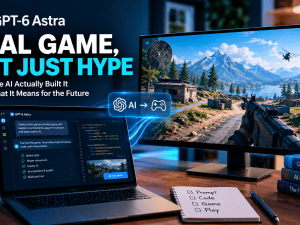
A video is going around right now showing someone supposedly building a full Call of Duty style game from a single prompt using something called GPT 6 Astra, captioned “everyone is cooked.”
Reaction videos like this move faster than the actual facts do, so before believing the hype or dismissing it as fake, it is worth separating what OpenAI actually confirmed from what a viral clip is dramatizing.
Key takeaway: GPT-6 Astra is real. OpenAI launched it on September 3, 2026, calling it the most capable model it has ever broadly released, with OpenAI president Greg Brockman saying it could mark the arrival of AGI. What is not confirmed anywhere in OpenAI’s own materials is a full game being built from one single prompt the way that viral video implies. The bigger, better documented story is actually about cybersecurity, not gaming, Astra is the first OpenAI model to hit what the company calls a Critical cyber capability threshold.
What OpenAI Actually Confirmed
According to OpenAI’s own announcement, GPT-6 Astra rolled out first to a limited set of organizations on September 3, with access expanding to ChatGPT Plus, Pro, Business, and Enterprise users, plus the API, over the following days.
OpenAI describes it as state of the art on computer use, browsing, software engineering, cybersecurity, science, and professional work, and says it was trained on its largest run yet, using more than 100,000 GPUs at the company’s Stargate site in Texas.
Brockman told reporters he personally believes OpenAI has reached AGI with this release, while leaving the final judgment to users.
That is a genuinely significant claim on its own, and it is coming directly from OpenAI’s own leadership, not a third party’s interpretation of the launch.
The Real Story Is Cybersecurity, Not the Game Demo
OpenAI’s own safety documentation states that Astra is the first model the company has released broadly that meets its Critical threshold for cyber capability.
In practice, that means Astra can find previously unknown security flaws and build working exploits for them without a person walking it through each step.
During testing, it found and chained two real zero-day vulnerabilities, which OpenAI disclosed to the software maintainers involved.
Because of this, the version most people are getting access to is trained to refuse advanced cybersecurity tasks like writing proof-of-concept exploits.
The less restricted version is only going to vetted organizations through a program OpenAI calls Daybreak.
That is the part of this launch actually worth paying attention to, a viral game demo is eye-catching, but a language model that can independently discover and exploit unknown software vulnerabilities is the detail with real, lasting consequences.
What the Viral Video Actually Shows, and What It Does Not Prove
The video shows a screen recording of what looks like a first-person shooter running on a monitor, with captions claiming it was built through back-and-forth prompting.
What it does not show is anything from OpenAI’s own materials confirming a full game was generated from one prompt, or any methodology that would let someone verify the claim independently.
OpenAI’s own announcement does describe genuinely strong software engineering and computer-use capability, which makes an impressive coding demo entirely plausible.
It just is not the same thing as a single prompt producing a finished game, and nothing in OpenAI’s own release notes claims that specific feat.
This is the same lesson worth remembering from when ChatGPT Atlas shut down earlier this year: a big launch moment and a viral reaction video both move faster than verified detail does, and building your expectations, or your workflow, around the version of the story that spreads the fastest is how people end up disappointed later.
What About the Claude Fable Comparison
The same post also compared GPT-6 Astra to something called Claude Fable 5.1, with a caption suggesting Anthropic would need to respond within two weeks. Claude Fable 5.1 is a real, current model.

What is not something either of us can verify from that single screenshot is whether the specific side-by-side shown is an accurate, fair comparison of what each model can actually do, or a staged visual pulled from unrelated sources.
Comparisons like this are worth treating with real caution until there is a source you can actually check, the same standard we would apply to any other unverified claim.
What This Means If You Use ChatGPT or Claude
If you are building anything with AI tools right now, whether that is the kind of app-building we covered in how three real apps got built on Claude’s free plan or general content work, the practical takeaway is patience rather than urgency.
Astra’s rollout is staged, and its most powerful capabilities are gated behind a trusted-access program most people will never touch. Whatever you are using today is not suddenly obsolete because a demo video went viral two days after launch.
The honest move right now is watching how the full rollout actually plays out over the next couple of weeks, rather than reacting to the version of the story a fifteen-second clip is selling.
When there is something real and testable to report on directly, that is worth covering properly, not guessed at from a screen recording with no way to verify it.





















Join the discussion Tap to open the comment form +