

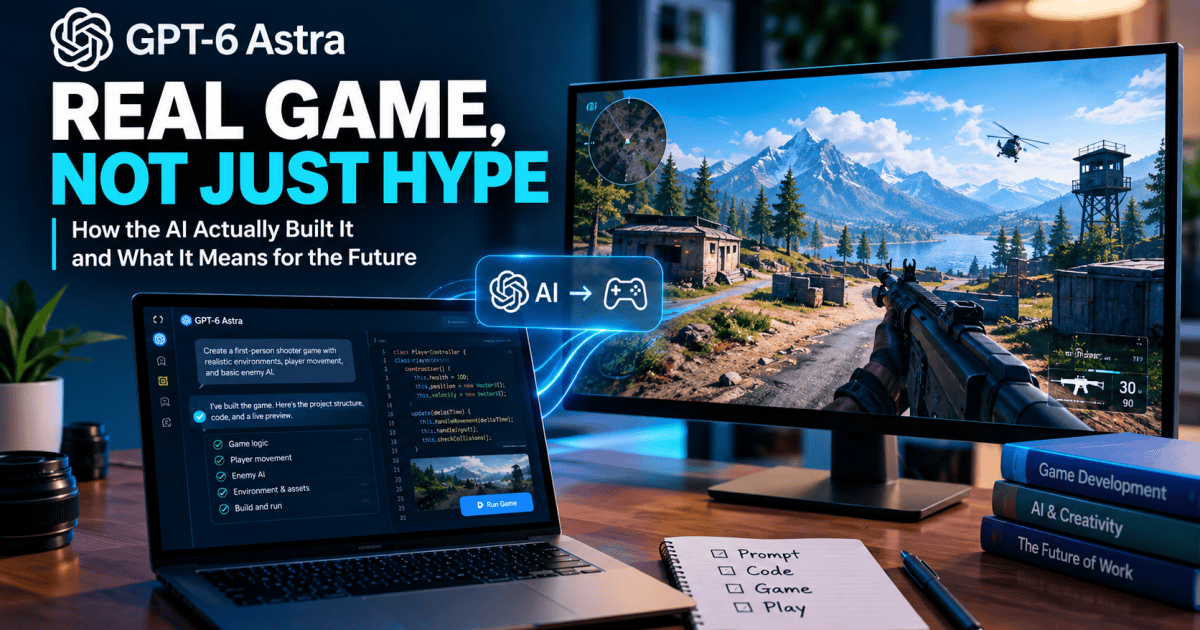
The viral GPT-6 Astra game demo was not just internet hype after all. What initially looked like another exaggerated AI video has now been confirmed: GPT-6 Astra can be used to build a functional game through natural-language instructions and computer interaction.
That changes the question completely.
Instead of asking whether the demo is real, the more interesting question is how much of the game Astra actually created, how much human input was involved, and what this tells us about the future of game development.
OpenAI’s latest model is capable of writing and modifying code, working with development environments, operating a computer, and iterating on software based on instructions. Put those abilities together and game creation starts to look very different from the traditional process of writing thousands of lines of code by hand.
But “AI created a game” still needs some context. A functioning prototype is not the same thing as producing a polished AAA title like Call of Duty. The real story is somewhere in between and it may be even more interesting than the viral caption suggests.
In this follow-up, we’ll break down what GPT-6 Astra actually did, what the developer still had to do, how the workflow works, and whether this is genuinely a turning point for independent game developers.
Key takeaway: GPT-6 Astra is real, and its game and 3D-building capability is real too, confirmed directly on OpenAI’s own announcement page, not just implied by hype. What is not confirmed is that any single video shows this happening from one literal prompt with no iteration. Most documented examples involve back-and-forth refinement or chaining tools like Blender into Unreal Engine. The cybersecurity result from this same launch, the first model to hit OpenAI’s Critical threshold, is arguably the more consequential part of the announcement.
What is Actually Confirmed by OpenAI
OpenAI launched GPT-6 Astra on September 3, 2026, calling it the most capable model it has broadly released, with access rolling out first to a limited set of organizations, then expanding to ChatGPT Plus, Pro, Business, and Enterprise users plus the API over the following days.
The company says it was trained on its largest run yet, using more than 100,000 GPUs at its Stargate site in Texas.
OpenAI president Greg Brockman said he personally believes the company has reached AGI with this release, ending the launch briefing with “welcome to the AGI era.” That is Brockman’s own stated position, reported directly, not an official company declaration that AGI has been achieved as a settled fact.
Astra’s Game and 3D Building Is Real, Confirmed Directly by OpenAI
OpenAI’s own announcement page states plainly that Astra “models a house in Blender and turns it into a walkable scene in Unreal Engine 5,” and describes the model letting non-technical people “create and play custom games that go beyond rudimentary elements in minutes.” That is OpenAI’s own language, not a third party’s interpretation.
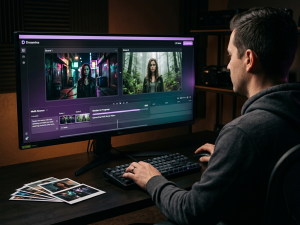
Independent documentation backs this up with real, named examples. One builder used Astra to create a browser-based Mario Kart-style racer running on Three.js, with working physics, multiple tracks, and a collectible currency system, published as an early alpha they were still refining.
Another widely documented case involved AI developer Matt Shumer building a populated Unreal Engine world where the characters, driven by Astra, began talking to each other without being individually scripted to do so.
The honest caveat sitting underneath all of this: most of these builds combine Astra with other tools rather than resulting from one isolated prompt. Blender into Unreal Engine is a chain of steps, not a single instruction.
The Mario Kart builder called their result a work in progress, not a finished product from one shot. That is a meaningfully different claim than “one prompt, one finished game, no further work,” which is closer to what the viral video’s framing implies without actually showing.
The Cybersecurity Result Is the More Consequential Story
OpenAI’s own safety documentation states that Astra is the first model the company has released broadly that meets its Critical threshold for cyber capability, meaning it can find previously unknown security flaws and build working exploits without step-by-step human guidance.
During testing, it found and chained two real zero-day vulnerabilities, which OpenAI disclosed to the software maintainers involved.
Because of this, the publicly available version is trained to refuse advanced tasks like writing proof-of-concept exploits, while a less restricted version is only going to vetted organizations through a program OpenAI calls Daybreak.
A viral game demo is eye-catching. A model that can independently discover and exploit unknown software vulnerabilities is the detail with real, lasting consequences, and it is getting a fraction of the attention the game clips are getting.
Where Claude Fable 5.1 Actually Fits
Claude Fable 5.1 is real and current, and this is not just Anthropic’s own claim. OpenAI’s own Astra announcement directly benchmarks against it by name, showing Astra scoring higher on a terminal-task benchmark while noting Fable 5.1’s own competitive score.
In a separate documented head-to-head, both models were asked to build the same seaside house in Blender, and both produced a working result, with reviewers noting Astra’s version included more finishing detail.
That is a genuinely different, more grounded picture than a viral comparison video implies, and it comes from the source with the least reason to flatter Anthropic: OpenAI’s own comparison page.
What This Means If You Use ChatGPT or Claude
If you are building anything with AI tools right now, the practical takeaway is that Astra’s capability jump is real, not manufactured hype, and it is worth taking seriously rather than dismissing as a staged demo.
At the same time, this is the same lesson worth remembering from when ChatGPT Atlas shut down earlier this year: a big launch moment always produces both real capability and exaggerated retelling of that capability at the same time, and the two are worth telling apart before you build expectations, or a workflow, around either one alone.
The rollout is still staged, and the most powerful parts of it are gated behind a trusted-access program most people will never touch.
Whatever you are using today for the kind of building we covered in how three real apps got built on Claude’s free plan is not suddenly obsolete because a demo clip went viral two days after launch.
When Astra’s wider rollout actually reaches an account either of us can test directly, that is the point where a real hands-on comparison becomes possible, not before.


















Join the discussion Tap to open the comment form +