
I run two YouTube channels that use AI in very different ways, and the experience has taught me something I didn’t fully appreciate when I started: using AI isn’t necessarily the problem. What matters is what the finished content looks like and how much original value the creator is actually adding.
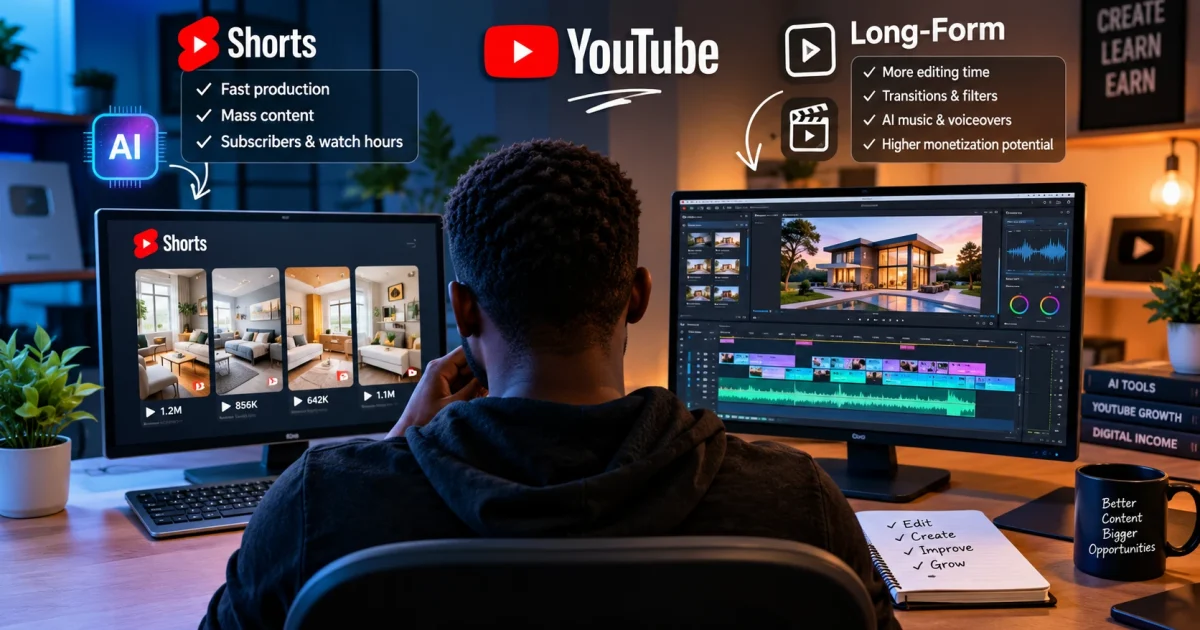
On one channel, I use AI to mass-produce YouTube Shorts in the interior design and renovation niche. Shorts are quick to make, don’t require much editing, and the strategy has worked for growth. I’ve gained subscribers and accumulated real watch time.
But there was a problem. When I looked at the channel as a whole, many of the videos were starting to look too similar. The rooms changed. The renovation ideas changed. A few other elements changed too. But the underlying format remained almost the same.
My other channel is different. I still use AI to generate much of the material, but I spend considerably more time turning that material into the final video. I add transitions, filters, my own AI-generated music, ElevenLabs voiceovers and other editing choices.
That experience is what made YouTube’s current monetization rules click for me. The question isn’t simply whether AI was involved. The bigger question is whether the finished channel offers original, meaningful content or starts to look like a production line.
If you’ve read our earlier guide to building an AI storytelling workflow for YouTube, this is the other side of that story: what happens when you take that workflow to the monetization stage.
YouTube Is Not Banning AI-Generated Videos
Let’s clear up the biggest misconception first.
YouTube does not have a blanket ban on AI-generated or AI-assisted videos. Its current monetization policy says content needs to be original and authentic, and it specifically says monetized content should not be mass-produced, generic, repetitive or manipulative.
YouTube also gives a specific example that is particularly relevant to AI creators: AI-generated content made with generic or unoriginal templates that gives the impression of mass production without adding the creator’s original, authentic insights or perspective can be ineligible for monetization.
That is very different from saying “YouTube doesn’t monetize AI.”
The real question is not whether AI touched the video. It’s whether the finished content still gives viewers something original, useful, entertaining or meaningfully different from the next video on the channel.
What Changed in YouTube’s AI Content Rules?
There are several dates worth separating because they are easy to mix together.
| Date | What happened |
|---|---|
| July 15, 2025 | YouTube renamed its “repetitious content” policy to “inauthentic content” and clarified that it covers repetitive and mass-produced content. YouTube said this was already ineligible under its existing monetization standards. |
| January 2026 | YouTube publicly identified low-quality, repetitive AI content as a problem it was working to reduce, while continuing to describe AI as a creative tool. |
| July 16, 2026 | YouTube further clarified the inauthentic-content rules, spelling out three categories of content that can prevent monetization: generic or repetitive content, unsatisfying or off-putting content, and AI personas related to sensitive topics. |
| May 2026 | YouTube expanded its AI disclosure system, including more prominent labels and automatic detection of significant photorealistic AI use. |
| February 1, 2027 | New YPP applicants will face higher entry thresholds, while existing YPP creators will need 10 million qualified Shorts views in the previous 90 days to receive Shorts ad and YouTube Premium revenue sharing for that month. |
The July 2026 development is important, but it should not be described as YouTube suddenly creating a brand-new “AI ban.” YouTube’s Trust & Safety team described the change as a clarification of the existing policy.
Why My AI Shorts Channel Started Looking Too Similar
This is where my own experience comes in.
My interior design and renovation Shorts were deliberately built for speed. AI made it possible to produce them quickly, and because Shorts don’t require the same production process as my long-form videos, I could publish much more frequently.
And it worked in one important sense: I got subscribers and watch hours.
The problem appeared when I looked at the videos together rather than individually.
One video might show a different living room. Another might show a different bedroom. Another might show a renovation transformation. But if the same basic structure, pacing, visual treatment and production formula keep appearing, changing the room or renovation idea doesn’t necessarily make the channel substantially different from one upload to the next.
That is remarkably close to how YouTube currently describes generic or repetitive content: videos that look like they were made from a template or become repetitive when viewers watch several videos from the same channel. YouTube says content can be ineligible when videos are interchangeable and fail to provide meaningful creative, educational or other value from one upload to the next.
So my lesson wasn’t that AI Shorts don’t work.
They can clearly work for audience growth.
The lesson was that growth and monetization eligibility are not the same thing.
What YouTube Means by “Inauthentic Content”
YouTube’s July 2026 clarification makes the current framework easier to understand.
1. Generic or repetitive content
This is the category most relevant to my Shorts experience.
YouTube says content can be ineligible when it looks like it was made from a template, feels repetitive after watching several videos from the same channel, or provides little meaningful variation or value. It specifically includes AI-generated content made with generic or unoriginal templates that gives the impression of mass production without the creator’s original perspective.
2. Unsatisfying or off-putting content
The July 2026 clarification also covers content designed around distressing or emotionally manipulative material intended to attract views. This isn’t an AI-only rule. YouTube’s explanation makes clear that this category can apply whether or not AI was used.
3. AI personas discussing sensitive topics
The third category is more specifically connected to AI. YouTube has highlighted AI personas presenting information on sensitive subjects such as health, finance and legal matters. This is a narrower issue than simply using an AI voice, AI images or AI-generated video.
That distinction matters because someone can use AI throughout a legitimate production workflow without automatically falling into this category.
Why My Long-Form AI Videos Are Different
My long-form channel follows a completely different production process.
AI is still part of the workflow. But I don’t simply generate a video and upload it.
- I spend time editing the final product.
- I make decisions about transitions and filters.
- I create music for the videos.
- I use ElevenLabs for voiceovers.
- I work on the pacing and presentation instead of treating the first AI-generated output as the finished product.
That doesn’t mean I can guarantee YouTube will monetize a video simply because I spent more time editing it. YouTube does not publish an editing-time threshold, and monetization decisions are made with the channel’s broader content in mind.
But there is an important difference in the production philosophy.
With the Shorts channel, the objective was largely to make a repeatable format faster.
With the long-form channel, the objective is to use AI as part of a larger creative process and spend more time shaping the final result.
That distinction is much closer to what YouTube’s current policy asks creators to think about: whether each video provides meaningful creative, educational or other value rather than simply reproducing a production template at scale.
AI Disclosure Is a Separate Issue
There is another YouTube rule AI creators need to understand, because it is easy to confuse disclosure with monetization.
In May 2026, YouTube made its labels for photorealistic and meaningfully AI-altered or AI-generated content more prominent. For long-form videos, the label can appear below the video player, while for Shorts it can appear directly over the video. YouTube also introduced automatic signals to help identify significant photorealistic AI use when creators haven’t disclosed it themselves.
But YouTube explicitly says that the disclosure label itself does not change whether a video can be recommended or monetized.
So these are two different questions:
- Does this video need an AI disclosure?
- Does this content meet YouTube’s monetization policies?
Getting the first question right does not automatically answer the second.
That is particularly relevant to my own workflow because I use AI-generated music and AI voice tools. YouTube’s disclosure guidance separately identifies certain forms of synthetic or altered content that require disclosure, so creators should check the current upload disclosure options rather than assuming that every use of AI is treated the same way.
What Is Changing for YouTube Shorts in 2027?
There is another change Shorts creators need to watch, and it is separate from the inauthentic-content policy.
Starting February 1, 2027, YouTube says creators who are already in the Partner Program will need 10 million qualified Shorts views in the previous 90 days to receive Shorts ad and YouTube Premium revenue sharing for that month. If a channel falls below the threshold, it remains in YPP and can continue earning from other eligible revenue streams such as long-form content. Shorts revenue sharing resumes when the channel again reaches the required threshold.
This is important for anyone building a business around high-volume Shorts.
But there is another change that applies to new creators entering YPP.
From February 1, 2027, YouTube says new applicants will need 8,000 qualified watch hours in the previous 365 days or 20 million qualified Shorts views in the previous 90 days, alongside the 1,000-subscriber requirement, to unlock ad and Premium revenue sharing. Existing YPP creators are not affected by this higher entry threshold.
So these should not be confused:
- 20 million qualified Shorts views: the new entry threshold for new YPP applicants from February 2027.
- 10 million qualified Shorts views: the recurring 90-day threshold for Shorts ad and YouTube Premium revenue sharing for creators already in YPP.
What I’d Change About My AI Shorts Strategy
I don’t think the answer is to stop using AI.
For me, the lesson is to stop treating AI as a reason to make every video follow the exact same production formula.
If I were rebuilding the Shorts strategy, I’d look for ways to make the substance of each video more distinct, rather than simply changing the room, furniture or renovation concept inside the same template.
That could mean developing a recognizable voice, adding original commentary, changing the structure when the subject requires it, introducing genuinely different storytelling approaches, or creating a stronger editorial point of view.
The goal isn’t to make every video completely unrelated to the previous one. YouTube explicitly allows channels to follow similar patterns and even use the same intro or outro, provided the substance of the videos is materially different and provides creative, educational or other value.
My biggest lesson: AI can make production faster, but faster production can also make it easier to accidentally build a channel where every video feels like the same video with different nouns.
What AI YouTube Creators Should Take From This
If you’re using AI to create YouTube videos, I wouldn’t ask only, “Can YouTube detect that I used AI?”
I’d ask a more useful question:
If someone watches five or ten videos from my channel back-to-back, do they see five or ten genuinely different pieces of content, or one production template repeated several times?
That is much closer to the issue YouTube’s current policy is trying to address.
AI can help with research, scripting, narration, visuals, music and editing. The tool itself isn’t automatically what determines monetization eligibility. The bigger risk is allowing the convenience of AI to turn the entire channel into a mass-production system with little meaningful variation or original perspective.
What This Means for Nigerian Creators
For Nigerian creators building faceless channels, this matters because AI has dramatically lowered the cost of producing videos. A creator can now research a topic, generate a script, create visuals, produce a voiceover and publish far faster than was possible a few years ago.
That opportunity is real. But so is the temptation to produce dozens of videos from the same template.
If you’re using AI for a Nigerian-focused channel or targeting viewers in the US, UK, Canada, India or elsewhere, the underlying YouTube monetization rules are the same. The more useful strategy is to use AI to accelerate your workflow while making sure the final videos still have a clear reason to exist beyond filling another upload slot.
My Takeaway After Using AI on Two Channels
Using AI has made me faster as a YouTube creator, but it has also shown me where speed can become a weakness.
My AI Shorts channel demonstrated how quickly a repeatable format can produce subscribers and watch time. It also showed me how easy it is for a channel to become visually and structurally repetitive.
My long-form channel has taken more work because I spend much more time shaping the final production. I haven’t simply stopped using AI; I’ve used it as part of a more involved creative workflow.
I wouldn’t turn my experience into a guarantee that one format will always be monetized and another won’t. YouTube reviews channels individually and its policies cover much more than whether AI was used.
But after working with AI on both formats, one lesson stands out for me:
Don’t focus on hiding the fact that you use AI. Focus on making sure there is something genuinely yours in the finished content.
Prince Theophilus is the founder of FaithfulBiz, where he writes about AI tools, blogging, technology and building digital opportunities. He also runs YouTube channels that use AI-assisted production.
















Conversation (0)