


I have been rejected from AdSense eight times. After the eighth one, I did what most people do: I went looking for answers online.
What I found was a mess of confident-sounding advice that contradicts itself from one article to the next.
So instead of just repeating what I read, I checked the biggest claims against Google’s own actual pages. Some of it held up. Some of it did not.
Key takeaway: The two most repeated AdSense “requirements” online, domain age and traffic minimums, do not appear anywhere in Google’s own eligibility documentation. What actually matters is what Google does say plainly: original content that meets its policies, required pages like a Privacy Policy, and a site that is easy to navigate with no broken links or empty pages. I am still mid-process myself, this is not a success story yet, it is what I have verified so far.
The Domain Age Myth
This is the single most repeated claim in every AdSense guide online: your domain needs to be a certain number of months old before Google will even consider it.
Three months, six months, the exact number changes depending on which article you read, which alone should be a signal that nobody is quoting an actual rule.
From Google’s own AdSense eligibility page: Google states plainly that you can sign up for AdSense if you have your own content that meets its policies and you are 18 or over. The page lists exactly what it requires: ownership of the site, access to its HTML source, and compliance with Program policies. Domain age is not mentioned anywhere on it.
What is actually happening is a correlation getting mistaken for a rule. Most approved sites are three to six months old, not because Google checks a calendar, but because that is roughly how long it takes a real person to build the kind of content depth Google is actually looking for.
A six-week-old domain with fifteen genuinely thorough posts likely has a better shot than a six-month-old domain with five thin ones.
The kind of depth that actually holds up looks like real troubleshooting detail people search for by the thousands, the same standard behind our breakdown of why ChatGPT slows down, not a rewritten version of what the top five results already say.
The Traffic Myth
The second most repeated claim is that you need a minimum number of daily visitors before applying.
This one is also not an official requirement. Sites with close to zero organic traffic have been approved. Traffic is not the gate. It is, at most, a soft signal that a site is real and getting found, not a number you need to hit before applying.
What Actually Is Real
Stripped of the myths, what Google’s own guidance and its actual, published policies point to is simpler than most checklists make it sound.
Required pages are real: a Privacy Policy, an About page, a way to contact the site owner. Original content that genuinely answers a question is real.
And a clean, navigable site with no broken links, no empty category pages, and no placeholder content is real too, this is exactly the kind of thing an automated review or a human reviewer would actually notice.
That last one is the part most guides mention in passing and then move on from, but it deserves more attention than it gets.
Google’s own page-readiness checklist asks a version of the same question directly: does your site have clear, easy-to-use navigation.
A single forgotten empty category page, or a handful of internal links pointing to pages that no longer exist, is a concrete, fixable thing sitting in plain view. It is also exactly the kind of detail that is easy to miss on a site with dozens of pages built up over months.
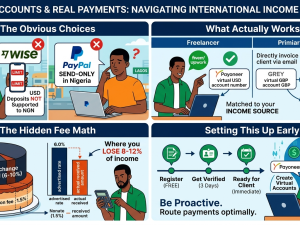
This is the same discipline that mattered when we corrected outdated payment advice for Nigerian creators: check the primary source directly rather than repeating what everyone else already assumes is true. Wise and PayPal’s actual capabilities had changed while the advice about them stayed frozen in 2022. AdSense requirements online have the same problem.
Where I Actually Am Right Now
I am not writing this from the other side of approval. I am writing it in the middle of trying to get there, honestly.
After the eighth rejection, I went through my entire site page by page rather than guessing at another small fix. Content that was thin or written before I had a real editorial standard got rewritten or removed.
Internal links pointing to pages that no longer existed got found and fixed, several of them were sitting on pages that were otherwise ready to go.
I checked every required page is actually present and actually linked, not just technically existing somewhere Google would have to search for.
I do not know yet whether this specific round works. What I do know is that I would rather tell you honestly what I have verified against Google’s own documentation than repeat a number I found on someone else’s blog and hope it holds up.
What This Means If You Are Going Through the Same Thing
Do not treat domain age or a traffic count as the reason you were rejected unless you have actually confirmed that is the issue.
Check the boring, concrete things first: does every required page exist and link correctly, does every internal link on your site actually go somewhere real, is there a stray empty page or category sitting unused somewhere.
Those are the things worth auditing before you assume the problem is something as uncontrollable as how old your domain is.
I will update this once I have a real result to share either way, approved or rejected again. Either outcome is more useful to you honestly reported than a guess dressed up as certainty.




















Join the discussion Tap to open the comment form +