


My average position on Google dropped from 21.3 over the last three months to 27.7 in the last 28 days.
That’s a real six-point slide, not noise, and my first instinct was the same one most people have: panic and start rewriting things.
Instead I sat with the number for a day and actually read what Search Console was telling me, the same way I did when I worked through the AdSense rejection audit on this site.
This is that process, laid out so you can run it yourself the next time your own position graph dips.
Key Takeaway: A position drop by itself tells you almost nothing. What matters is whether it’s happening across your whole site or a few pages, whether your click volume actually fell with it, and whether the timing lines up with anything you changed. Chase those three questions before you touch a single article.
Average Position Is a Blend, Not a Single Number
The 21.3 and 27.7 figures are averages across every query and every page that earned an impression.
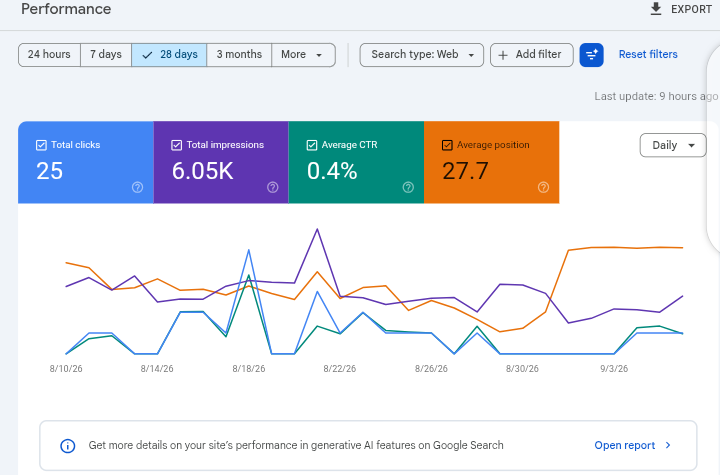
A handful of new posts ranking poorly in their first weeks can drag that average down even while your established pages hold steady.
Before assuming site-wide decline, it’s worth checking whether the drop is broad or concentrated.
In Search Console, the Pages tab under Performance breaks this apart by URL instead of averaging everything together.
That single view answers the first real question: is this one or two pages losing ground, or is it genuinely everywhere?
Check Clicks Before You Check Position
A worse average position sounds alarming, but if your total clicks over the same period haven’t dropped in proportion, the practical damage is smaller than the headline number suggests.
Position and clicks don’t always move together, since new pages entering the index at a rough position 40 can pull the average down without touching your existing traffic at all.
Pull up your clicks trend for the same date range next to the position trend.
If clicks are flat or only mildly down while position swings harder, you’re likely looking at new content settling in rather than existing pages losing rankings.
Line Up the Timing With What You Actually Changed
Google confirms broad core updates through its Search Status Dashboard, and checking whether a confirmed rollout lines up with your dip is worth doing before assuming the cause is something on your own site.

Absent a confirmed update, the more likely explanations are usually closer to home: a batch of new posts published in a short window, a category restructure, or internal linking changes that temporarily confuse how Google understands your site’s structure.
I went through this exact list against my own recent changes, including the subdomain noindex work and the Midjourney content consolidation covered in an earlier audit.
None of it lines up cleanly enough yet to call it a confirmed cause, and that’s worth saying plainly rather than forcing a tidy explanation onto a graph that might just need more time to settle.
What the Pages Report Actually Showed
The Search Status Dashboard came back clean, no confirmed rollout in the window, so the explanation had to be sitting inside my own site.
Sorting the Pages report by impressions instead of clicks is what actually cracked it open.
Two Midjourney posts, a parameters guide and a prompts guide, were pulling in 937 and 458 impressions in this 28-day window alone, roughly 23 percent of all impressions on the entire site.
Both were ranking at position 53 and 66. Two pages carrying almost a quarter of the site’s total impression volume while sitting on page six and page seven of results will drag a site-wide average down hard, since the average has to account for that volume even though almost nobody scrolls far enough to click either one.
This is the exact cannibalization pattern from an earlier audit on this site, where the same Midjourney topic was split across a main-domain page and a subdomain page instead of consolidated into one.
The consolidation work was already underway before this check, which means the fix and the diagnosis arrived from two different directions and met in the middle.
The Rest of the Picture Wasn’t as Bad
Once those two pages were set aside, the remaining top pages were holding reasonable ground: the ChatGPT slowness post at position 12.4 on over 1,300 impressions, the logout-issue post at position 10.3.
One page, a Grok pricing review, sat at position 36.4 for reasons unrelated to cannibalization, likely just genuine competition on that specific query, and stayed on the list to keep an eye on separately.
Why Waiting for the Fix to Land Is the Right Call Here
The redirect and consolidation work on the Midjourney pages had already been done before this Pages report was pulled, which means the numbers above are a snapshot of the problem right before the fix takes effect, not after.
Search engines typically need one to two weeks to fully process a redirect and reassign the ranking signal to the surviving page, so the honest next step is watching this same report again in two weeks rather than declaring victory or panicking today.
If the average position climbs back toward 21 once those two pages either redirect cleanly or start ranking as one consolidated page instead of two competing ones, that confirms the cause.
If it doesn’t move, the search continues elsewhere. Either way, the answer will come from checking the same report again, not from guessing harder at this one.
If You’re Watching a Drop Right Now
Sort your own Pages report by impressions, not clicks, and look for any page carrying an outsized share of impressions while ranking past position 30.
That combination is often the fastest explanation for a dragged-down average, and it’s usually fixable without touching your best-performing pages at all.























Join the discussion Tap to open the comment form +