
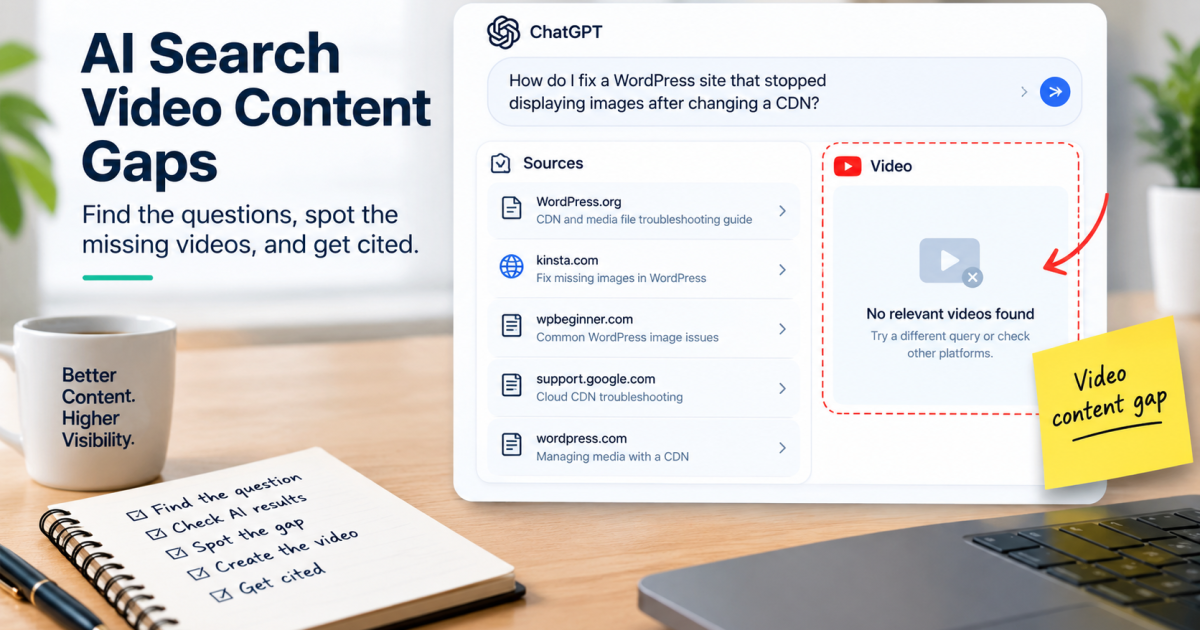
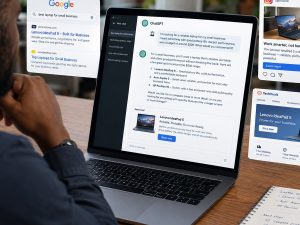
Ask ChatGPT, Perplexity or another AI search platform a specific question in your niche and pay attention to the sources it cites.
You may notice something interesting.
The answer can contain several articles, documentation pages, forums or other websites while video appears rarely, or not at all.
That does not mean AI search has a universal dislike of video. The more useful insight is that AI search does not treat video equally across platforms, queries or content formats.
That unevenness can create a video content gap.
If people are asking questions that could be answered well with video, but AI search repeatedly relies on written sources, there may be an opportunity to create a useful video that fills part of that gap.
For creators, publishers, educators and businesses trying to improve their AI search visibility, this is worth testing.
Key takeaway: Don’t assume that AI search has one universal video blind spot. Test specific questions, study the sources being cited, identify where useful video coverage is weak, and create content that directly answers the missing question.
AI Search Does Not Treat Video Equally
One mistake in AI search optimization is treating every AI platform as if it uses the same retrieval system.
It does not.
ChatGPT Search, Perplexity, Gemini, Google AI features and other AI search products can return different sources for the same question. Their citation patterns can also change depending on the subject, wording and search intent.
OpenAI says ChatGPT can search the web and provide links to relevant sources. It also warns that search results and citations can sometimes be incomplete, outdated or incorrect. Websites that want to be eligible for inclusion in ChatGPT Search should also avoid blocking OAI-SearchBot. OpenAI’s ChatGPT Search documentation explains how the system works and why users should check cited sources.
That means a video that is rarely cited by ChatGPT may still have better visibility on another AI search platform.
Recent research illustrates the difference. Indexly analysed more than 3 million citation URLs from 95,000 AI prompt responses and identified 22,781 YouTube citations. In that dataset, 95.74% of YouTube citations pointed to long-form videos, while Shorts accounted for 3.04%. The distribution also varied substantially between AI platforms. See the full Indexly analysis.
The important lesson is not that one particular percentage will remain unchanged. AI search systems and their source mixes can change.
The useful lesson is this:
Look for gaps at the query and platform level rather than making broad assumptions about AI search.
Visibility Is Not the Same as Citation
There is another distinction worth making before looking for content gaps.
AI visibility, a mention and a citation are not necessarily the same thing.
Your brand or content may be mentioned in an AI answer without receiving a direct source link. A platform may also use information from a source without presenting the source in the same way every time.
A citation is the clearest signal because the platform explicitly identifies or links to the source it used.
So when testing your own content, don’t record only whether your brand appeared.
Record whether:
- your brand was mentioned
- your website or video was visible
- your specific page or video was cited
- the citation was directly relevant to the question
This distinction becomes particularly important when measuring AI search performance. AI visibility is broader than citation alone, while citation is a more specific and measurable form of source recognition.
What a Video Content Gap Actually Looks Like
Imagine someone asks:
“How do I fix a WordPress site that stopped displaying images after changing a CDN?”
An AI search engine might find several written troubleshooting guides, documentation pages and forum discussions.
But perhaps none of the available videos clearly demonstrates the exact problem and solution.
That is a much more useful observation than simply saying, “AI does not cite videos.”
You have identified a specific information need where video could potentially add something useful.
The same opportunity can appear in finance, software, education, technology, digital marketing, business, DIY and many other areas.
The important word is specific.
How to Find Video Gaps in AI Search
1. Start with narrow questions
Broad topics are difficult to evaluate because they contain too many possible search intents.
Instead of testing:
“Google AdSense”
try:
“What should I do if my AdSense PIN has not arrived after requesting it three times?”
Instead of:
“AI SEO”
try:
“How can I check whether ChatGPT is citing my website?”
Narrow questions make citation patterns much easier to identify.
2. Test the same question across platforms
Run your questions through the AI search platforms that matter to your audience.
Record:
- which websites are cited
- whether a YouTube video appears
- whether the video is actually relevant
- whether the same video keeps appearing
- whether the available videos are outdated
- whether several written sources exist without a useful video
One AI response is not enough to establish a pattern. AI answers can change based on the system, query wording, timing and available sources.
3. Test a group of related questions
Instead of testing one question and immediately creating a video, test perhaps 10 to 20 closely related questions.
If most answers contain several written sources but useful video appears rarely, that is a stronger signal.
You may have found a topic where written coverage is strong but video coverage is relatively thin.
A Simple AI Search Video Gap Analysis
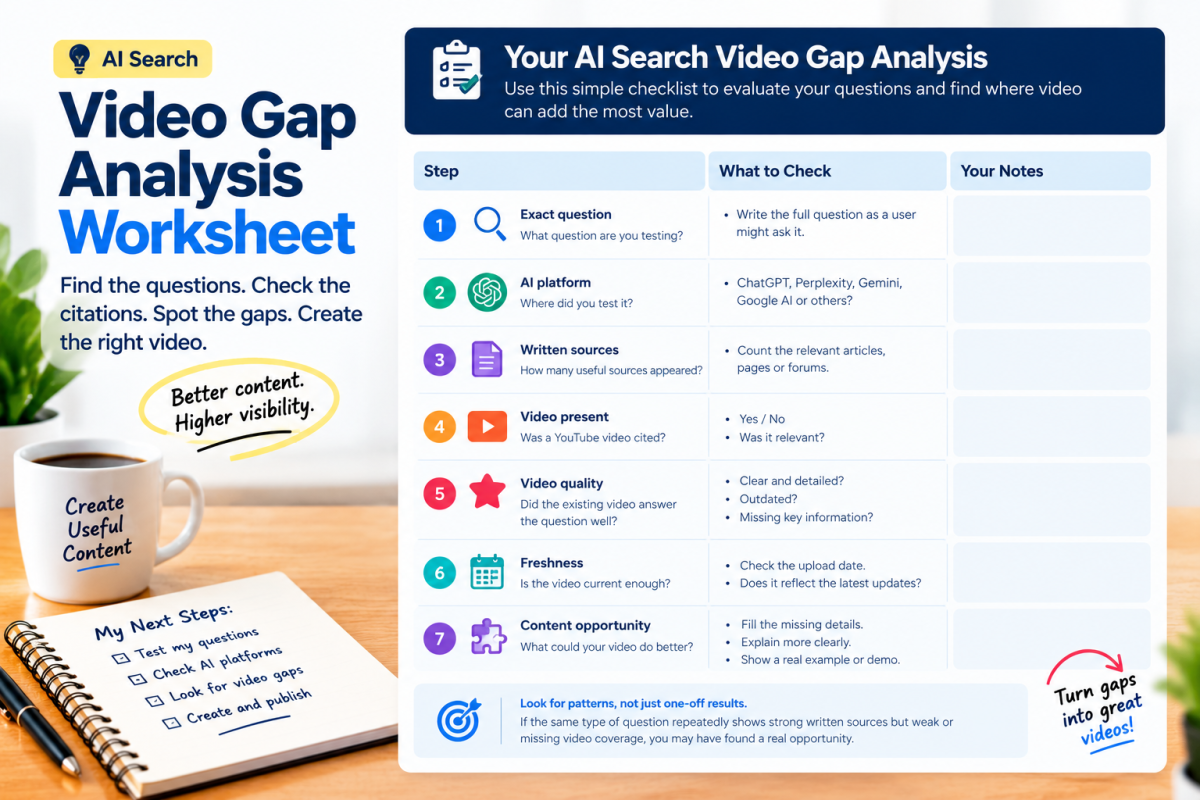
You can do this research with nothing more complicated than a spreadsheet or notebook.
For every question you test, record the following:
Question: What exact question did you test?
Platform: ChatGPT, Perplexity, Gemini, Google AI or another platform?
Written sources: How many useful articles or web pages appeared?
Video present: Was a relevant video cited?
Video quality: Did the cited video actually answer the question?
Freshness: Is the existing video current enough for the subject?
Missing information: What does the existing video fail to explain?
Your opportunity: What could your video answer more clearly?
After testing several related questions, look for repetition.
If the same type of question repeatedly produces strong written sources but weak or missing video coverage, you have a much stronger candidate for a video content gap.
Do not treat one missing video as proof of an opportunity. Look for a pattern.
Audience-Specific Examples of Video Gaps
The best opportunities become easier to understand when you look at them from the audience’s perspective.
For a Nigerian finance creator
Instead of producing another broad video about “investing in Nigeria,” investigate specific questions such as:
“How does a Nigerian investor calculate the dollar value of a stock investment?”
If AI search provides plenty of written explanations but few useful videos that demonstrate the calculation, that could be worth investigating.
For a blogger
A question such as:
“Why has my AdSense PIN not arrived after several requests?”
has much clearer intent than simply targeting “Google AdSense.”
A creator could demonstrate the actual steps, explain what happens after repeated requests and show where the relevant settings are located.
For a WordPress creator
Instead of making a general “WordPress SEO tutorial,” investigate a specific problem such as:
“Why can’t Google Search Console read my WordPress sitemap?”
The more specific the problem, the easier it becomes to compare existing written and video coverage.
For an AI and SEO creator
A question such as:
“How can I check whether ChatGPT cites my website?”
could naturally lead to a screen-recorded tutorial showing the process.
FaithfulBiz already covers this broader subject in How to Know If ChatGPT Cites Your Website. The two articles therefore serve different but closely related search intents.
These examples are not claims that these specific searches currently have a video gap. They demonstrate the type of narrow question you should investigate before deciding to create the video.
What Makes a Video More Useful as an AI Search Source?
There is no published formula that guarantees ChatGPT, Perplexity or another AI system will cite a particular video.
However, several characteristics make sense if your goal is to create a strong answer to a search-driven question.
Answer the question directly
If the viewer wants to know how to solve a particular problem, get to the solution quickly.
Do not spend the opening minutes on a long introduction before addressing the question.
Use a descriptive title
A title should make the subject obvious.
How to Fix AdSense PIN Not Received After 3 Requests
is more informative than:
My AdSense Problem Finally Solved!
The first tells both the viewer and search systems exactly what the video covers.
Make the description genuinely useful
Explain what the video covers and include important context naturally.
Do not turn the description into a collection of unrelated keywords.
Use accurate captions or a transcript
Titles, descriptions, captions and transcripts can provide useful textual context around video content.
But it would be too strong to claim that every AI system requires a transcript before it can understand or cite a video. Different platforms use different retrieval and ranking systems.
Prioritise factual clarity
If the video covers finance, technology, regulation or another fast-changing subject, include dates and explain important limitations.
A clear, accurate answer is more valuable than a video created purely to chase an AI citation.
Production quality still matters to viewers too. Good audio, clear visuals and sensible pacing should not be sacrificed simply because citation behaviour is uncertain.
Why Long-Form Video Deserves Attention
If AI search visibility is one of your goals, do not automatically assume that Shorts are the most useful format.
In Indexly’s 2026 dataset, 95.74% of YouTube citations pointed to long-form videos, while Shorts accounted for 3.04%. That does not mean Shorts cannot be cited. It suggests that longer videos deserve serious consideration when the subject requires explanation, demonstration or step-by-step instructions.
A five-minute tutorial can often answer a complicated question more completely than a 30-second clip.
That makes long-form video particularly interesting for troubleshooting, tutorials, comparisons and educational searches.
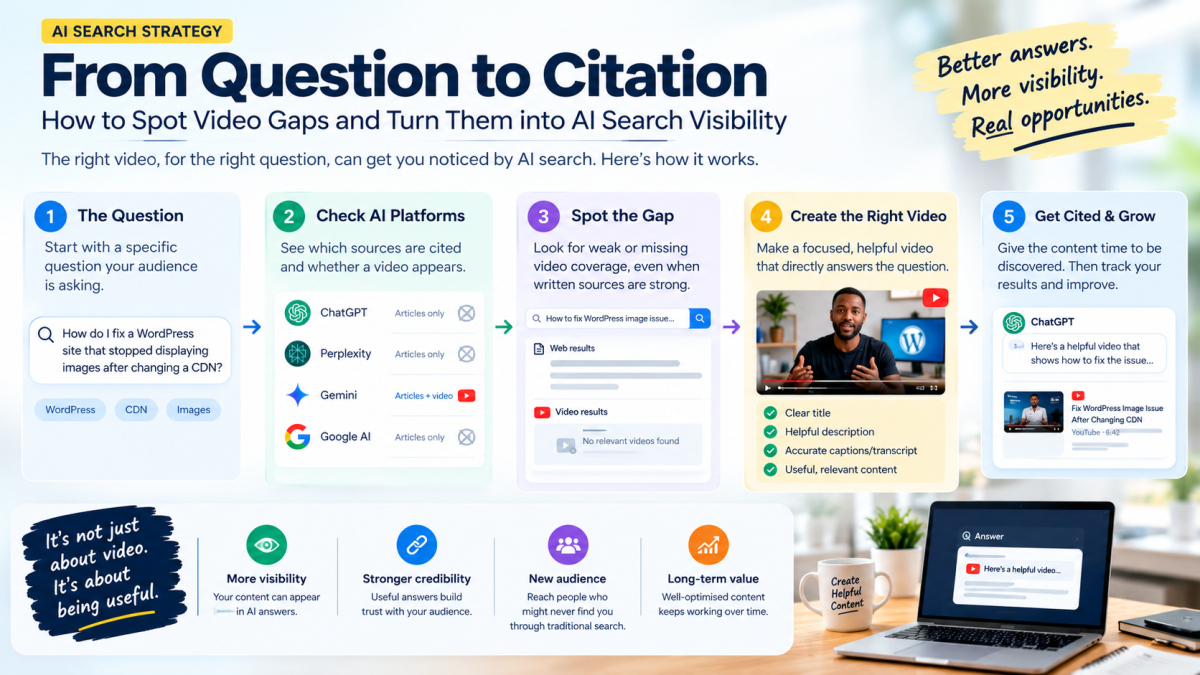
How to Fill a Video Citation Gap
Once you identify a promising gap, do not simply create another generic video about the broader topic.
Create the video around the actual question you found.
- Write down the exact query.
- Check the query across relevant AI platforms.
- Study the existing sources and videos.
- Identify what is missing.
- Create a direct, useful answer.
- Use a clear title, description and captions.
- Publish and give the content time to be discovered.
- Test the same questions again later.
The missing element might be an explanation, demonstration, current information or simply a clearer answer to the exact question.
You are not trying to manipulate an AI system.
You are creating a better source for a question people are already asking.
A Citation Is Not an Endorsement
This distinction is particularly important for publishers.
If ChatGPT or Perplexity cites your video, that does not mean the platform has verified every claim in it.
OpenAI explicitly warns that search results and citations can sometimes be incomplete, outdated or incorrect. Users are advised to check important information against the underlying sources. OpenAI’s current ChatGPT Search guidance explains this.
For creators, an AI citation should therefore be viewed as a visibility signal, not an official endorsement.
An AI citation can increase your content’s visibility, but the citation itself does not prove that every claim in the content is correct.
This matters even more when covering finance, health, law, technology specifications or other subjects where outdated information can cause real problems.
Do Not Abandon Written Content
Video should not replace your written content strategy.
In many cases, the stronger approach is to create both.
A detailed article can provide context, evidence and supporting information, while a video can demonstrate the process or explain the same subject visually.
The two formats can also support each other.
For example, a FaithfulBiz article can explain the complete process while a related video demonstrates it on screen. The article can then link naturally to the video, and the video can point viewers back to the more detailed written explanation.
There is also a technical consideration for websites targeting ChatGPT Search. OpenAI says publishers should not block OAI-SearchBot if they want their content to be eligible for discovery, summaries and citations in ChatGPT. Allowing the crawler does not guarantee that a page will be cited, but blocking it can prevent normal discovery through that route. See OpenAI’s publisher guidance.
How to Track Your Results
If AI visibility matters to your content strategy, keep a simple record of your important questions.
For each query, note:
- the exact question
- the date tested
- the AI platform
- the sources cited
- whether YouTube appeared
- which video was cited
- whether your own video appeared
- whether your brand was mentioned without a citation
Repeat the tests periodically.
Do not worry about proving that your video will always be cited. AI search results change, and a citation today may not appear in the same answer later.
The more useful goal is to discover whether your content is becoming a recurring source for the questions that matter to your audience.
What This Means for Creators and Publishers
The opportunity here is not simply to make more videos.
It is to make the right video for the right question.
AI search is becoming another place where the relevance, clarity and usefulness of your content can affect whether it becomes part of an answer.
Sometimes the missing content will be an article. Sometimes it will be a video. In other cases, the best answer may be original research, a comparison, a calculator, documentation or a first-hand case study.
That is why the strongest AI search strategy starts with the information gap rather than the format.
Find what people are asking. See what AI systems are currently using to answer them. Look for recurring weaknesses or missing formats. Then create something genuinely useful to fill that space.
For video creators, that turns AI search from another vague SEO buzzword into something you can actually investigate, test and improve.
The real opportunity is not to make AI cite you at all costs. It is to become one of the useful sources available when someone asks a question your content can answer well.



















The focus on identifying video content gaps specifically for AI search—and optimizing those videos to earn citations—offers a practical angle beyond traditional keyword research.