

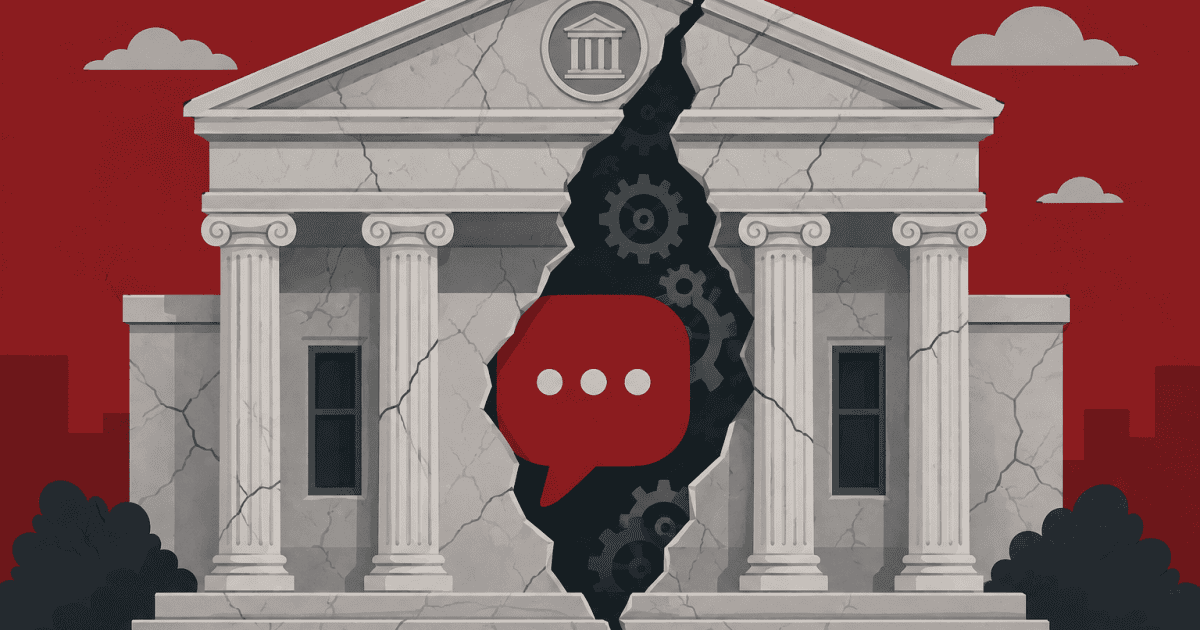
Someone built a fake think tank. They gave it a name, a website, a street address in Israel, and a list of famous experts. Then they used ChatGPT to make it look real online.
It almost worked. Then OpenAI caught it.
Key Takeaway
OpenAI banned a cluster of Russia-linked ChatGPT accounts on August 25, 2026. They had built a fake “expert” website called the International Burke Institute, stocked it with plagiarized academic articles, and used ChatGPT to push it across social media while hiding their Russian origins. Most of the institute’s own content was not even AI-generated. The plagiarism was old-fashioned copy and paste.
What Actually Happened
OpenAI published the details itself. A cluster of ChatGPT accounts, very likely run from Russia, had been generating social media posts in English. The operators typed their prompts in Russian. They told ChatGPT to strip out anything that might reveal that.
OpenAI does not allow access to its models from Russia. So the operators used VPNs to get around that. Simple workaround. It worked, at least until the posts themselves gave the game away.
Most of what ChatGPT generated pointed back to one thing: a website for something calling itself the International Burke Institute, or IBI. Registered in February 2025. Based, it claimed, in Israel. Home to “world-class experts,” including names like Francis Fukuyama and Noam Chomsky.
The Think Tank Was Barely a Think Tank
Here is where it gets almost embarrassing. OpenAI reviewed 36 articles on the IBI site attributed to its supposed experts. Thirty-four were copied from somewhere else. Not paraphrased. Copied.
One article on a China-Pakistan trade corridor was lifted from Cambridge University Press and credited to the wrong professor entirely.
Another, on migration policy, was pulled from the Migration Policy Institute and attributed to a real academic named Kate Howell, who does exist. She is a food science professor in Australia. She has never written about migration policy in her life.
None of that plagiarized content came from an AI model, OpenAI was clear about that. Humans did the copying. ChatGPT’s job was narrower: write the social posts that pointed people toward it.
One Word Gave Away the Whole Operation
The IBI also ran something it called a “sovereignty index,” a made-up rating system that scored countries and consistently made Russia look good while trashing the US, France, Germany, and the EU.
An article about Germany described its coalition government using a phrase no native German or English speaker would ever choose.
OpenAI traced it back to a Slavic word for traffic light, machine-translated into nonsense English. Small detail. It is also exactly the kind of small detail that unravels an entire operation.
Did It Actually Work?
Barely. OpenAI rated the operation’s reach at the low end of Category Three on the Brookings Breakout Scale, a real framework researchers use to measure how far influence campaigns spread. Most of the posts got very few views. The official IBI accounts had small followings.
A cluster of related Telegram channels did better, somewhere between 10,000 and 20,000 followers each. Still small next to what a real news outlet reaches in a day.
OpenAI made an interesting point about why this one mattered anyway. It was not the audience. It was the infrastructure. A fake institute, fake credibility, real academic work stolen to dress it up, and a rating system built purely to make a talking point look like data. That is a template. Templates get reused.
Why This Is Worth Knowing, Even If You Never Touch a Think Tank Website
Most people who use ChatGPT are not building fake research institutes. They are writing emails, generating images, editing a video script. This story is not really about them.
It is a reminder of something simpler: content that sounds confident and cites real names is not automatically true.
That fake migration policy article had a named author, a professional-sounding bio, a publish date. All of it was fabricated. If you have ever wondered how to tell what ChatGPT is actually pulling from when it answers a question, this is the same basic problem from the other direction.
Confident presentation and real accuracy are two different things, and AI tools make the first one cheap to produce at scale.
The part worth sitting with is the ending. ChatGPT did not stop this operation on its own. Investigating unusual AI-generated posts is what led OpenAI to the rest of it. The same tool that helped build the operation is also what exposed it.




















Join the discussion Tap to open the comment form +