

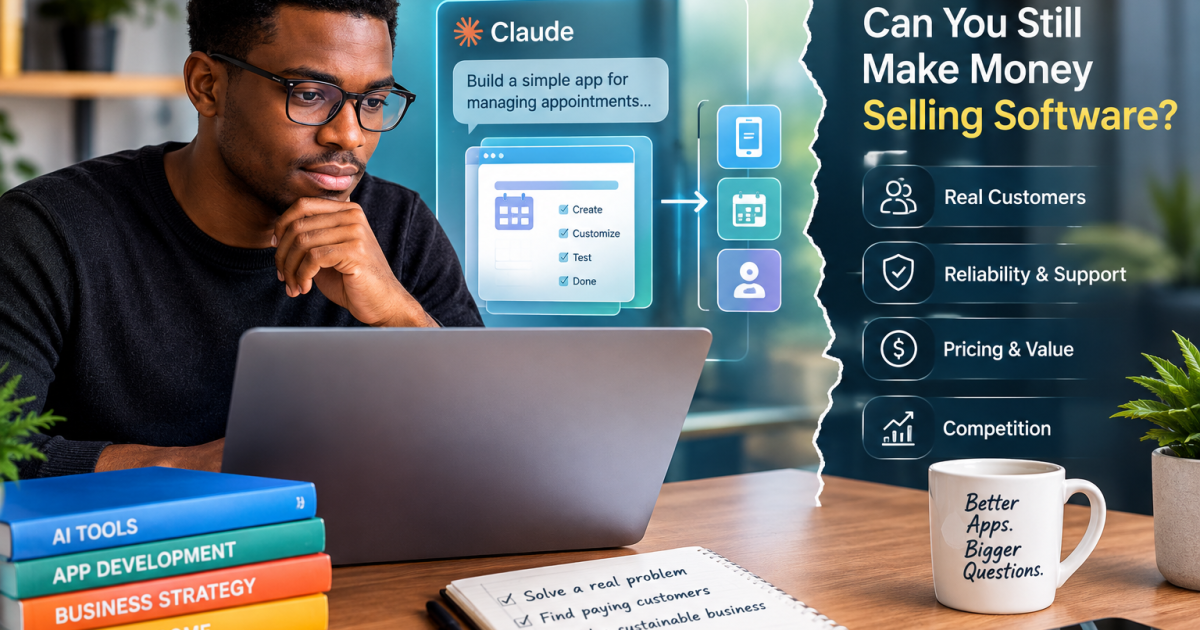
I have used Claude to build three working apps on its free plan. The experience changed how I think about software development, particularly what it now takes to turn an idea into something people can use.
A personal finance tracker. A salon booking system. A habit tracker.
These were not just ideas sitting in a notebook. I gave Claude instructions, reviewed what it produced and tested the resulting applications. You can read the details in my experiment, How I Used Claude AI to Build 3 Apps in One Hour on the Free Plan.
That experience made one thing clear to me: you no longer need to approach every software idea as a project that automatically requires a large development budget.
But it also raises a more difficult question.
If I can build an app with AI, what stops hundreds of other people from building something similar? And if customers can find increasingly capable alternatives, why would they pay me for mine?
That is the business question behind a discussion I came across on Reddit. The original poster argued that AI could have the opposite effect from the opportunity many aspiring entrepreneurs expect: instead of making niche apps easier to sell, it could make existing niche software easier to replace.
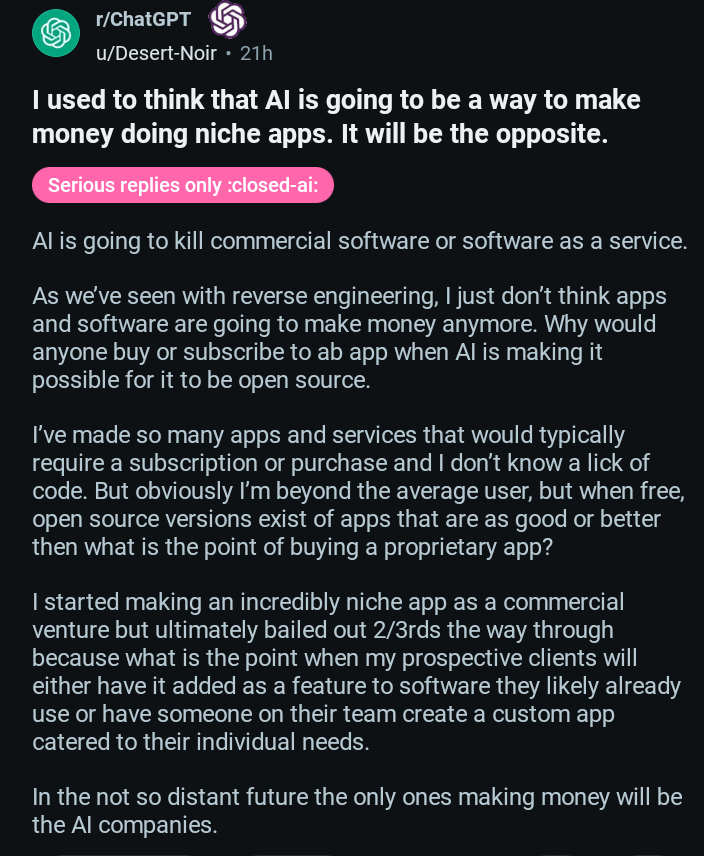
The discussion included a particularly interesting example. One commenter described replacing a publishing tool that cost $200 per month with a custom alternative built over a weekend.
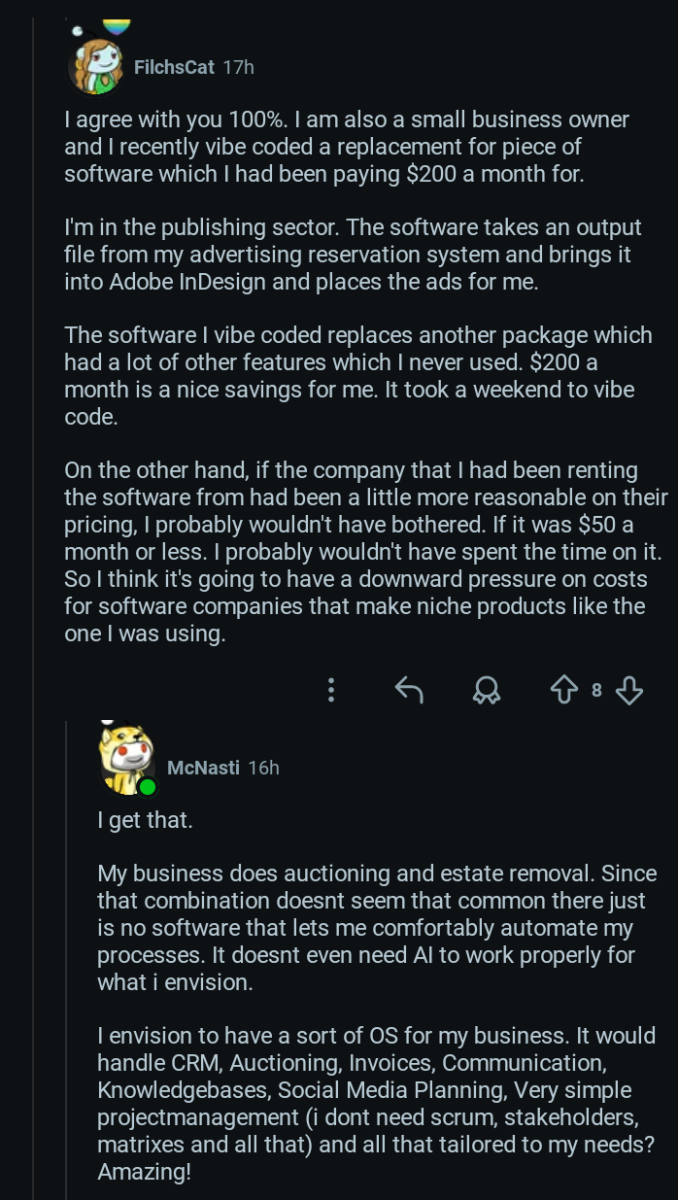
It is an anecdote, not proof that software subscriptions are about to disappear. But it illustrates a possibility worth examining.
AI may make building software easier without making the software business itself easier.
For anyone hoping to make money with AI apps, understanding that difference could be more important than learning another development tool.
1. The Problem Is No Longer Just Building the App
For years, turning a software idea into a working product could involve hiring developers, learning to code or spending months working through technical problems.
AI-assisted development changes that starting point.
A person can describe an application, generate an initial implementation, request changes and test a working prototype without writing every line of code manually.
My own experiments with Claude showed me how quickly this process can move. But there is an important distinction between producing a working application and building a dependable product that customers will pay to use.
An application can look impressive and still have bugs. It can demonstrate its main feature without handling unusual situations. It can work during a demonstration but fail when real users enter unexpected data.
There are also questions about security, data storage, backups, maintenance and deployment.
AI can help with these tasks, too, but it does not remove the need to verify that the finished product works as intended.
The more interesting change is what happens when more people can get past the initial development barrier.
Imagine a market where hundreds of entrepreneurs can create a basic invoice generator, appointment-booking application or social media content tool.
The ability to build one becomes less distinctive.
Customers still need a reason to choose a particular product, and the person selling it still needs a way to reach those customers.
That is where the business challenge begins.
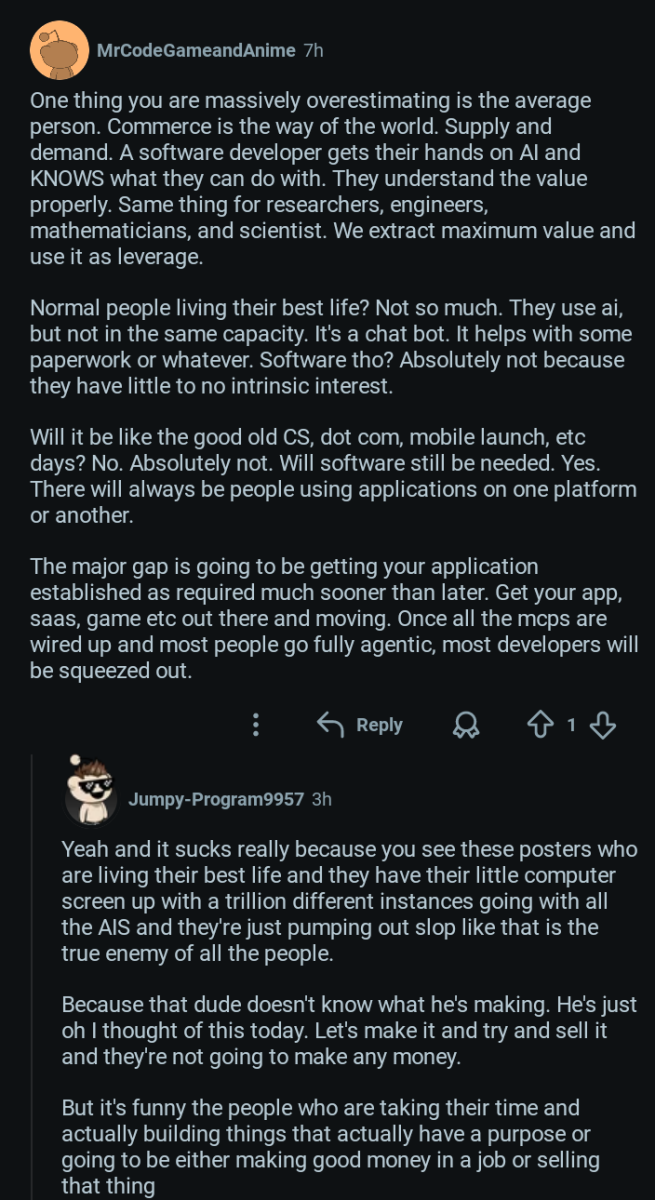
And because of that I like what this commenter said here:
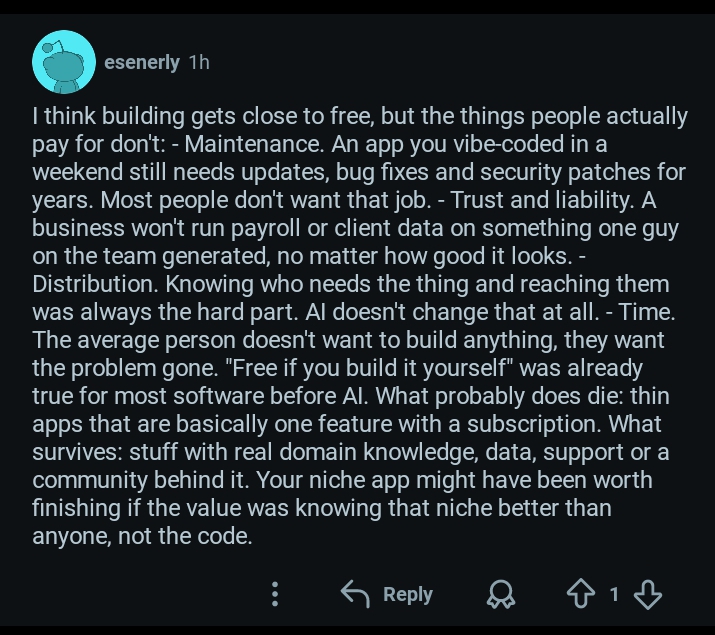
2. Why Would Anyone Pay for Software They Could Build Themselves?
The Reddit discussion raises a reasonable question: if a business can use AI to build a tool tailored to its needs, why continue paying for a general-purpose subscription?
Consider a small publishing business paying $200 every month for software.
That works out to $2,400 over 12 months, assuming the subscription continues at the same price.
If the business can replace the essential functionality with a custom tool, the potential savings are substantial.
But the subscription price alone does not tell us whether building a replacement is the better decision.
The business must also consider the time spent building it, the reliability of the result, future maintenance and the consequences if something stops working.
A tool that works for one person and one workflow may be relatively straightforward to reproduce. A platform serving thousands of customers, managing complex permissions and integrating with multiple systems is a different proposition.
This is why I would not interpret the Reddit example as evidence that commercial software is becoming worthless.
Instead, it highlights a more specific possibility: some customers may decide that the benefits of a customised alternative outweigh the cost of an existing product.
The opportunity depends on what the original software does, how much of its functionality the customer actually needs and how difficult the replacement is to maintain.
And there was what a commenter said here on this one:
What the $200 example does and does not prove
The commenter described replacing an expensive publishing tool with a custom solution.
That tells us something about one person’s experience and perceived value. It does not establish that the replacement offers every feature of the original product, that other customers could reproduce the result or that the approach would work across the publishing industry.
We should also consider an important detail: the commenter suggested that a sufficiently lower subscription price might have changed the decision.
That observation points to an additional possibility.
Some software businesses may face pressure not because their products have no value, but because customers begin questioning whether that value justifies the price.
For a small software company, this could make pricing, customer relationships and the ability to demonstrate a clear return on investment increasingly important.
3. AI Could Make Competition Tougher for Generic Apps
Not every software product faces the same level of risk.
A simple tool that performs one easily described task may be more vulnerable to competition than a complex product embedded in a customer’s daily operations.
Consider three broad categories.
Simple, single-purpose applications
These include basic calculators, straightforward text generators and small utilities.
If an AI tool can produce a reasonably good alternative in minutes, a developer may struggle to justify charging a premium for an undifferentiated product.
That does not mean every simple application will fail. A tool can still succeed if it is convenient, trustworthy, well designed or distributed to the right audience.
But building the same feature as everyone else is unlikely to be a strong long-term strategy on its own.
Specialist workflow tools
These applications solve problems for particular professions or industries.
Imagine a tool designed for a small salon, a property manager, a specialist retailer or a local service business.
A generic application might offer similar basic features, but a specialist product could understand the customer’s actual workflow, terminology, reporting needs and operating constraints.
AI makes it easier to create the initial software. It does not automatically give every competitor the same understanding of the customer.
That knowledge can become part of the product’s value.
Complex, business-critical software
Accounting systems, logistics platforms and enterprise applications can involve sensitive data, integrations, permissions, regulatory requirements and substantial operational dependencies.
Reproducing one visible feature is not the same as replacing the entire system.
Businesses may also be reluctant to switch away from software that reliably supports essential operations.
This is one reason established software providers can retain an advantage even as AI-assisted development becomes more accessible.
Stripe’s guide to the SaaS business model explains how software businesses depend on factors beyond the product itself, including customer acquisition, retention, support and recurring revenue.
The lesson is not that established software companies are immune to disruption.
It is that the difficulty of replacing a product depends on more than the difficulty of reproducing its interface or writing its code.
4. The Hidden Cost of Building Your Own Software
Before replacing a subscription or launching an AI-built product, it helps to calculate the full cost of ownership.
A custom application might eliminate a licence fee while introducing other responsibilities.
| Consideration | Existing software subscription | Custom AI-assisted application |
|---|---|---|
| Initial setup | Usually straightforward | May require substantial testing and configuration |
| Customisation | Limited by the available features | Can be tailored to a particular workflow |
| Maintenance | Often handled by the provider | Someone must manage updates and repairs |
| Security | Depends on the provider and configuration | Depends on implementation and ongoing oversight |
| Reliability | Depends on the service and its infrastructure | Depends on the quality of the application and its hosting |
| Ongoing cost | Subscription and usage fees | Hosting, AI usage, maintenance and other operating costs may apply |
| Support | Usually provided under the service’s terms | May require the owner or a hired specialist to resolve problems |
Neither option automatically wins.
Suppose a business pays $200 per month for an existing product. Its annual subscription cost is $2,400.
A custom alternative could make financial sense if it delivers the required functionality and its total cost of building, operating and maintaining it is lower.
However, a quick prototype is not a complete cost estimate.
If the owner spends dozens of hours repairing the application, handling data problems or adding missing features, some of the apparent savings may disappear.
The same applies to an entrepreneur selling software. If customers depend on the product, the developer cannot simply stop paying attention after the first version works.
The relevant question is not whether AI can build the application cheaply. It is whether the application can deliver its promised value at a sustainable cost.
That is a much more useful way to evaluate the opportunity.
5. So, Is There Still Money in Building Niche Apps?
Yes, there can be. But I would be cautious about treating AI-assisted development as a business model by itself.
Lower development costs may make it possible to serve smaller markets that previously could not justify the cost of custom software.
Imagine a business process that is too specialised for a large software company to prioritise. A smaller entrepreneur who understands that industry might be able to build a useful solution with a much smaller initial budget.
The potential opportunity is not simply to create a cheaper copy of an existing application.
It is to identify a group of customers whose needs are not being met adequately.
That might involve a specialised workflow, a missing integration, a confusing administrative process or a recurring task that consumes too much time.
AI can help develop the solution. It can also help with research, prototyping, documentation and testing.
But the entrepreneur still needs to establish whether the problem matters enough for customers to pay for a solution.
The three questions I would ask before building
1. Who has this problem?
“Small businesses” is usually too broad a starting point.
A more useful description identifies a particular type of business, the person experiencing the problem and the circumstances in which it occurs.
For example, instead of targeting every business that needs appointments, investigate the booking and reminder problems experienced by a specific category of service provider.
The more clearly you understand the customer, the easier it becomes to evaluate whether your proposed solution is relevant.
2. How are customers solving the problem today?
Look at existing software, spreadsheets, manual processes and services.
If customers already have a solution, determine what frustrates them about it. Perhaps it costs too much, requires unnecessary steps or does not support an important part of their workflow.
Do not assume that an existing product is inadequate simply because you can build an alternative.
You need evidence that the alternative would offer a meaningful improvement.
3. Why would customers pay for your solution?
The answer should go beyond “because I built it with AI.”
Customers might pay because the product saves time, reduces errors, simplifies a complicated task or provides functionality they cannot easily obtain elsewhere.
The benefit needs to matter to the buyer.
If you cannot explain why a customer would choose your product over an existing alternative, building more features may not solve the underlying problem.
6. You May Not Need to Sell an App at All
This is the opportunity I find particularly interesting.
When people discuss AI business ideas, they often jump straight to creating a product and charging customers a monthly subscription.
But software is only one way to deliver value.
An entrepreneur could use AI to provide a service, automate an existing business process or create a customised solution for a client.
Consider someone who understands the daily operations of small retail businesses.
They could spend months building a generic inventory application and then compete with existing products for subscribers.
Alternatively, they could work with a few businesses to identify specific administrative problems, create tailored workflows and charge for implementation and ongoing support.
The second approach may be more suitable for someone who already has access to potential customers but has not yet established demand for a standalone product.
It also provides a way to learn from real users before investing in a larger application.
Other possibilities include:
- Helping businesses automate repetitive administrative work.
- Building internal tools for a particular industry.
- Connecting existing software through automation.
- Creating specialised reporting and data-processing workflows.
- Offering AI-assisted services with a clearly defined business outcome.
None of these models guarantees income. Each still requires customer acquisition, delivery, pricing and ongoing work.
The advantage is that you do not have to convince customers to adopt an entirely new software product before you can demonstrate value.
You can begin with the problem and choose the delivery method that makes the most sense.
For a deeper look at the skills involved, see our guide to the AI skills businesses will need beyond prompting.
7. How to Test an AI App Idea Before Spending Weeks Building It
One mistake I would avoid is treating a successful prototype as evidence of market demand.
A working application proves that a particular implementation is possible. It does not prove that customers want it, will pay for it or will continue using it.
Here is a more disciplined approach.
Step 1: Describe the problem in one sentence
Identify the customer, the problem and the consequence.
For example:
“Independent salon owners spend too much time managing appointment changes and reminding customers about bookings.”
This is a starting hypothesis, not a claim that every salon has this problem.
Step 2: Speak to potential customers
Ask how they currently handle the task.
Find out what takes the most time, what causes mistakes and what they have already tried.
Avoid leading questions such as, “Would you use my AI app?”
People may express enthusiasm for an idea without having any intention of paying for it.
Questions about existing behaviour are generally more informative.
Step 3: Investigate the alternatives
Identify products and manual processes that already address the problem.
Compare their capabilities, costs and limitations.
You may discover that the market is already well served. Alternatively, you might identify a specific gap that existing products handle poorly.
Either outcome is useful before you commit to development.
Step 4: Test the proposed solution with the smallest useful demonstration
Build only what you need to test the central idea.
That might be a clickable prototype, a simple working tool or a manually delivered service supported by AI.
The purpose is to determine whether the proposed solution addresses a genuine need, not to produce a feature-rich application immediately.
Step 5: Look for evidence of willingness to pay
Ask potential customers what the problem currently costs them and what a useful solution would need to deliver.
Where appropriate, test a real offer, request a paid pilot or seek a commitment to a clearly defined trial.
Positive comments are weaker evidence than actual purchasing behaviour.
Step 6: Calculate the ongoing cost
Estimate hosting, AI usage, payment processing, support, maintenance and customer acquisition.
For a subscription business, also consider how many customers you need to cover these costs and how much effort it takes to retain them.
A product can attract users and still fail to become a sustainable business.
Step 7: Build only after the evidence justifies it
If customers show a meaningful need and your proposed solution offers a credible advantage, development becomes a more informed investment.
If the evidence is weak, refine the idea or investigate another problem.
The objective is not to avoid building things. It is to avoid spending weeks building something that nobody has a compelling reason to buy.
8. What This Means for Entrepreneurs in Nigeria
For Nigerian entrepreneurs, AI-assisted development could make certain forms of custom software more accessible.
A freelancer may be able to prototype an internal tool without immediately hiring a developer. A small business might explore replacing an expensive subscription with a simpler application tailored to its operations.
An entrepreneur could also build solutions around local business processes that are poorly served by generic products.
But the same commercial questions apply.
Does the tool work reliably? Who will maintain it? How will users access it? Does it handle customer data appropriately? What happens when something breaks?
There may also be practical considerations involving payment systems, internet access, hosting costs and integration with the services a business already uses.
A solution that looks inexpensive during development may become costly if it requires frequent repairs or depends on infrastructure the business cannot reliably maintain.
This is why I would evaluate custom software as a business decision, not simply a technology experiment.
The best opportunity might be building an application, providing a service or combining both.
The right choice depends on the customer, the problem and the economics of delivering the solution.
Key Takeaways
- AI can reduce some software development barriers, but it does not automatically create paying customers.
- Simple, easily replicated apps may face more competition when similar alternatives become cheaper to produce.
- Custom software can save money, but maintenance, security, hosting and reliability still matter.
- Niche software businesses may find opportunities by serving customers whose specific needs are poorly addressed by existing products.
- Selling an AI-powered service or customised solution may be more practical than launching a standalone app.
- Validate demand and investigate willingness to pay before investing heavily in development.
The next time you have an idea for an AI app, do not begin with the prompt.
Begin with the customer.
9. My Take: AI Changes the Starting Point, Not the Rules of Business
After using Claude to build working applications, I am convinced that AI-assisted development deserves serious attention.
It can help people move from an idea to a prototype far more quickly than traditional approaches might allow.
That creates opportunities for people who previously lacked the technical skills or resources to experiment with software.
But I would not tell anyone that building an app with AI is a reliable shortcut to making money.
The Reddit discussion is useful precisely because it highlights the other side of the opportunity.
If a business can replace an expensive subscription with a custom tool, the software provider may lose a customer. If many entrepreneurs can build similar applications, each one may face more competition. And if customers can obtain the same result through a cheaper alternative, a product’s price and perceived value may come under pressure.
At the same time, lower development costs could make specialised products and smaller software businesses more viable.
Both outcomes are possible. The result depends on the market and the quality of the business behind the software.
For me, the practical lesson is straightforward.
Do not start by asking which app AI can help you build.
Start by asking which problem you understand well enough to solve, who needs that solution and why they would choose to pay for it.
Then use AI to build the most effective solution you can.
The opportunity is not simply that more people can build software. It is that more people can now test ideas and deliver solutions that would previously have been too expensive or difficult to develop.
That is worth exploring. But the business still has to make sense.
























Conversation (0)