

The first time someone mentioned a “context window” to me, I nodded like I understood it. But I didn’t. I went home, searched for it, found a two-page technical explanation full of terms I didn’t know, and closed the tab.
I kept using AI tools anyway. And for a while, that was fine. But I kept running into the same wall: conversations that started well and then fell apart. Outputs that were good for simple tasks but completely wrong for anything complex. Moments where the AI confidently gave me information that turned out to be entirely made up.
The problem wasn’t the tools. It was that I didn’t understand what was actually happening underneath them. Once I did, everything changed. Not in a theoretical way. In a practical, daily-use way that made my outputs sharper and my time spent prompting much shorter.
These are the AI concepts you must understand — explained the way I wish someone had explained them to me. No engineering background required.
Why This Knowledge Actually Matters
Most people approach AI tools the way most people approach a car. They know how to drive it. They have no idea how the engine works. And that is fine, until something goes wrong and they have no idea what to do about it.
With AI, “something going wrong” looks like: getting a confident answer that is completely incorrect. Running out of useful context midway through a complex task. Getting creative, unpredictable output when you needed something precise. Or getting a robotic, flat response when you needed something with energy and personality.
Each of those problems has a specific explanation. And once you understand the explanation, you can fix it — or avoid it entirely. That is the difference between someone who uses AI and someone who uses AI well. If you’ve ever wondered why certain people seem to get dramatically better results from the same tools everyone else has access to, this is usually why. Understanding what’s underneath changes how you interact with what’s on the surface.
Tokens: How AI Actually Reads What You Write
When you type something into an AI tool, it does not read your words the way you do. It breaks your input down into smaller units called tokens. A token is roughly three to four characters long on average, which means a single word might be one token, or it might be two or three, depending on its length and complexity. Punctuation and spaces are tokens too.
Why does this matter in practice? Because AI models have a limit on how many tokens they can handle at once. That limit covers both your input and the model’s response. When you’re working on a long document or a complex task, you’re eating into that limit with every word you write.
This is why AI sometimes seems to “forget” things you mentioned earlier in a long conversation. It hasn’t forgotten, exactly. It’s that your earlier messages fell outside the boundary of what it can currently hold in focus. Understanding tokens helps you work around this by being more deliberate about what you include in each prompt and when to start a fresh conversation rather than continuing one that has grown too long.
It also explains why concise, specific prompts tend to get better results than vague, wordy ones. Less noise means more of your token budget goes toward the actual task.
The Context Window: AI’s Short-Term Memory
The context window is directly connected to tokens, and it is probably the single most important concept for anyone doing serious work with AI tools.
Think of it this way. Imagine you’re working with a very capable assistant who can only remember the last few pages of the document you’ve been working on together. Everything before those pages is gone from their immediate awareness. They can still do excellent work on the pages they can see — but if you reference something from earlier without reminding them of it, you’ll get a confused or inaccurate response.
That is the context window. It’s the total amount of information the AI can “hold in mind” at any given moment. Different models have different context window sizes. Some can handle a few pages of text. Others can process entire books. But all of them have a limit, and running into that limit without knowing it exists is a common source of confusing, off-track AI behaviour.
When you understand this, you start doing things differently. You summarise earlier parts of a conversation before continuing. You paste in the specific section of a document that’s relevant to the task, rather than the whole document. And also You break a big project into smaller chunks that each fit comfortably within the window. These aren’t workarounds. They’re just how you use the tool properly once you know how it actually works.
Temperature: Why the Same Prompt Can Get Different Responses
This one surprised me when I first learned about it, because it explained something I had been experiencing without understanding.
Temperature is a setting that controls how predictable or unpredictable an AI’s responses are. At low temperature, the model plays it safe. It picks the most probable next word at each step, which produces responses that are consistent, precise, and sometimes a little flat. At high temperature, the model takes more risks. It considers less probable options, which produces responses that are more varied, more creative, and occasionally more wrong.
Most consumer AI tools don’t let you set the temperature directly. But many do — and even in tools where you can’t set it explicitly, understanding the concept changes how you write your prompts.
If you need a factual summary, a professional email, or a precise analysis, you want behaviour that leans toward low temperature. You signal this by being specific and formal in your prompt. If you need ideas, creative variations, or something with energy and personality, you want something closer to high temperature. You signal this by giving the AI more freedom in your instructions, asking for multiple options, or explicitly requesting something creative or unexpected.
Understanding temperature is why some people can reliably get both sharp analytical writing and genuinely creative output from the same tool. They’re not hoping for the right response. They’re setting up the conditions for it.
AI Hallucination: When Confidence and Accuracy Part Ways
This is the concept most people hear about and least understand in terms of why it actually happens.
AI hallucination is when an AI model generates information that sounds completely plausible and confident but is factually incorrect or entirely made up. It might cite a research paper that doesn’t exist. It might give you a statistic that sounds reasonable but has no basis in reality. And It might describe a person’s career accurately for three paragraphs and then quietly invent a job they never had.
The reason this happens comes from how these models are built. They are trained to predict what the next most likely word, phrase, or sentence should be, based on patterns in enormous amounts of text. They are very good at generating text that sounds like what an accurate answer would sound like. But “sounds like an accurate answer” and “is an accurate answer” are not the same thing. When a model doesn’t have reliable information about something, it doesn’t say “I don’t know.” It generates what the answer probably looks like. And that generated answer can be confidently wrong.
The practical response to this is not to distrust AI output entirely. It’s to verify anything important before you act on it. Use AI to draft, research, brainstorm, and structure. Use your own judgment — and where necessary, primary sources — to confirm. This is especially true for statistics, dates, quotes, research citations, and any claim that would be embarrassing or costly if it turned out to be wrong.
Smart AI users don’t treat the model as an authority. They treat it as a highly capable first draft that needs a human eye before it goes anywhere important. That one shift in mindset will save you from the most serious mistakes people make when working with these tools. For a deeper look at the patterns that trip people up, this breakdown of why most people fail with AI is worth reading alongside this.
Prompt Engineering: The Skill That Changes Your Results Immediately
Prompt engineering has become a term that gets thrown around a lot, but the core idea is simple enough to apply today without any special training.
How you ask a question determines the quality of the answer you get. This is true in human conversation and it is true with AI, except that with AI the connection between input quality and output quality is more direct and more consistent than it is with people.
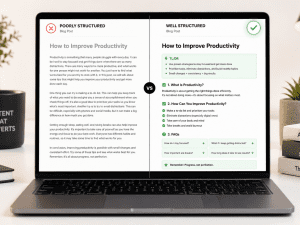
A vague prompt produces a vague response. A specific prompt produces a specific response. But it goes further than that. The structure of your prompt, the context you provide, the format you request, the examples you include — all of it shapes what comes back to you.
Compare these two approaches to the same task:
Version one:
“Write something about saving money.”
Version two:
“Write a 400-word blog introduction for Nigerian young professionals aged 22 to 30 who are earning their first stable salary and want to start saving but don’t know where to begin. Use a conversational tone, open with a relatable scenario, and end with one clear action they can take today.”
The second prompt takes about 30 extra seconds to write. The quality difference in what you get back is not marginal. It’s significant enough that the two responses would barely look like they came from the same tool.
Learning to write better prompts is one of the fastest returns on time investment available to any AI user right now. It doesn’t require a course or a certification. It requires paying attention to what your prompt is actually communicating and asking yourself whether the AI has everything it needs to give you what you want. For a broader look at where this skill fits in the current AI landscape, this piece on prompt and context engineering gives useful perspective.
AI Agents: Where Things Are Heading
Most people currently use AI in a back-and-forth way. You write something. The AI responds. You write something else. The AI responds again. Each step requires your input.
AI agents are different. An agent is an AI system that can take a goal and pursue it across multiple steps, making decisions and taking actions along the way, without needing you to manage each step manually.
In practical terms, this means an agent can be given a task like “research the top five competitors in this market and summarise their pricing and key messaging” and it will do the searching, reading, comparing, and summarising on its own. You come back to a finished output rather than managing a conversation that produces one.
This is still developing, and the current versions of AI agents work better for some tasks than others. But the direction is clear, and the people who understand what agents are and how they work will be far better positioned to use them effectively as they become more capable and more accessible. If you want to understand what is already possible, this explanation of how AI agents actually work is a useful starting point.
How These Concepts Connect to Real Opportunity
Understanding these concepts is not just intellectually satisfying. It is practically useful in ways that show up in the quality and speed of your work.
When you understand tokens and context windows, you stop having confused conversations with AI that go off-track after twenty minutes. You structure your work to stay within what the model can handle effectively.
When you understand temperature, you stop getting frustrated when creative prompts produce flat responses or precise prompts produce wandering ones. You adjust your approach to match what you need.
When you understand hallucination, you stop either trusting everything or dismissing everything. You use AI for what it does well and apply your own verification where accuracy genuinely matters.
When you understand prompt engineering, you start getting better outputs from the tools you’re already using, today, without upgrading anything or learning a new platform.
And when you understand agents, you start thinking about how your workflows can eventually become less dependent on your moment-to-moment attention — which is where the real productivity gains start to compound.
The people getting consistent results with AI are not necessarily using better tools. They understand what their tools are actually doing. That understanding is available to anyone willing to spend time with it, and the gap between people who have it and people who don’t is widening every month.
If you want to take these concepts and turn them into practical skills and income, this guide on using AI to upskill and start earning is the most direct next step. And if you want to understand which tools are worth building these skills around, this breakdown of AI tools that actually save time gives you a grounded starting point without the noise.
You’ve done the harder part already. Most people skim articles like this and move on. If you read this far and understood it, you are already operating with more context than the majority of people using these tools every day. The only thing left is to use it.




















Join the discussion Tap to open the comment form +