
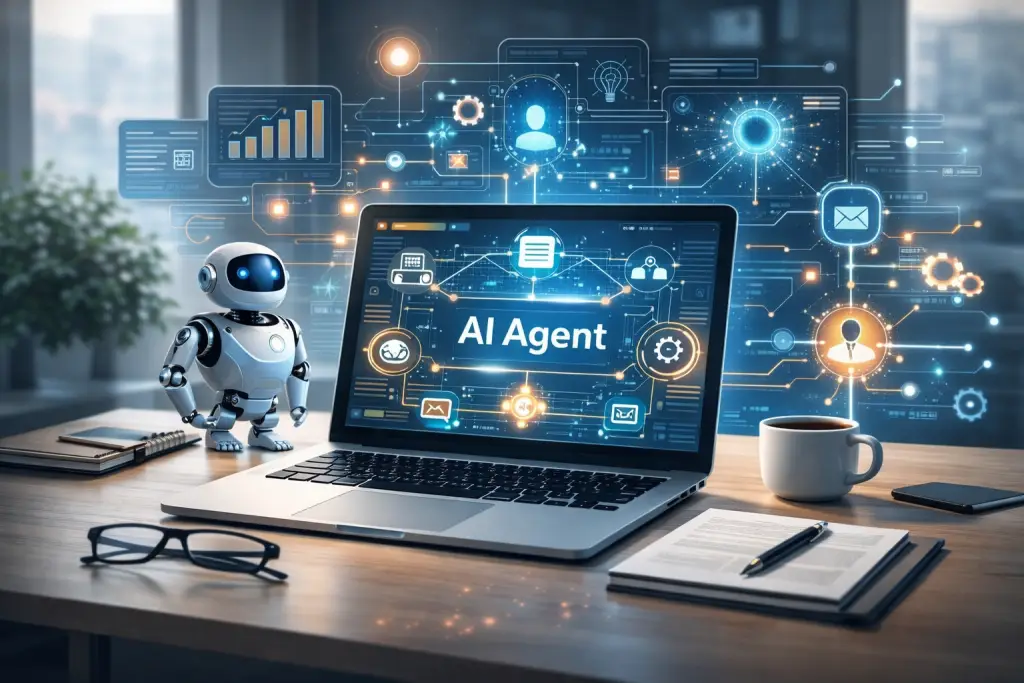
If you’ve been following developments in artificial intelligence, you’ve probably started hearing the term AI agents more frequently.
Not just chatbots. Not just tools.
Agents.
At first, it sounds like another trendy term.
But it isn’t.
AI agents represent a fundamental shift in how artificial intelligence is being used. Instead of systems that simply respond to instructions, we are now moving toward systems that can decide, act, and complete tasks with minimal human input.
Understanding this shift is not optional anymore.
Because this is where the future of digital work is heading.
What Are AI Agents and How Do They Work?
To properly understand what AI agents are, you need to move beyond simple definitions.
An AI agent is a system designed to:
- observe its environment
- process information
- make decisions
- take actions to achieve a goal
This is consistent with how AI systems are defined in modern research, including explanations provided by IBM’s artificial intelligence overview.
The key difference is that AI agents are not passive.
They don’t just wait for instructions.
They operate with intent.
The Core Idea Behind AI Agents
At the center of every AI agent is a simple concept:
Goal-driven behavior.
Instead of asking, “What should I say?” an AI agent asks:
“What should I do next to achieve this goal?”
This shift is what makes AI agents significantly more powerful than traditional AI tools.
It is also why companies are investing heavily in this direction, as seen in ongoing developments across major AI labs like Google DeepMind.
AI Tools vs AI Agents: The Difference
Most people today interact with AI through tools.
For example:
- writing content with AI
- generating images
- asking questions
These systems are reactive.
They wait for input.
They respond once.
And then they stop.
AI agents are different.
They are proactive.
They can:
- handle multi-step tasks
- interact with multiple tools
- adjust actions based on results
This shift is already visible in real-world use cases, which connects directly with how people are applying AI practically today in real-world AI usage examples.
In simple terms:
Tools assist. Agents execute.
How AI Agents Works (Step-by-Step System)
Let’s understand how AI agents works, it helps to break the process into components.
1. Perception (Understanding Input)
An AI agent first gathers information.
This may come from:
- user prompts
- databases
- external APIs
- system events
This stage is similar to how humans observe their environment.
2. Reasoning (Processing Information)
The system then processes the input using machine learning models.
These models analyze:
- context
- intent
- constraints
This stage is where intelligence is applied.
3. Planning (Deciding What to Do)
Unlike simple AI systems, agents do not produce a single output.
They plan actions.
They determine:
- what steps are needed
- in what order
- using which tools
This is what makes them powerful.
4. Action (Executing Tasks)
The agent then performs the task.
Examples include:
- sending emails
- generating reports
- updating systems
- triggering workflows
This ability to act is what separates agents from basic AI tools.
5. Feedback (Learning and Adjusting)
Many AI agents include feedback loops.
This allows them to:
- improve performance
- correct mistakes
- adapt to new situations
This aligns with ongoing research in adaptive AI systems, including work highlighted by Stanford Human-Centered AI.
Real-World Applications of AI Agents
AI agents are already being used in multiple industries.
Customer Support Systems
Modern AI agents can:
- handle customer inquiries
- track orders
- process refunds
- escalate complex issues
This reduces the need for human intervention.
Content and Marketing Automation
AI agents can manage entire workflows:
- research topics
- generate content
- optimize SEO
- schedule publishing
This builds on strategies discussed in AI strategy insights.
Business Operations
Organizations are using AI agents to:
- analyze large datasets
- automate repetitive processes
- optimize decision-making
This transformation is already visible in how AI is changing business operations globally, including insights covered in AI and business transformation.
Why AI Agents Matter Right Now
This is not just a technical evolution.
It is a shift in how work is done.
Previously:
- humans perform tasks
- AI assists
Now:
- humans define goals
- AI agents execute tasks
This fundamentally changes productivity.
It also explains why AI is becoming central to future work systems, as reflected in broader trends covered in recent AI developments.
Limitations and Risks of AI Agents
Despite their potential, AI agents are not perfect.
They can:
- make incorrect decisions
- misinterpret instructions
- require supervision
This is why responsible AI usage is important.
Even leading research institutions emphasize human oversight in AI systems.
The Future of AI Agents
AI agents are still evolving.
But the direction is clear.
They will become:
- more autonomous
- more reliable
- more integrated into daily workflows
This evolution is part of a broader shift in artificial intelligence systems.
AI is moving from tools to systems.
From assistance to execution. —
What This Means for You
If you understand AI agents early, you gain a strategic advantage.
Because most people are still focused on basic tools.
But the real transformation is happening at the system level.
Where work becomes automated.
Where tasks become scalable.
And where efficiency increases.
This is why learning practical AI usage is important, as explained in how to use AI to improve your skills.
Before You Leave
Don’t ignore this shift.
AI is no longer just about answering questions.
It is about getting things done.
The people who understand this early will move faster.
Work smarter.
And position themselves better.
I’m telling you straight.
This is not just another trend.
This is how digital work is evolving.
Pay attention to it now.

Prince Theophilus (Mr. Prince) is a Nigerian digital entrepreneur, AI-focused content creator, and founder of FaithfulBiz. He helps individuals turn ideas into income by leveraging modern technology, practical strategies, and real-world digital skills.
Over the years, he has worked across freelance platforms, built multiple online projects, and gained hands-on experience using AI tools such as ChatGPT, Claude, Gemini, Canva, CapCut, and other automation platforms to improve productivity and scale online income.
Through FaithfulBiz, he shares clear, beginner-friendly guides, tested strategies, and honest insights on making money online, using AI tools effectively, and building sustainable digital businesses. His goal is to simplify complex concepts and help everyday people take advantage of opportunities in the digital economy without confusion or overwhelm.