

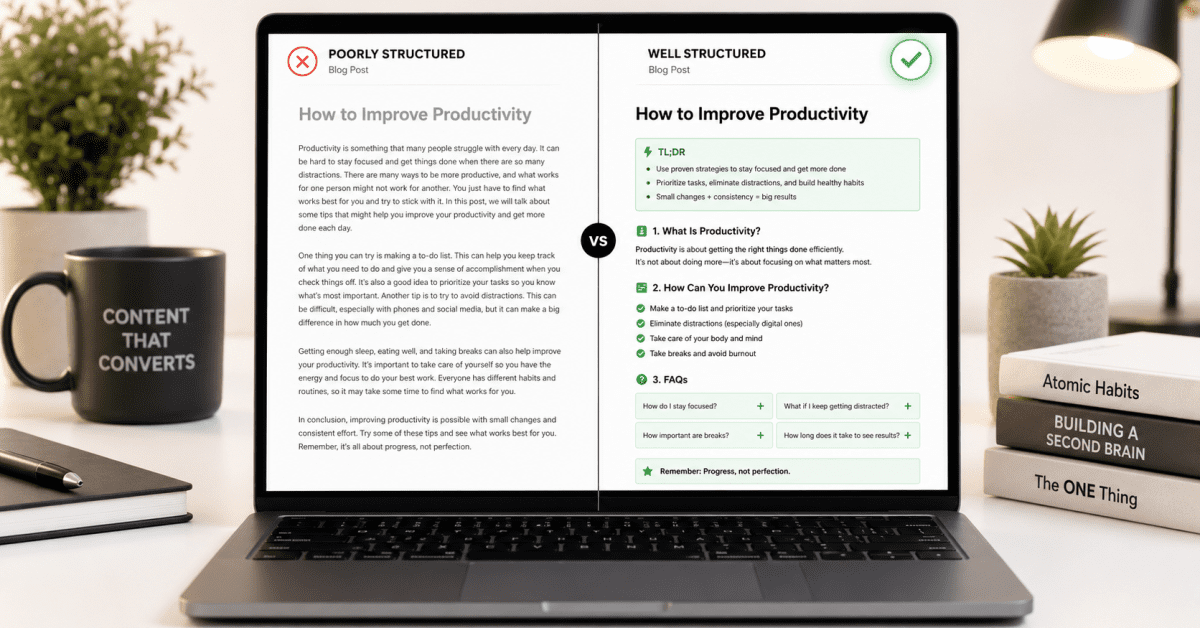
I want to show you something practical before we go any further.
Take any blog post you have published in the last twelve months. Open it right now if you want to follow along. Read the first three paragraphs.
Ask yourself honestly: if an AI tool retrieved this page to answer the question my title promises to answer, could it extract a clear, specific, usable answer from those three paragraphs alone?
For most blog posts — including most of the ones on this blog before we started applying these principles — the honest answer is no.
The first three paragraphs typically set context, tell a story, explain why the topic matters, or introduce the writer. The actual answer is somewhere in the middle.
The AI scans the beginning, does not find a clear extraction point, moves to the next retrieved page, and the post never gets cited despite covering the topic perfectly.
That is not a content quality problem. It is a content structure problem. And structure problems are the most fixable category of problem in blogging — because you do not need to rewrite everything.
You need to reorganise what you already have, add a few specific elements, and in most cases the change takes under an hour per post.
This is the practical guide to optimizing blog content for AI recommendation — not a theory of how AI search works, but the specific steps that move your existing content from invisible to cited, applied in order of impact.
TL;DR: How to Get Your Blog Cited by AI Tools
To ensure AI engines like ChatGPT, Perplexity, and Google Gemini extract and recommend your content, you must optimize its structure for rapid machine retrieval:
- Lead With the Answer: Put a direct, 1-2 sentence solution to your post’s primary question within the first 150 words.
- Add a Summary Block: Place a visual TL;DR at the top to give AI bots a pre-synthesized extraction point.
- Use Question Headings: Rewrite your H2s and H3s as specific questions to target natural language user queries.
- Build an Entity Web: Naturally weave in highly related niche terms, tools, and technical concepts to prove coverage depth.
- • Cite Dated Statistics: Use specific numbers backed by named sources and years to serve as verifiable facts.
- Deploy FAQ Schema: Add an FAQ section at the end using Yoast or JSON-LD blocks to feed structured data directly to search bots.
- Refresh Date Semantics: Keep content current by updating time-sensitive facts every 3-6 months and updating the published date.
The Mindset Shift Before the Tactics
The most useful frame for understanding AI content optimization is this: you are writing for two audiences simultaneously.
The human reader who arrives on your page and reads it start to finish deserves a post that is engaging, narratively satisfying, and worth their time.
The AI tool that retrieves your page and scans it for extractable content deserves a post that surfaces its most useful information immediately, structures it clearly, and backs its claims with verifiable evidence.
These two requirements are not in conflict. In fact, the same structural improvements that make your content more extractable by AI tools also make it more readable and more useful for humans.
Clearer headings help human readers navigate. A direct answer at the top helps impatient readers decide whether to keep reading.
Specific statistics make arguments more persuasive to people, not just to machines. FAQ sections answer the follow-up questions human readers always have.
The bloggers who treat AI optimisation as a separate technical layer on top of their normal writing process are doing unnecessary work.
The ones who integrate these principles into how they write every post from the beginning find that the writing gets better overall — not just more machine-readable.
That integration is what this guide is designed to help you build.
Step 1: Restructure Your Opening for Maximum Extractability
The most impactful single change you can make to any existing blog post is restructuring the opening to lead with the answer rather than the setup.
This does not mean eliminating your introduction or cutting the narrative that draws readers in. It means adding a clear, direct statement of the post’s core answer somewhere within the first 150 to 200 words — before the storytelling, not instead of it.
The practical structure that works consistently is what content professionals call the inverted pyramid approach applied at the post level.
State the most important point first in one or two clear sentences. Then provide the context and background that helps the reader understand why that point matters.
Then deliver the detailed explanation, examples, and evidence that make the post worth reading in full.
What This Looks Like in Practice
Before optimization, a post about why ChatGPT gets slower might open like this: “I remember the first time I noticed it.
I had been using ChatGPT for about an hour on a complex writing project, going back and forth with the same conversation thread, when I realised something had changed.
The responses were taking longer. The interface felt heavier.” That is a good human opening. It is not a good AI extraction point.
After optimization, the same post opens like this: “Yes — ChatGPT does get slower the more you use it in a single conversation thread.
The browser has to render an increasingly large thread with each new message, and the AI model must re-read the full conversation history before generating each reply.
Both problems compound as the thread grows — and both reset immediately when you start a fresh conversation with a summary of the key context.” Then the personal story follows.
The human reading experience is barely changed. The AI now has a clear, specific, directly usable answer in the first 150 words.
That one structural adjustment is the difference between a post that gets retrieved and passed over versus a post that gets retrieved and cited.
Step 2: Add a TL;DR Summary Block
A TL;DR section — Too Long; Didn’t Read — at the top of a longer post gives AI tools a pre-structured, condensed version of the content’s most important points.
This is one of the single highest-impact additions you can make to any post over 800 words, and it takes approximately ten minutes to write once the post exists.
The TL;DR serves a dual purpose. For human readers, it functions as an executive summary — helping them quickly assess whether the post covers what they need before committing to reading in full.
For AI tools, it functions as a concentrated extraction block — a structured, pre-synthesised version of the content that the AI can incorporate directly into a generated answer with minimal processing.
A well-written TL;DR for a post about AI content optimization might read: “To get your blog posts cited by AI tools like ChatGPT and Perplexity:
add a direct answer in your first 150 words, structure headings as specific questions, include verifiable statistics with named sources, add a FAQ section with schema markup,
submit your sitemap to Bing Webmaster Tools, and ensure GPTBot and ClaudeBot are allowed in your robots.txt.” That 60-word summary covers the entire post’s most extractable information in a form that takes an AI tool less than a second to process and use.
Format your TL;DR as a distinct visual block — a bordered callout box, a shaded background section, or a clearly labelled paragraph — so both human readers and AI scanning systems recognise it as a structured summary rather than part of the regular body text.
Step 3: Rewrite Your Headings as Specific Questions and Answers
This is the structural change that creates the most additional AI citation opportunities per unit of effort.
Each well-written heading in your post is a potential extraction point — a section that can be cited for a different but related query than your post’s primary keyword.
A post with eight specific, question-reflective headings has eight potential citation opportunities. A post with four vague headings has, at most, one.
The heading transformation is straightforward. Every heading that currently reads as a category label — “Benefits,” “How It Works,” “Common Mistakes,” “Tips and Tricks” — needs to become a specific answer to an implied question. “Benefits” becomes “What You Actually Gain When AI Tools Start Citing Your Blog.” “How It Works” becomes “How ChatGPT Decides Which Sources to Include in Its Answers.” “Common Mistakes” becomes “Why Most Blog Posts Never Appear in AI Citations Despite Good Rankings.”
The Double Benefit of Question-Based Headings
Question-based headings do not just create AI extraction points.
They also directly target the “People also ask” and voice search query formats that appear throughout Google’s search results — the natural language questions that AI systems use to understand what users actually want beyond the search term they typed.
A heading that reads like a question someone would ask aloud is simultaneously optimised for AI citation, for PAA boxes, and for voice search — three distribution channels in one structural change.
The most effective question headings are specific enough to be immediately answerable without further context. “Why Does ChatGPT Get Slower in Long Conversations?” is immediately answerable. “Understanding Performance Issues” is not. The first tells the AI exactly what follows.
The second tells it almost nothing.
Step 4: Build Your Entity Web
AI tools assess the depth and authority of a page’s coverage by looking for related entities — the specific terms, tools, concepts, and ideas that naturally appear in well-developed content about a subject.
A post about using Midjourney for business that naturally mentions –ar, –stylize, –v 8.1, commercial licensing, prompt structure, and use cases like product photography and brand identity is recognised as substantive coverage of the topic.
A post that only mentions “Midjourney” and “AI images” repeatedly without these surrounding concepts is treated as shallow regardless of its length.
Building your entity web is not the old SEO practice of keyword stuffing with related terms. It is the natural outcome of writing with genuine knowledge and covering a topic properly.
When you actually know your subject — when you have used the tools, experienced the outcomes, and developed real perspective on the topic — the related entities appear in your writing automatically because they are part of how you think about the subject.
Their absence is usually a signal that the content was written without adequate knowledge, not that it needs to be retrofitted with more terms.
For each post, ask yourself: what are the five to ten concepts, tools, and ideas that someone who genuinely understands this topic would naturally mention?
If those concepts are absent from your current draft, their absence reflects a gap in coverage that both human readers and AI tools will notice — one through the feeling that something important is missing, the other through a lower topical relevance score that reduces citation likelihood.
Step 5: Add Statistics With Named Sources and Dates
Specific, verifiable statistics with named sources and publication dates are the single highest-impact credibility signal available in content.
AI tools are trained to associate specificity with trustworthiness — a claim backed by a named source and a date can be verified, which makes it safe to cite.
A general claim with no attribution cannot be verified, which makes the AI tool reluctant to extract it as a citable fact.
The standard to aim for is not one or two statistics buried in the post. It is three to five specific, verifiable claims distributed through the post’s most relevant sections — particularly in the sections most likely to be extracted for the primary query.
Each statistic should include the number, the source name, and the year. “ChatGPT handles over 800 million weekly active users as of February 2026, confirmed by OpenAI” is a citable fact. “ChatGPT has enormous numbers of users” is not.
The sources do not need to be original research. Published reports, official company announcements, industry analyses from recognised organisations, and documented case studies all qualify.
What matters is that the claim is specific enough to verify and attributed clearly enough to trace. That combination transforms the surrounding content from opinion to evidence — and AI tools overwhelmingly prefer to cite evidence over opinion when both are available for the same topic.
Step 6: Expand and Schema-Mark Your FAQ Section
FAQ sections deserve significantly more attention than most bloggers give them, because they are disproportionately valuable for AI citation relative to the effort required to write them.
A well-constructed FAQ section at the end of a post creates multiple additional extraction points — each question-and-answer pair is a potential citation for a different query variation around the same topic.
The questions in your FAQ should cover the natural follow-up questions that arise after reading the main post — the things a reader would type into a search engine or ask an AI tool after absorbing your primary content.
For a post about why blog posts appear in AI answers, useful FAQ questions include “How long does it take for a blog post to start appearing in ChatGPT answers?”, “Does a blog post need to rank on Google to be cited by Perplexity?”, and “What is the difference between ranking in Google AI Overviews and being cited by ChatGPT?”
Each of these questions targets a different query variation and creates a separate citation opportunity.
Adding FAQ schema markup to these sections is the technical step that transforms good FAQ content into a formal signal to both Google and AI tools.
In Yoast SEO, use the dedicated FAQ block for each question-answer pair — it generates the schema automatically.
If you are adding schema manually, the JSON-LD format for FAQ schema is straightforward and can be placed in a Custom HTML block at the bottom of the post.
The schema tells the AI tool “this content is structured as verified question-and-answer information” — which is precisely the format AI citation systems are optimised to extract from.
Step 7: Update the Published Date and Refresh Old Content
AI tools, particularly Perplexity, weight recency as a significant credibility signal for topics where information changes over time.
A post published in 2023 about AI tools — a category where everything changes every few months — is treated as potentially outdated regardless of whether its content is actually current.
A post that shows a recent publication or update date is treated as more reliable for time-sensitive topics.
For posts that cover topics where accuracy is time-dependent — AI tools, pricing, features, platform changes, regulatory status — reviewing and updating the content every three to six months,
then updating the published date to reflect that refresh, is one of the simplest ways to maintain AI citation eligibility over time.
The update does not need to be a comprehensive rewrite. Adding one new relevant statistic, updating a pricing figure, noting a new feature, or adding a section about a recent development is sufficient to justify refreshing the date and signalling to AI tools that the content is current.
This is particularly relevant for FaithfulBiz, where most content covers AI tools and platforms that update frequently.
The ChatGPT slow post, the Midjourney parameters guide, and the free AI tools roundup are all strong candidates for regular refresh cycles — not because the core content is wrong, but because AI tools become more likely to cite content they perceive as current on topics where currency matters.
The Priority Order: Where to Start When You Have Limited Time
If you cannot apply all seven steps to every post immediately — and very few bloggers can — here is the priority order based on impact per hour of effort invested.
Start with Step 1 for your three highest-impression posts. Adding a direct answer to the opening section takes under ten minutes per post and has the highest impact on AI selection rates of any single change.
Your Search Console “Pages” tab shows which posts are receiving the most impressions — those are the posts already passing the retrieval stage and failing the selection stage.
That is where the effort pays back fastest.
Then apply Step 6 to the same three posts — add or expand the FAQ section and apply schema markup.
What is Most Important For AEO and GEO
FAQ sections with schema are among the most reliable citation generators available and the per-hour effort-to-impact ratio is excellent once you understand the format.
Then work through Steps 2 through 5 progressively, starting with your highest-traffic posts and working down.
The goal is not to optimize every post perfectly in a single session. It is to apply consistent improvements across your most-retrieved content systematically until AI optimization becomes part of how you write every new post from the first draft, rather than a retrofit process applied to existing content.
For the full picture of how these content-level optimizations fit into the broader strategy of getting found by AI search systems, the complete guide to getting your content found by AI covers the infrastructure and platform-specific context that makes these steps most effective.
And for understanding specifically why some posts get cited while others with similar content do not, this detailed breakdown of why blog posts appear in AI answers gives you the diagnostic framework to identify exactly which gap your highest-impression posts are falling into.
The posts being cited by AI tools in 2026 are not necessarily the longest, the most backlinked, or the most keyword-optimised.
They are the clearest, the most specific, and the most structured for extraction. Every improvement in this guide moves your content closer to that profile — and the compounding effect of applying these changes across your most-retrieved posts is, in most cases, larger than the effect of writing new posts without them.























Join the discussion Tap to open the comment form +