
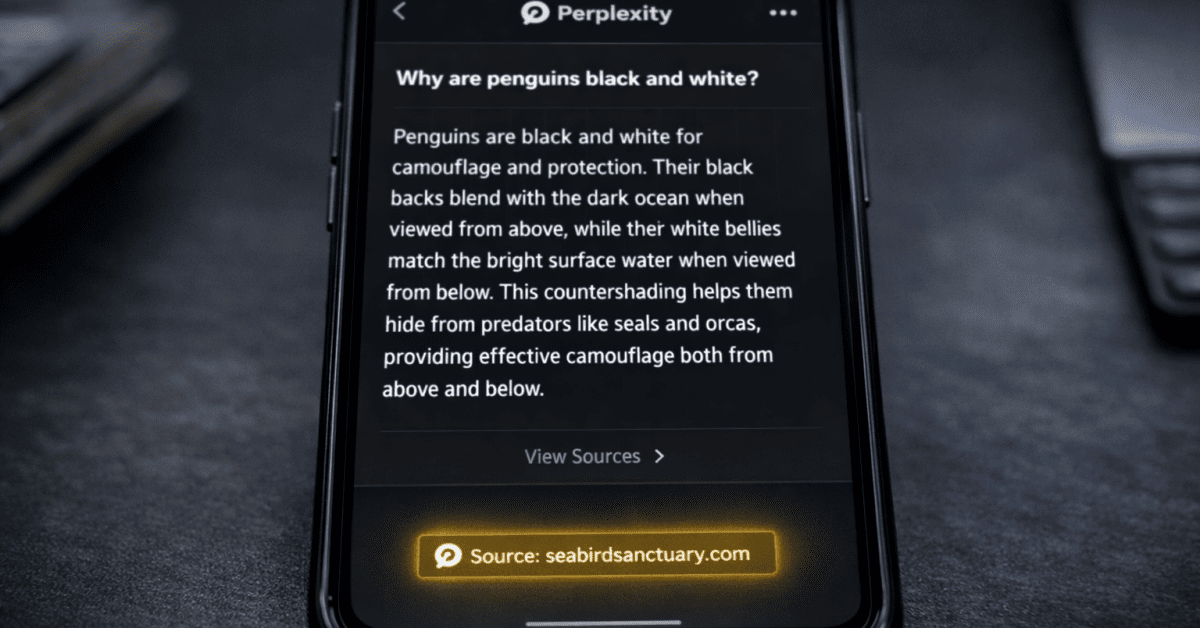
If you have ever copied a search query into Perplexity or ChatGPT and noticed a familiar blog post URL appearing as one of the cited sources at the bottom of the answer — maybe your own, maybe a competitor’s — you have witnessed something that is quietly reshaping how content discovery works in 2026.
Some blog posts make it into those answers consistently. Others covering the exact same topic never appear at all, regardless of how long they are or how well they rank in Google’s traditional results.
The gap between the ones that get cited and the ones that get ignored is not random. It is not primarily about domain authority or backlinks. And it is not about keyword density.
It is about something much more specific — and much more within your control — than most SEO advice currently acknowledges.
This post explains exactly why blog posts show up in AI answers from tools like ChatGPT, Perplexity, and Google AI Overviews: the specific structural and content signals these tools look for, the reason some posts get extracted while others get passed over, and the precise changes you can make to any existing post today to significantly improve its chances of being cited the next time someone asks an AI about your topic.
First: How AI Tools Actually Select What to Cite
Most people assume AI tools cite content based on the same signals that determine Google rankings — domain authority, backlink count, keyword matching.
This assumption explains why so many bloggers are confused when a post ranking on Google page one never appears in a single AI citation, while a newer, lower-authority post on a more specific topic gets cited repeatedly.
The selection process is different. ChatGPT, Perplexity, and Google AI Overviews use a process called Retrieval-Augmented Generation — they actively retrieve relevant content from search indexes in real time and generate answers from that retrieved material.
The content they retrieve is not necessarily the content that ranks highest for the exact query term. It is the content that is most directly useful as source material for generating an accurate, trustworthy, well-structured answer.
The AI is essentially asking: “If I need to extract a specific claim, a clear definition, a verifiable statistic, or a structured process from this page to include in my answer — can I do that easily and confidently?”
Pages that make extraction easy get cited. Pages that require careful sequential reading to understand do not — because the AI cannot read carefully. It scans, extracts, and synthesises.
The Two Stages Every AI Citation Goes Through
Understanding that AI citation happens in two distinct stages changes how you think about optimising for it. Stage one is retrieval — the AI tool determines which pages from its available search index are relevant to the query.
This stage rewards traditional SEO signals: your page needs to exist in the Bing index for ChatGPT, in Google’s index for Gemini and AI Overviews, and in Perplexity’s own crawl for Perplexity citations. If your page is not indexed, it cannot be retrieved regardless of its quality.
Stage two is selection — from the retrieved pages, the AI determines which ones to actually extract content from and cite in the generated answer.
This stage rewards the structural and content signals that most traditional SEO guidance does not cover: directness, extractability, credibility markers, and topical specificity.
A page can clear stage one and fail stage two — getting retrieved but not selected — because its content is structured for human reading rather than machine extraction.
The Structural Signals That Determine Selection
Research published in 2025 by Princeton, Georgia Tech, and the Allen Institute for AI identified the specific content features most strongly correlated with AI citation.
The findings are consistent across multiple AI platforms and multiple content categories. Understanding each one gives you a specific, actionable target for every post you write or update.
Direct Answer in the First 200 Words
Content that provides a clear, direct answer to the implied question within the first 200 words is cited at significantly higher rates than content that delays the answer for context or introduction.
The reason is mechanical — AI retrieval systems evaluate the beginning of a page first and most heavily. A post that opens with a 300-word backstory before reaching the point has, from the AI’s perspective, buried its extractable content in a position the tool may not weight as highly.
The counterintuitive implication is that adding a direct, clear answer sentence or paragraph near the very top of an existing post — before your current introduction — can improve its AI citation rate without changing any of its traditional SEO characteristics.
You are not shortening the post or removing the context. You are surfacing the key point to a position where AI tools encounter it early and treat it as the post’s primary contribution.
Specific, Verifiable Facts and Statistics
AI tools measure content trustworthiness by the density and specificity of verifiable claims. A post that states “many bloggers are finding that AI tools are changing their traffic patterns” provides no extractable, verifiable information.
A post that states “ChatGPT referral traffic converts at 15.9 percent compared to 1.76 percent for traditional Google organic search, according to Seer Interactive’s 2026 analysis” provides a specific, attributable, verifiable claim that the AI can extract with confidence and include in a cited answer.
The practical implication is not that every post needs to be a research paper. It is that the posts most likely to be cited are the ones where specific claims are backed by specific evidence.
Dates. Named sources. Percentages. Verifiable outcomes. Even one or two well-cited statistics in a post significantly improves its trustworthiness score in the AI’s evaluation — because the AI is trained to associate specificity with credibility.
Question-Structured Headings
Your H2 and H3 headings are the primary navigation tool AI tools use when scanning a post. Vague headings give the tool almost no useful information about what each section contains.
Specific, question-reflective headings — “Why Does Perplexity Cite Some Blog Posts and Not Others?” — tell the AI exactly what follows and allow it to route specific query types to specific sections of your post without parsing the entire document.
A post with clear, specific headings has a much larger surface area of potential citations than a post of identical length with vague headings.
Each specific heading creates a separate extraction point — a section that could be cited for a different but related query.
A 2,000-word post with eight specific question-structured headings is functionally eight potential citations. A 2,000-word post with three vague headings is functionally one.
Entity Coverage — The Related Terms That Build Context
AI tools evaluate the completeness and depth of a page’s coverage of a topic by looking for the presence of related entities — the specific terms, concepts, tools, and ideas that naturally co-occur with a well-developed treatment of the subject.
A post about using ChatGPT for blogging that naturally mentions GPT-5.5, prompt engineering, context windows, Deep Research, and output quality is recognised as covering the topic with genuine depth.
A post that only repeats the main keyword phrase without these surrounding entities is treated as shallow regardless of its word count.
This is not the old SEO strategy of cramming related keywords into content. It is the natural result of actually knowing your topic well and writing about it with genuine expertise.
The entities should appear because you understand the subject well enough to discuss it fully — not because you inserted them to satisfy a checklist.
When the expertise is real, the entity coverage is automatic. When it is absent, no amount of keyword optimisation compensates for the gap.
Why Your Post Is Getting Impressions But Not Citations
If your Google Search Console shows a post receiving impressions from AI-related queries but not the clicks and citations you expected, the most likely explanation is one of three specific gaps — and identifying which one applies is the fastest path to fixing it.
Gap One: The Answer Is Buried
This is the most common gap. Your post covers the topic thoroughly and accurately, but the most useful, extractable content — the direct answer to the query — appears in the middle or toward the end of the post after substantial setup.
AI tools retrieve this post because the topic is relevant and the domain has established some credibility. But when the tool scans for extractable content, the most useful material is not where it is looking first.
The fix is to add a two to three sentence direct answer at the very top of the post — above your current introduction — that states the core point clearly. You can then keep everything else exactly as it is. The introduction, the context, the detailed explanation, the examples — all of it stays. You are simply creating an extraction point at the location the AI tool checks first.
Gap Two: Missing Credibility Signals
Your post is clearly written and well-structured, but it contains primarily general claims and the author’s opinion without specific verifiable evidence.
AI tools faced with a choice between two posts covering the same topic will consistently prefer the one with datable, attributable, specific claims — because those posts allow the AI to generate an answer it can stand behind as trustworthy.
The fix is to add three to five specific, verifiable facts or statistics to the post — with named sources and dates — in the sections most likely to be extracted.
These do not have to be original research. They can be findings from recognised studies, confirmed statistics from official sources, or documented outcomes from credible publications.
The presence of specific, verifiable claims signals to the AI that this post can be trusted as a source in a way that general claims cannot.
Gap Three: Not in the Right Index
Your post is well-structured and credible, but it is not being cited by ChatGPT specifically — even though it ranks reasonably well in Google.
This gap is almost always an indexing issue rather than a content issue. ChatGPT uses Bing’s index rather than Google’s.
A post that ranks well in Google but is not indexed in Bing is invisible to ChatGPT’s citation process regardless of its quality.
The fix is to submit your sitemap to Bing Webmaster Tools at bing.com/webmasters if you have not already done so.
After submission, expect a four to eight week lag before your content begins appearing in ChatGPT citations.
During that period, the content quality signals described above determine how frequently it gets selected once it is in the retrievable pool.
The Checklist: Updating an Existing Post for AI Citation
For any existing post that is receiving impressions from relevant queries but not converting to AI citations, the following sequence covers the highest-impact improvements in order of priority.
Add a direct answer in the first 150 words that states the post’s core point clearly and specifically. This is the single highest-impact change available for most posts and takes under five minutes to implement.
It requires no restructuring of the existing content — just a new opening paragraph that leads with the answer before the context.
Review every heading and update any that are vague or promotional. Replace “Understanding the Basics” with “How ChatGPT Decides Which Sources to Cite.” Replace “Why This Matters” with “What Happens to Your Traffic When an AI Cites Your Blog.” Specific headings create multiple extraction points. Vague headings create none.
Add two to five specific, verifiable statistics or facts in the sections most relevant to the post’s primary query. Include the source name and date alongside each one.
These credibility anchors disproportionately improve the AI’s trust assessment of the entire post, not just the section where they appear.
Add or expand the FAQ section at the end of the post to cover the natural follow-up questions around your topic. Each FAQ question and answer creates a separate extraction point for a different but related query variation.
A post with eight specific FAQ items has eight additional opportunities to be cited beyond its main content.
If you use Yoast SEO, switch your FAQ section to use Yoast’s FAQ block to generate FAQ schema automatically.
If you do not use Yoast, add JSON-LD FAQ schema manually in a Custom HTML block. The schema signals to Google and AI tools that this content is formally structured as question-and-answer material — which is exactly the format most AI citations draw from.
The Platform-Specific Nuances Worth Knowing
Optimising for AI citation is not a one-size-fits-all process across every platform. Perplexity, ChatGPT, and Google AI Overviews select content using overlapping but not identical criteria, and understanding the differences helps you prioritise which improvements to make for the platforms your audience actually uses most.
Perplexity cites the widest range of sources and is the AI tool most likely to cite a newer, lower-authority blog post that is structured clearly and covers a specific topic with genuine depth. It rewards recency, specificity, and evidence density.
A post published last month on a specific, well-structured topic with clear claims and good entity coverage is a realistic Perplexity citation target even for a blog that is still building authority.
ChatGPT is more conservative in its citation behaviour. It draws from Bing’s index, which takes longer to update than Google’s, and it tends to prefer sources with established publishing histories and multiple credibility signals.
A blog that has been consistently publishing on a specific topic for six to twelve months with clear authorship, specific data, and regular updates is in a stronger position for ChatGPT citation than a newer blog with individually excellent posts but limited publishing history.
Google AI Overviews operates most conservatively of all, drawing almost exclusively from content that already ranks reasonably well in traditional Google results.
For AI Overviews specifically, strong traditional SEO remains the primary prerequisite. The structural improvements described in this post matter for AI Overviews, but they matter less than establishing clear topical authority and strong E-E-A-T signals through consistent, credible publishing in a defined niche.
What to Do This Week
The most effective way to begin improving your AI citation rate is not to rewrite every post on your blog from scratch.
It is to identify the two or three posts receiving the most impressions for relevant queries in your Search Console — the posts Google has already identified as topically relevant — and apply the checklist above specifically to those posts.
Those posts are already passing stage one of the AI citation process — they are in the index and being retrieved for relevant queries.
The gap is in stage two — selection. Improving the structure and credibility signals of posts that are already being retrieved is dramatically more efficient than trying to rank new posts from scratch on competitive topics.
For FaithfulBiz specifically, the ChatGPT slow post at position 9.9 with over 3,700 impressions in the past seven days is the most obvious immediate target.
It is already the highest-performing page on the site. Adding a direct answer summary at the top, reviewing its heading specificity, and adding three to five additional verifiable statistics to its most-cited sections could move it from occasional citation to consistent citation — which at its current impression volume represents a meaningful traffic gain.
What AI Citation Truly Means
For the broader picture of what AI citation means for your content strategy and which platforms to prioritise as your site grows, the complete guide to getting your content found by AI covers the full landscape in one place.
And if you want to understand the specific role that answer engine optimisation plays as the foundation for everything in this cluster, the AEO guide for bloggers gives you the strategic framework before the tactical implementation.
The blogs that will be best positioned at the end of 2026 are not necessarily the ones with the most posts or the strongest backlink profiles.
They are the ones whose existing content has been structured to serve both human readers and AI extraction systems simultaneously — which turns out to be the same thing as writing clearly, specifically, and with genuine expertise about a defined subject.
The AI era is not rewarding a new kind of content. It is finally rewarding the kind of content that was always worth writing.
















Join the discussion Tap to open the comment form +