

Here is something most YouTube creators do not know: when ChatGPT or Perplexity surfaces a YouTube video in its answers, it almost never watched the video.
It read the transcript.
Every YouTube video generates an automatic transcript — the text version of everything spoken in the video. AI tools treat that transcript the same way they treat a blog post.
They scan it for clear answers, extract useful information, and decide whether the content is worth citing in a generated response.
The quality of your video, the production value of your thumbnail, the length of your intro — none of these factors influence AI citation. The transcript does. The description does. The structured metadata around the video does.
This means that two creators publishing videos on the same topic can have dramatically different AI search visibility — not because of view count, not because of subscriber numbers, but because one creator’s video has a clean, information-rich transcript with clear statements and specific claims, and the other’s has a transcript full of filler phrases, rambling preambles, and content that takes three minutes to reach the point.
This guide covers exactly how to optimize YouTube videos for AI search — what AI tools look for when they evaluate video content, the specific changes to your recording approach and your metadata that improve AI citation rates, and why this matters even if your primary content home is a blog rather than a YouTube channel.
Why AI Tools Are Citing YouTube More Than Ever in 2026
YouTube is the second largest search engine in the world by query volume. It hosts over 800 million videos and adds roughly 500 hours of new video content every minute.
AI tools like Perplexity, ChatGPT, and Google AI Overviews cannot ignore this volume — which is why their content retrieval systems have become increasingly sophisticated at indexing, reading, and citing YouTube content alongside written web pages.
Data from YouTube’s own AI Overview analysis shows that videos heavily cited in AI search queries average over 500 words in their descriptions.
That single statistic reveals everything important about how AI tools evaluate video content — they are not assessing the video itself.
They are assessing the text around and within the video. Creators who write descriptions as genuine text documents rather than keyword-stuffed afterthoughts are building assets that AI tools can actually use as source material.
Google AI Overviews, which appear in up to 60 percent of all search results pages as of 2026, regularly include YouTube videos alongside written content in their generated answers.
The videos that appear are not necessarily the most viewed or the most subscribed — they are the videos whose surrounding text most clearly matches the query intent and whose content can be extracted as a trustworthy, direct answer.
This shifts the competitive dynamic for YouTube visibility in the same way it has shifted it for blog posts — away from pure volume metrics and toward content quality and structural clarity.
The Transcript: Your Most Undervalued AI Asset
YouTube’s automatic captions generate a transcript for every published video, and this transcript is indexed by Google and retrievable by AI tools.
For most creators, the automatic transcript is a byproduct they never think about. For AI search visibility, it is the primary asset that determines whether your video content gets cited.
The automatic transcript has a significant limitation: it transcribes exactly what you said, including every filler word, every rambling transition, every moment of verbal uncertainty.
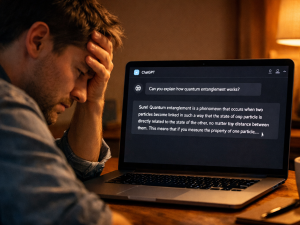
“So, um, today I kind of want to talk about, you know, the way that ChatGPT can sometimes feel really slow, and like, there are a bunch of different reasons why this happens” is what the AI tool reads. It cannot extract a clear, citable claim from that sentence because the sentence does not contain one.
The AI-friendly version of the same content in a transcript reads: “ChatGPT gets slower in long conversations for two specific reasons.
First, the browser has to render an increasingly large thread with each new message. Second, the AI model re-reads the full conversation history before generating each reply.” That is extractable. The AI can cite it. The first version is not.
How to Improve Your Transcript Quality Before Publishing
YouTube allows creators to edit automatic captions after a video publishes. This is one of the most impactful and least used optimisation tools available on the platform.
After publishing, go to YouTube Studio, open the video, click Subtitles, and select the auto-generated caption file.
Edit it to correct transcription errors, remove excessive filler words, break rambling sentences into clear statement units, and ensure that the most important claims in your video appear as clean, complete sentences in the transcript text.
The editing does not need to be exhaustive — a full word-for-word transcript edit would take longer than creating new content.
Focus on the opening two to three minutes, which AI tools weight most heavily, and the sections where you make your most important claims or deliver your most specific, verifiable information.
Cleaning these sections takes fifteen to twenty minutes and creates permanently improved AI citation potential for the video’s entire lifetime on the platform.
If you use NotebookLM as part of your content research and creation workflow — and if you have covered it on your blog — you may already know that NotebookLM can ingest YouTube URLs and generate structured summaries of video content.
What this actually demonstrates is that AI tools are reading your video transcripts right now, for every video you publish. Understanding how NotebookLM processes YouTube content gives you a practical first-hand demonstration of exactly what AI tools extract — and what they cannot — from your video transcripts.
Writing YouTube Descriptions as AI-Readable Documents
The YouTube description field is the second most important text asset AI tools use when evaluating a video. Most creators either leave it nearly empty, fill it with social media links and sponsor mentions, or write a paragraph that describes the video in vague terms without actually providing any of the information the video contains.
AI-optimised YouTube descriptions are written as miniature blog posts — genuine text documents that provide the key information from the video in a form the AI can extract independently of the transcript.
A description for a video about Midjourney parameters that reads “In today’s video I’m going to teach you everything you need to know about Midjourney parameters — don’t forget to like and subscribe!” gives an AI tool almost nothing to work with.
A description that opens with “Midjourney V8.1 has fifteen key parameters that control the output of every image you generate.
The most important are –ar for aspect ratio, –v for model version, –stylize for artistic interpretation, –chaos for variation, and –hd for native 2K resolution. This video covers each one with specific recommended values for different creative use cases” is extractable as a factual summary of the video’s content.
The standard to aim for is a minimum of 300 to 500 words in every video description for content where AI citation is a goal. Include the specific claims, statistics, steps, and recommendations that the video covers.
Write in complete sentences. Answer the primary question the video addresses within the first 150 words of the description — the same principle that applies to blog post openings. Use natural language that mirrors how a knowledgeable person would explain the topic rather than keyword strings assembled for traditional search.
Structuring Your Video Script for AI Extraction
The most durable solution to transcript quality is not editing transcripts after the fact — it is recording more clearly from the beginning.
Videos scripted or outlined to deliver information directly and specifically produce transcripts that are naturally AI-friendly because the spoken content is already structured as clear, complete statements rather than improvised rambling that eventually arrives at a point.
The Opening Structure That AI Tools Reward
The most impactful structural change you can make to your recording approach is delivering the video’s core answer in the first sixty seconds — before the background, before the credentials, before the context. “In this video I’m going to show you three things” followed by three minutes of setup before the first thing is not AI-friendly.
“ChatGPT gets slower in long conversations because the browser has to render the entire thread with each new message — here is exactly how to fix it in two minutes” is the opening that creates a citable extract in the transcript’s most heavily weighted section.
This approach mirrors the direct answer structure that improves AI citation rates for blog posts, which is not a coincidence.
AI tools evaluate the beginning of any content — written or transcribed video — most heavily when making citation decisions.
A video that answers its primary question in the first sixty seconds is being evaluated by the AI on its strongest material. A video that spends its first three minutes on introductory context is being evaluated on its weakest material.
Using Chapter Markers as Structured Headers
YouTube’s chapter system — created by adding timestamps to video descriptions in the format “0:00 Introduction, 1:30 Why ChatGPT Gets Slower, 3:45 The Two-Minute Fix” — creates navigational structure that functions similarly to H2 headings in a blog post.
AI tools use chapter markers to understand the structure of a video’s content and to identify which section is most relevant to a specific query.
Specific, descriptive chapter titles create multiple extraction points in the same way that specific H2 headings do in blog posts. “Part Two” tells the AI nothing.
“Why Long Conversations Slow Down ChatGPT’s Browser Interface” tells it exactly what the section contains and allows the AI to route specific queries to specific chapters without needing to process the entire transcript. Add chapters to every video over five minutes in length and write the chapter titles as specific, complete descriptors of what each section covers.
Tags, Titles, and Metadata for AI Discoverability
YouTube’s title and tag system feeds into the metadata that AI tools use to categorise and evaluate video content. In 2026,
YouTube titles optimised purely for clickbait — “I Tried This ONE THING and Everything Changed!” — perform worse in AI search than titles that clearly describe the video’s content.
AI tools cannot evaluate the implied promise of an emotional headline. They can evaluate the explicit information in a descriptive one.
The most AI-friendly YouTube titles follow the same principle as the most AI-friendly blog post titles: they describe what the video actually contains in specific, searchable terms.
“Midjourney V8.1 Parameters Guide: –ar, –v, –stylize, –hd Explained With Examples” is a better AI search title than “Everything You Need to Know About Midjourney Settings” — because the first title tells the AI exactly what entities are covered, which query types it should be surfaced for, and what specific value it delivers.
Tags remain relevant as a metadata signal for AI tools even as their importance for traditional YouTube recommendation has fluctuated.
Use tags that specifically describe the tools, concepts, and topics covered in your video — the entity web principle applied to metadata. For a video about making money with ElevenLabs, relevant tags include ElevenLabs, voice AI, text to speech, AI income, synthetic voice, AI freelancing, and the specific use cases covered in the video. This entity web in your tag metadata reinforces the topical coverage signal that makes your video more citeable for related queries.
The Blog-Video Integration Strategy
For creators who publish both a blog and a YouTube channel — which increasingly describes the most effective content strategies in 2026 — the relationship between written and video content is a significant AI search advantage that most creators are not deliberately exploiting.
A blog post and a YouTube video covering the same topic from complementary angles create mutual authority reinforcement.
The blog post provides the deep written coverage that AI tools can extract clean text citations from. The video provides the demonstration and the personality that makes the content more engaging and more memorable for human viewers.
When both reference each other — the blog post embeds the video, the video description links to the blog post — they create a content cluster that AI tools recognise as authoritative coverage of the topic from multiple formats.
The FaithfulBiz content strategy already demonstrates this in practice. The ChatGPT slow post has the highest AI citation rate on the site in part because it covers the topic with text-based specificity that makes it extractable.
A companion video covering the same topic with a clean transcript and a description that links back to the post would create a second citation point for the same topic cluster — one that reaches the portion of the audience that discovers content through YouTube rather than through Google Search or AI answers.
For bloggers considering whether to start a YouTube channel alongside their written content, the AI search visibility argument is now a meaningful additional reason to do so.
Video transcripts, descriptions, and metadata create additional indexed text content that feeds into the same AI retrieval systems as blog posts — effectively doubling the surface area of your topical coverage in AI search indexes without requiring you to write twice as many blog posts.
Practical First Steps for AI YouTube Optimization
If you have an existing YouTube channel, the highest-impact immediate improvements are the same three priority actions regardless of how many videos you have published.
Edit the transcripts of your five most-viewed videos to clean up the opening two to three minutes. These videos are already receiving the most traffic and are most likely to be retrieved by AI tools.
Improving their transcript quality at the highest-value extraction points directly improves their citation potential without requiring new content creation.
Rewrite the descriptions of those same five videos as genuine text documents — 300 words minimum, opening with the video’s core answer, covering the main claims and specific information the video contains.
This is the single most impactful metadata change available and it compounds immediately with existing view count and authority signals those videos have already accumulated.
Add chapter markers to every video over five minutes long that does not currently have them. Write each chapter title as a specific descriptor of the section’s content.
This creates structured navigation that AI tools use to locate relevant sections for specific queries — turning a single long video into multiple potential citation points for different query variations around the same topic.
For new videos going forward, build the answer-first structure into your scripting and recording process from the beginning.
The investment in structuring your content clearly before you record is smaller than the investment in editing transcripts after the fact — and the result is higher-quality source material for both human viewers and AI extraction systems simultaneously.
The Bigger Picture: YouTube as Part of Your AI Visibility Stack
This post is the final piece of the AI search visibility cluster on FaithfulBiz — and the YouTube angle is a fitting place to close, because it illustrates the broader principle that runs through every post in this cluster.
AI tools do not care what format your content takes. They care whether the content they retrieve answers the query clearly, specifically, and credibly.
A blog post, a YouTube transcript, a podcast transcript, a voice search response — all of them are evaluated by the same fundamental criteria.
The creator who understands these criteria and applies them consistently across every format they publish in is building AI visibility that compounds across multiple channels simultaneously rather than investing in one platform at the expense of others.
The Complete Picture
The complete picture of how to get found by AI across all these formats starts with the complete guide to getting your content found by AI — which covers the infrastructure, the platform-specific nuances, and the strategic framework that makes every tactical improvement in this cluster most effective.
If you want to understand specifically why some posts and videos get cited while others do not, the breakdown of why content appears in AI answers gives you the diagnostic framework.
For the step-by-step content optimization checklist that applies to both blog posts and video descriptions, the AI content optimization guide covers every specific improvement in order of impact.
And for the voice search angle — which connects directly to what YouTube optimization is also trying to achieve — the voice search guide for freelancers and bloggers rounds out the full picture of conversational and spoken content discovery.
AI tools are reading your YouTube videos right now. The question is whether what they are reading is clear enough, specific enough, and structured enough to be worth citing as the answer to someone’s question.
That question has a practical answer — and every improvement in this cluster brings you closer to being the source the AI chooses rather than the one it passes over.









Join the discussion Tap to open the comment form +