

Something real is happening in the AI space right now, and it is not just tech Twitter noise.
Searches for “Claude vs ChatGPT” hit 110,000 in March 2026 alone — up eleven times compared to the same period the previous year. A movement called #QuitGPT has gathered over 1.5 million participants. At HumanX, one of the largest AI industry conferences, CNBC reporters noted that Claude was dominating conversations that used to be dominated by ChatGPT. One CEO described Claude Code as having become “a religion” among his engineers.
That is not a small shift. That is a meaningful change in where serious users are placing their trust and their workflows.
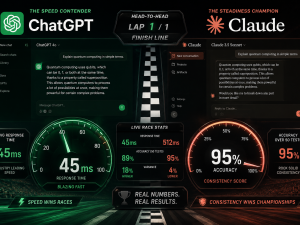
But here is what most of the comparison content gets wrong: this is not a story about ChatGPT failing. It is a story about the AI market maturing. Users are no longer picking one tool and using it for everything. They are getting more deliberate about which tool does which job best. And understanding that distinction is exactly why the question of switching from ChatGPT to Claude keeps coming up in every serious AI conversation right now. Read the complete ChatGPT guide
Let me break down what is actually happening, what the data shows, and what it means for how you use these tools.
What Changed on Claude’s Side
Claude’s rise in 2026 is not accidental. Anthropic has been making aggressive, visible product moves that have changed what Claude can actually do for serious users.
Claude Opus 4.7 introduced a 1 million token context window — meaning you can drop an entire legal contract, a full research paper series, a complete software codebase, or a book-length document into a single conversation and Claude can reason across all of it without losing the thread. GPT-5.4 also reached 1 million tokens in its context window, but Claude got there first and built its strongest use cases around it earlier.
On the coding side, the data is striking. Claude Opus 4.6 scores 80.8% on SWE-bench Verified, which is the industry standard benchmark for real-world software engineering tasks. Seventy percent of developers surveyed in the most recent Stack Overflow research now say they prefer Claude for coding work, citing more accurate refactoring, better multi-file codebase handling, and significantly fewer hallucinated API calls compared to ChatGPT. Claude Code, Anthropic’s agentic coding tool, now generates an estimated $2.5 billion in annualised revenue and holds 54% of the enterprise coding market.
If You Are a Writer
For writers and knowledge workers, the shift is less about benchmarks and more about feel. Claude consistently produces prose that is cleaner, more naturally structured, and easier to edit into something publishable. It avoids the overused AI phrases and mechanical paragraph patterns that make ChatGPT output easy to identify. For anyone producing content that needs to read like a person wrote it, that difference shows up quickly in daily use.
Anthropic has also made a public commitment that separates Claude from its competitors in a way that matters to users who think carefully about what they are handing their work to. In 2026, Anthropic confirmed that Claude products will remain ad-free, explicitly stating that advertising incentives are incompatible with a genuinely helpful assistant. That is not just a branding statement. It tells you something about the product philosophy and why Claude’s outputs feel different from tools optimised around engagement rather than usefulness.
Where ChatGPT Is Still the Stronger Option
Keeping this honest means saying clearly what Claude does not do, because the gaps are real and they matter depending on your workflow.
Claude has no native image generation. If visual content creation is part of your work, ChatGPT is the only option between the two. DALL-E integration is deeply built into the ChatGPT interface, and the results are consistently strong for marketing content, concept visuals, and social media imagery.
Claude has no voice mode. ChatGPT’s Advanced Voice Mode allows real-time, natural-sounding voice conversations with emotional tone and interruption handling. Even free users get several hours of voice access daily. If you want to talk to your AI while driving, cooking, or walking, ChatGPT is your only real choice here.
ChatGPT’s web browsing integration is also meaningfully stronger. It connects to Bing, pulls live data mid-conversation, cites sources, and handles real-time questions about current events naturally. Claude has limited web search access through its tools, but it is not as seamless or comprehensive.
And then there is the ecosystem. ChatGPT has thousands of specialised GPTs built by the community, deep Microsoft integration through Copilot and Azure, Canvas for collaborative editing, and tool connections that make it feel like an all-in-one platform. For users who need one product to handle many different types of tasks — image generation, file analysis, voice, web research, and productivity workflows — ChatGPT still offers the broadest coverage in one place.
ChatGPT also has over 200 million weekly users and the largest installed base of any AI assistant. That means more documentation, more tutorials, more community support, and more third-party integrations. For teams or individuals who are just starting their AI journey, that ecosystem depth is genuinely valuable.
The Real Reason Users Are Switching, And Why It Is Usually Partial
Here is the pattern that the most honest comparison research keeps surfacing: the majority of people who “switch to Claude” do not actually leave ChatGPT behind completely. What they do is split their workflow.
They move their long-form writing, document analysis, and coding work to Claude. They keep their image generation, voice conversations, web research, and quick productivity tasks in ChatGPT. Both tools at the Pro tier cost $20 per month. Many serious users are running both subscriptions simultaneously and routing each task to whichever tool handles it best. But ChatGPT has more capability on paid plans.
That two-tool workflow is becoming the norm among professional AI users in 2026, and it reflects something important: the market has matured past the “which AI wins” question. The question people are actually asking now is “which AI wins for this specific task?” That is a much more useful question, and it is what is driving the surge in comparison searches and the switching conversation you keep seeing across tech communities.
The users who genuinely move most of their workflow to Claude are typically writers, researchers, analysts, and developers. These are people whose primary need is depth, accuracy, and quality of reasoning on complex, long-form tasks — exactly where Claude’s advantages are most pronounced. The users who stay primarily with ChatGPT are typically people who need broad utility, multimodal features, and a single platform that handles many different types of work without switching contexts.
Claude vs ChatGPT: A Straight Comparison by Use Case
Rather than a feature checklist, here is the clearest way to think about which tool fits which situation.
Choose Claude if your work involves:
Long-form writing, editing, and rewriting where tone and naturalness matter. Processing and reasoning across very large documents — contracts, research papers, lengthy briefs, full codebases. Coding and software engineering tasks where accuracy, fewer hallucinations, and autonomous project execution are the priority. Professional analysis that requires PhD-level reasoning depth. Work where you want a calm, focused environment without distracting features pulling your attention.
Choose ChatGPT if your work involves:
Image generation for marketing, content, or creative projects. Voice conversations and audio interaction. Real-time web research and live data queries. All-in-one utility across many different types of tasks in one session. Microsoft ecosystem integration through Word, Excel, Teams, or Outlook. Quick, conversational tasks where speed and breadth matter more than depth.
Consider both if:
You are a heavy AI user with varied needs across writing, research, coding, and creative work. You hit usage limits on one platform and need the other as a reliable backup. Your workflow genuinely requires capabilities from both ecosystems, and the combined $40 per month is within your budget for the productivity gain it delivers.
What This Means for Bloggers, Creators, and Online Business Owners
If you are building a content business, a personal brand, or an income stream online, the Claude vs ChatGPT conversation is not just interesting — it is directly relevant to how you spend your time and what your work actually looks like.
The posts that consistently perform in search and on Google Discover right now are not posts that look like they were generated quickly and published without thought. They are posts with real depth, genuine perspective, and writing that sounds like a person who knows what they are talking about. Claude’s writing output is closer to that standard by default than most other AI tools, which is why more content creators and bloggers are moving their writing workflow there.
But for the research phase — finding current data, verifying facts, checking what competitors are publishing, identifying trending angles — ChatGPT’s web browsing capability is still more practical than Claude’s limited search access. The smart workflow is to research in ChatGPT, write and refine in Claude, and use your own judgment throughout to make sure the output actually reflects your perspective and adds something real for your audience.
Understanding which AI tool fits which stage of your workflow connects directly to the broader skill of using AI deliberately rather than reactively. If you have not yet thought through which parts of your work AI should support and which parts should stay entirely yours, this breakdown of why most people fail with AI addresses exactly that distinction. And if you are thinking about which AI tools are worth building real skills around, this guide to AI tools that actually save time gives you a practical starting point across the full landscape.
The Bigger Picture: Why This Competition Is Good for Everyone
Anthropic pushing Claude forward aggressively is forcing OpenAI to respond faster. OpenAI pushing GPT-5.4’s ecosystem and multimodal capabilities is pushing Anthropic to close Claude’s gaps in voice, image, and web access. That competitive pressure is why both tools are significantly better today than they were twelve months ago, and why they will both be significantly better twelve months from now.
Users benefit from this competition in a direct, practical way. The tools get better faster, the pricing stays competitive, and the specialisation means you can find a combination that fits your exact workflow rather than settling for a single product that does everything adequately but nothing exceptionally.
The people who are positioned well in this environment are not the ones who picked a side in the Claude vs ChatGPT debate. They are the ones who understood the strengths of each tool early, built deliberate workflows around those strengths, and kept learning as both tools evolved.
That learning posture — staying curious, testing tools with specific tasks rather than general impressions, and adjusting based on real results — is the same posture that drives everything else that works in the AI space right now. Building that habit deliberately is worth more than any single tool preference.
The question was never which AI wins. It was always which AI wins for you, doing your specific work, on the tasks that matter most to your goals. That question now has clearer answers than it ever has before — and both Claude and ChatGPT deserve a seat at the table depending on what the answer is.














Join the discussion Tap to open the comment form +