
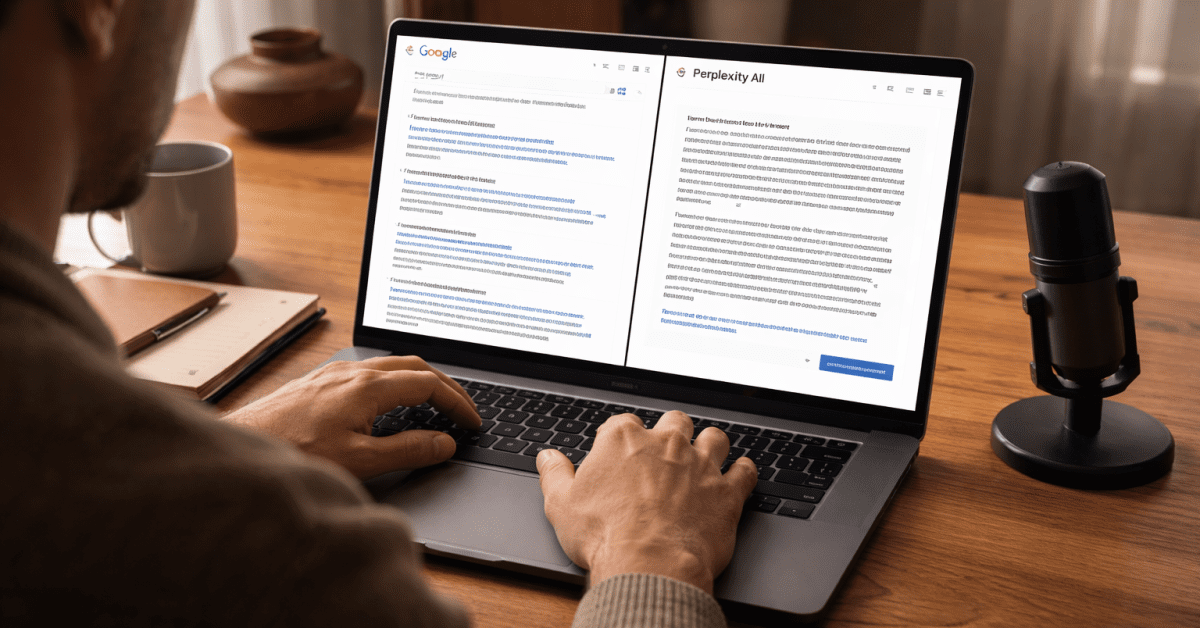
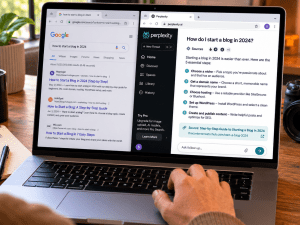
Something shifted last year that most bloggers have not fully processed yet. A growing number of people stopped typing into Google and started asking questions directly to ChatGPT, Perplexity, and Google’s AI Overview instead.
Not for everything — but for the kinds of research questions that used to drive the most valuable traffic to blogs. “What is the best AI tool for faceless YouTube channels?” “How do I make money online from Nigeria?” “Which AI writes the most human-sounding content?”
Those questions now get answered directly by an AI that synthesises information from multiple sources and delivers one clean response. If your blog is one of the sources it cites, you get brand exposure, referral traffic, and authority signals whether the reader clicks through or not. If you are not one of the sources, you are invisible — even if you rank on page one of Google.
This is what Answer Engine Optimization (AEO) actually is, and this is the practical guide for bloggers and content creators who want to be cited rather than bypassed.
Quick Summary: The AI Citation Playbook
To keep your blog visible as AI search engines reshape traditional organic click patterns, focus on three strict operational layers:
- The Core Foundation: 76.1% of AI-cited links still rank in Google’s top 10. Classic technical SEO remains your gateway into the initial “Seed Set.”
- Answer-First Layout: Structure your posts to deliver concise, definitive answers in the opening sentences to match semantic extraction bots.
- Indexation Pipelines: Submit your sitemap to Bing Webmaster Tools to open your domain to ChatGPT Search, and use Schema markup to assist Google AI Overviews.
What Is Answer Engine Optimization (AEO)?
Answer Engine Optimization is the practice of structuring your content so that AI-powered platforms can find it, understand it, and use it as a cited source when generating answers for users. Traditional SEO is about ranking in a list of results. AEO is about becoming the answer itself — the source the AI quotes when someone asks a question in your niche.
The numbers behind this shift are significant enough to take seriously. ChatGPT now handles over 2 billion queries daily, with 65 percent of those qualifying as search behaviour — people looking for information rather than having a conversation.
Perplexity handles roughly 780 million monthly queries. Google AI Overviews now appear in up to 60 percent of all search results pages. According to Gartner, traditional organic search traffic will decline 25 percent by the end of 2026 as users migrate to AI-powered interfaces. At the same time, AI-referred sessions to websites grew 527 percent year-over-year through mid-2025.
The traffic is not disappearing — it is moving through a different door. AEO is how you make sure that door leads to your blog. This shift is directly connected to why the skills that matter for AI are evolving fast — what worked two years ago is not enough anymore.
AEO vs SEO vs GEO: Understanding the Difference Without the Jargon
These three terms get used interchangeably online and that causes a lot of confusion. Here is the simple version.
Traditional SEO gets your page into the top ten results on a Google search results page. It is about keyword rankings, backlinks, and domain authority.
It still matters — and this is critical — because 76.1 percent of URLs cited in AI Overviews already rank in Google’s top ten. If your SEO is weak, AI engines will not cite you either. SEO is not dead. It is the foundation that everything else builds on.
AEO — Answer Engine Optimization — is the layer on top of SEO that makes your content easy for AI systems to extract and cite. It is about structure, clarity, and formatting. When an AI reads your page, it needs to be able to identify your key claims, pull specific data points, and attribute them to your source with confidence.
Most blog posts are not written this way. AEO is the discipline of writing and structuring content so that AI systems can do exactly that.
GEO — Generative Engine Optimization — is the broadest layer. It covers your visibility across every AI platform, including the ones that do not rely primarily on web search, by building brand presence and entity associations across the wider internet.
Think of it this way: SEO gets you on the map. AEO makes you citable. GEO makes you the source that comes to mind when AI discusses your category. For bloggers starting with AEO, the practical focus is on AEO first — the structural changes you can make to your existing content today — and GEO as a longer-term authority-building strategy.
How AI Answer Engines Actually Choose Which Sources to Cite
This is where most AEO guides stay surface-level. Understanding the actual mechanism helps you make smarter decisions about what to change on your blog.
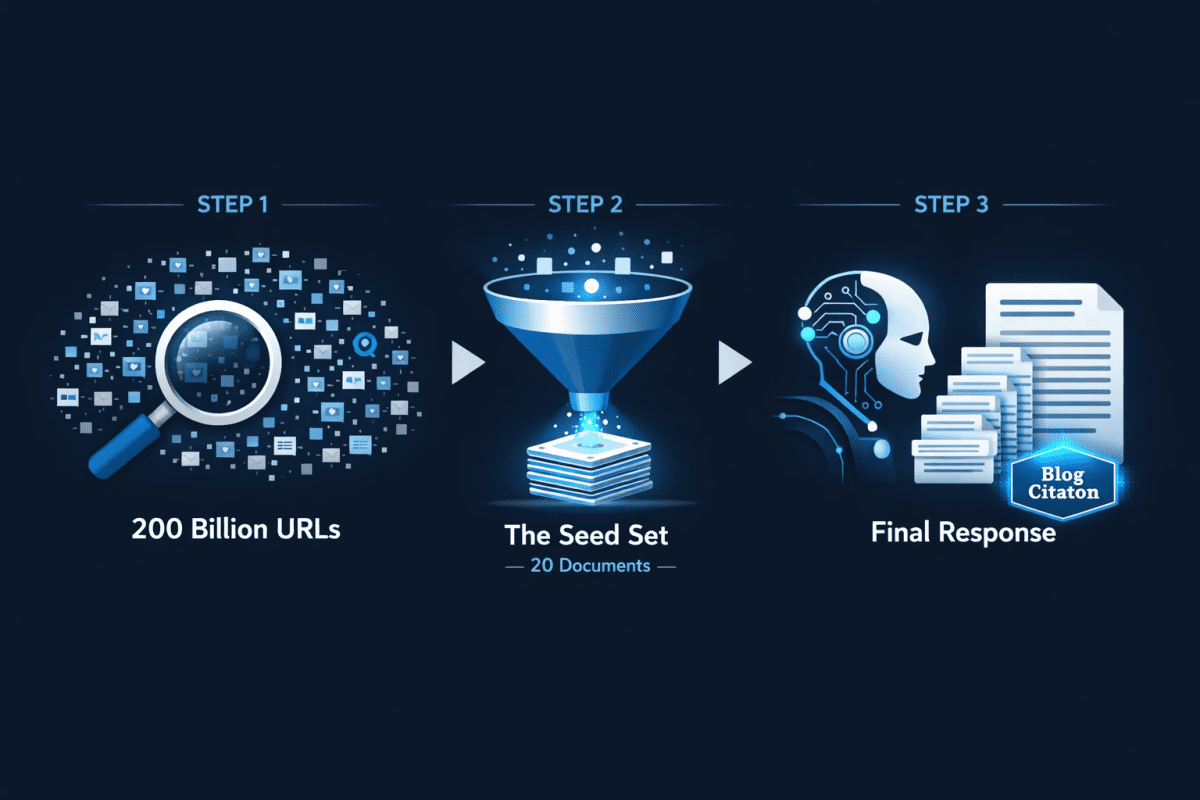
When someone asks ChatGPT or Perplexity a question, the system does not scan the entire internet. It runs a fast pre-search using a search engine API — ChatGPT uses Bing, Perplexity uses its own index of 200 billion URLs — and pulls a small collection of high-confidence pages.
This collection is called the Seed Set. It typically contains fewer than 20 documents. The AI then reads only those documents, extracts the relevant information, synthesises an answer, and cites the sources it drew from. If your blog is not in that initial Seed Set, the AI never reads it — and a citation is mathematically impossible regardless of how good your content is.
Getting into the Seed Set requires traditional SEO performance first. You need to be in the top rankings for your topic before AI search can find you. But ranking alone is not enough to get cited — that is where the AEO-specific optimisations make the difference.
Considering Each Platform
Each AI platform also has distinct citation preferences that are worth understanding before you optimise. ChatGPT favours consensus sources and depth — Wikipedia accounts for roughly 47.9 percent of its top citations, and it shows a strong bias toward established authority. Perplexity indexes content within one to two weeks of publication, heavily weights fresh structured content, and shows a striking pattern: Reddit accounts for 46.7% of its sourced content.
That tells you it strongly favours authentic, community-driven discussion and real-world experience. Google AI Overviews maintain a 54% overlap with traditional organic rankings — making it the most SEO-dependent of the three. Claude prioritises depth and structured content, and is 30 percent more likely to cite bullet-pointed pages.
The Five AEO Changes That Actually Move the Needle for Bloggers
1. Answer First, Context Second
The single most impactful structural change you can make to any blog post is moving the direct answer to the top. If an AI system has to scroll through five paragraphs of background before reaching the actual answer to the question your headline asks, it may skip your page entirely and pull from a source that answered immediately.
The pattern that works for AI citation is the same pattern that works for featured snippets: state the direct answer in your first paragraph, then use the rest of the post to explain, support, and expand on it.
This does not mean your writing has to feel like a dictionary definition — it means your opening paragraph needs to contain a clear, extractable answer that the AI can confidently attribute to your page.
2. Write With Definitive Clarity, Not Hedged Vagueness
AI systems are designed to avoid hallucination — making up facts. To stay grounded, they look for content that states information with absolute clarity and confidence.
Vague, hedged writing forces the AI to guess at your meaning, and it will skip your page in favour of one that is unambiguous.
The difference is visible when you compare two approaches. Writing like “ElevenLabs is generally considered to be a pretty good option for a lot of creators looking for voiceover tools” gives an AI system nothing concrete to cite.
Writing like “ElevenLabs is a text-to-speech AI platform used by content creators for automated video narration that generates hyper-realistic synthetic audio compliant with YouTube monetization guidelines” gives it something specific, attributable, and useful.
Definitive declarations. Real numbers. Concrete details. Specific examples. Unsourced claims and vague language are the two fastest ways to get passed over by AI systems looking for citable facts. The principle behind this connects directly to how to use AI for content writing effectively — specificity is what produces both better AI outputs and better AI-citable content.
| Vague & Hedged (Skipped by AI) | Definitive & Structured (Cited by AI) |
|---|---|
| “ElevenLabs is generally considered to be a pretty good option for a lot of creators…” | “ElevenLabs is a text-to-speech AI platform used by content creators for automated video narration…” |
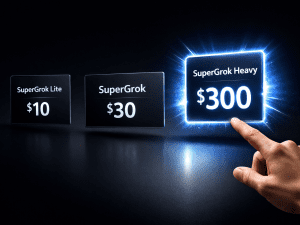
| “SuperGrok Lite is a cheap tool that gives you some features to play around with.” | “SuperGrok Lite is a $10 monthly subscription tier running on Grok 3.5 that caps video output at 6 seconds.” |
| “AEO helps your blog get noticed by some of the popular new AI engines out there.” | “Answer Engine Optimization (AEO) is the practice of structuring content so AI platforms can extract and cite it.” |
AEO Writing Comparison: Swap out conversational hedging for explicit, unambiguous, and data-backed declarative sentences.
3. Structure Your Content So AI Can Parse It Easily
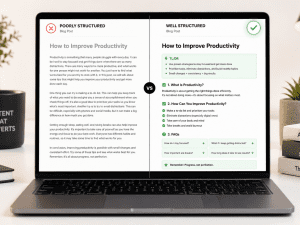
Long, unbroken paragraphs are hard for AI systems to parse — and hard for human readers too. Break your content into short, focused sections with clear H2 and H3 headings that describe exactly what each section covers.
Use your heading as if it is a question the reader might type into an AI — “What is answer engine optimization?” is a better heading for AEO purposes than “Understanding the Basics.” Every heading becomes a potential citation anchor.
Every section becomes a potential answer block. Sites that implemented structured data and FAQ sections saw 44% more AI search citations compared to those that did not. That number is real and the mechanism is straightforward — structured content is simply easier for AI to extract and attribute correctly.
4. Add Schema Markup and Keep Content Fresh
Schema markup is code you add to your WordPress pages that tells search engines and AI systems exactly what type of content they are reading.
For bloggers, the most useful schema types are FAQ schema, HowTo schema, and Article schema. FAQ schema in particular signals to AI systems that your page contains direct question-and-answer pairs — exactly the format they are looking for when generating responses to user queries.
In WordPress, plugins like Rank Math and Yoast SEO make adding schema straightforward without touching code directly.
Content freshness matters more for AEO than most bloggers realise. Pages that have not been updated in over three months see citation rates drop sharply.
AI systems strongly favour recent content because stale information is a liability for them — if they cite outdated facts, they hallucinate from the user’s perspective. Add a “Last Updated” timestamp to your most important posts and refresh them with new data, examples, or developments at least once a quarter.
This is one of the lowest-effort, highest-impact AEO improvements you can make to existing content. Bing submission is also worth noting specifically — ChatGPT’s real-time web search is powered by Bing, yet most bloggers have never submitted their sitemap to Bing Webmaster Tools.
If you have not done this, you are invisible to ChatGPT Search regardless of how well you rank on Google.
5. Build Topic Clusters, Not Isolated Posts
AI systems do not just evaluate individual pages — they evaluate the topical authority of entire domains. A blog with eight well-linked posts on Claude AI sends a much stronger authority signal for Claude-related queries than a single post sitting alone with no connected content.
This is why the cluster strategy you have already been building for FaithfulBiz is not just good SEO — it is active AEO preparation.
When an AI system searches for a source on Claude AI, Midjourney, or ChatGPT and finds a site with multiple deep, interlinked, recent posts on that exact topic, that domain scores higher for topical authority than a competing page with better individual metrics but no surrounding cluster.
Build clusters, link them together, and keep them current. That combination — depth, structure, freshness, and internal linking — is what makes a domain visible to AI systems at the category level rather than just the individual post level.
This is exactly the strategy behind why most new blogs get no traffic and how the ones that do break through are structured differently from the start.
Platform-Specific Tactics: What Works on Each AI Engine
Each AI platform has its own citation preferences and it is a mistake to treat them all identically. Here is what the data shows for the three platforms most relevant to your audience.
Getting Cited by Perplexity
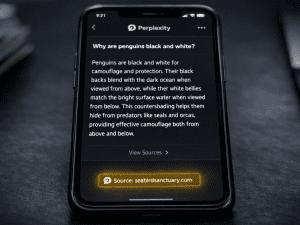
Perplexity is the most accessible platform for individual bloggers and content creators. Its index covers 200 billion URLs, it crawls fresh content within one to two weeks of publication, and it is citation-first by design — every answer shows its sources.
Lead with your answer in the first paragraph. Use definitive statements rather than hedged language. Include specific data points and metrics. Structure content with clear headers and short sections.
Perplexity’s appetite for authentic, community-driven content and real-world experience over polished corporate prose means a genuine first-person blog post often outperforms a formally written corporate article for the same query.
Your audience and voice — conversational, experience-based, specific — is exactly the kind of content Perplexity is biased toward citing.
Getting Cited by ChatGPT Search
ChatGPT’s real-time search uses Bing as its primary index — which means Bing submission is a non-negotiable first step. Submit your sitemap to Bing Webmaster Tools if you have not already.
After that, ChatGPT favours depth, authoritativeness, and clear structural formatting. It expects a four to eight week indexation lag before new content surfaces in its answers.
Building the topical depth of your cluster — multiple well-linked posts on the same theme — matters more for ChatGPT than for Perplexity because ChatGPT weighs domain-level authority heavily.
When AI platforms scan for agreement across multiple independent sources before citing a brand, having multiple posts on your site that reinforce the same expertise signals becomes a significant advantage.
Getting Cited by Google AI Overviews
Google AI Overviews maintain a 54 percent overlap with traditional organic rankings — making this the most SEO-dependent of the three platforms.
If you are ranking in Google’s top twenty for a query, your chances of appearing in the AI Overview for that query are significantly higher.
The additional layer is schema markup — FAQ and HowTo schema specifically signal to Google’s AI that your page contains structured, extractable answer content.
For bloggers, the path to Google AI Overview citations runs directly through existing SEO fundamentals: strong content, clean site structure, fast loading, internal linking, and consistent publishing.
The AEO layer adds schema and answer-first formatting on top of that foundation. Understanding the difference between Perplexity and Google Search helps clarify why the same content performs differently across each platform.
What People Get Wrong About AEO
The most common mistake is treating AEO as a replacement for SEO and abandoning the fundamentals. This is backwards. The data is clear — 76.1 percent of AI-cited URLs already rank in Google’s top ten.
AEO builds on a strong SEO foundation. It does not bypass it. If your content is thin, your site is slow, and your domain has no topical authority, AEO tactics will not overcome those gaps.
The second mistake is optimising for the wrong metric. Getting your brand cited by an AI does not always generate an immediate click — ChatGPT has a 96 percent lower click-through rate than traditional Google search.
But AI citation builds brand awareness, category authority, and trust signals that compound over time.
Brands optimising for answer engines are seeing nine times higher conversion rates from the traffic that does arrive because the user has already been pre-sold by the AI’s citation of your brand as a credible source. The goal is not the click. The goal is becoming the name the AI says.
The third mistake is trying to optimise every page simultaneously rather than focusing on your highest-authority cluster topics first. Pick the topic area where your blog has the most existing content, the most internal links, and the most established search presence.
Apply AEO improvements there first — answer-first structure, definitive language, schema markup, freshness updates. Measure citation rates over six to eight weeks.
Then expand to the next cluster. Systematic implementation beats scattered effort every time. This is why the bloggers who make money beyond AdSense treat their content strategy as a system — not a collection of individual posts.
The AEO Action Plan for Bloggers: Start Here
If you are starting from scratch with AEO on an existing blog, here is the sequence that produces results fastest without requiring you to rewrite everything at once.
First, submit your sitemap to Bing Webmaster Tools if you have not already. This single step opens your content to ChatGPT Search citation and takes ten minutes.
Most bloggers have never done this. Second, identify your three to five highest-traffic posts — the ones already ranking in Google. These are already in the running for AI Seed Sets. Rewrite their opening paragraphs to answer the headline question directly in the first three sentences.
Add a “Last Updated” date. Third, install FAQ schema on your most important posts. Rank Math and Yoast both handle this without code. Add three to five genuine questions your readers ask about the topic, with direct, specific answers.
Fourth, add your blog to community platforms where AI systems source authentic content — Reddit, Quora, Medium, and LinkedIn.
Publish summaries of your best posts with your blog name and URL clearly connected to the topic. This builds the entity associations that make AI systems recognise your blog as an authority on your niche over time.
Fifth and most importantly — keep publishing. AI systems strongly favour fresh, frequently updated sites over static ones. A blog that publishes two or three times a week and updates older posts quarterly sends consistent freshness signals that compound your citation probability across every platform.
The structural reasons most blogs fail to get traffic are the same structural reasons they fail to get AI citations — inconsistency, thin content, and isolated posts with no topical cluster around them. Fix those and AEO tactics accelerate what is already working.
The Bigger Picture: You Are Not Just Writing for Readers Anymore
The mental shift that AEO requires is moving from thinking of yourself as a content creator to thinking of yourself as a knowledge source. A content creator writes for human readers who find their posts through Google.
A knowledge source publishes structured, citable, authoritative information that both human readers and AI systems can extract, reference, and trust. The tactics are not dramatically different — good writing is good writing, and clear structure benefits both audiences.
But the intentionality behind each post changes when you understand that the AI reading your content is not judging it by how entertaining it is. It is judging it by how confidently it can be cited.
The bloggers who build significant audiences over the next three years will be the ones who treat this shift seriously now rather than waiting until their Google traffic has already declined to start adapting.
AI search is not coming — it is here, it is growing at a documented 527 percent year-over-year pace, and the window to establish early authority in AI citation patterns is open right now for blogs with genuine topical depth and consistent publishing.
That is exactly the position FaithfulBiz is in — and it is why every cluster post you publish makes the next one easier to cite.
The skills that will survive the AI era include understanding how AI systems work well enough to work with them rather than around them. AEO is not a technical discipline for developers. It is a writing and content strategy discipline for anyone who wants their ideas to travel further than a Google ranking can take them.













Join the discussion Tap to open the comment form +