
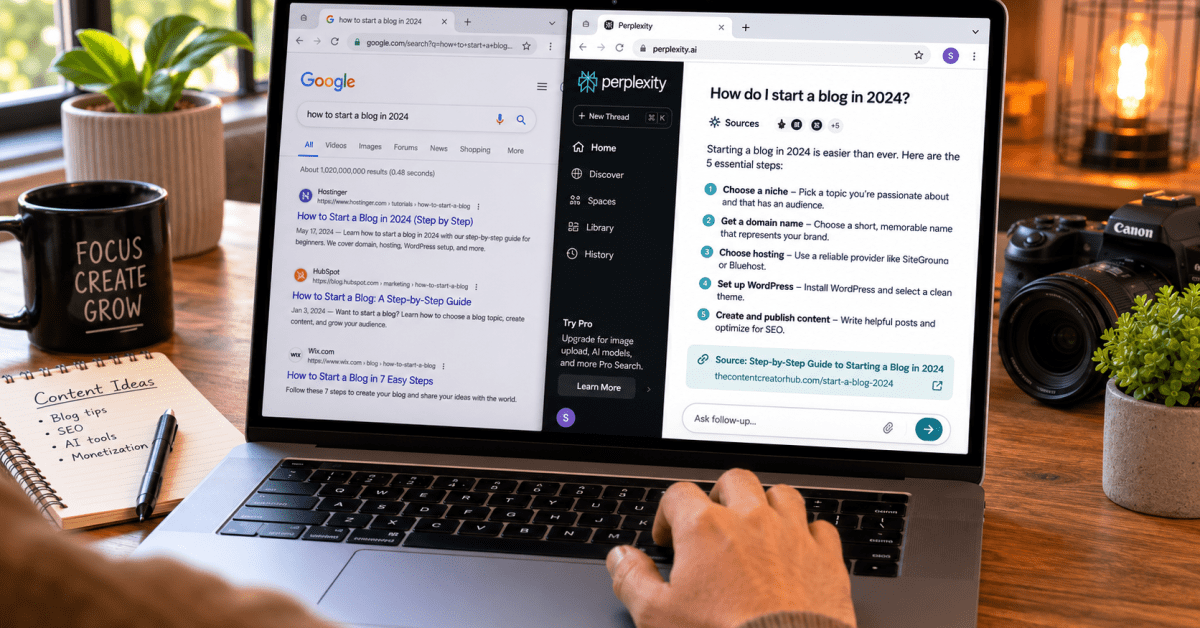
Something happened to one of my blog posts recently that stopped me mid-scroll.
I was testing a question in Perplexity AI — the kind of question I had written about months earlier.
The answer appeared almost instantly, synthesised from multiple sources, clearly structured, with citations listed at the bottom. I almost kept scrolling. Then I looked at the citations. One of them was my article.
Perplexity had read my post, extracted the relevant section, incorporated it into its answer, and linked back to FaithfulBiz as a source — all without me doing anything specific to make it happen.
The article had simply been written clearly enough, structured directly enough, and published with enough credibility signals that the AI chose it over every other page covering the same topic.
That moment made me understand something important about where content discovery is actually heading in 2026.
The question is no longer just “does my content rank on Google?” The question is “does my content get cited by the AI tools that 900 million people are now using every week to find information, make decisions, and discover what to buy?”
Those are two different questions with two different answers. And for bloggers and content creators who want to stay visible as search behaviour continues shifting, understanding the difference is no longer optional.
This guide covers everything you need to know about how to get your content found by AI — what is actually happening when AI tools cite a blog post, which signals they look for, and the specific practical changes you can make to your existing and future content to become the source they reach for rather than the one they skip.
Key Takeaway: The AI Discovery Playbook
Transitioning from a traditional ranked search footprint to an AI-cited knowledge source requires an intentional, structural layout adjustment:
- The Core Mechanism: AI search relies on Retrieval-Augmented Generation (RAG). Bots scan your site for clean, extractable snippets, not dense storytelling.
- The 200-Word Answer: Lead every post with a definitive, unhedged answer block in the opening paragraphs to maximize extraction potential during a pre-search query.
- The Citation Funnel: Traditional SEO acts as your gatekeeper. Land in Google’s top rankings to feed the initial AI Seed Set, then use AEO structuring to win the citation badge.
- Technical Infrastructure: Ensure your robots.txt allows GPTBot and ClaudeBot, and submit your sitemap to Bing Webmaster Tools to clear the path for ChatGPT Search.
The Shift That Changes Everything
In 2020, getting found online meant one thing: ranking in Google’s blue links. Someone typed a query, Google returned ten results, and they clicked one of them.
Your content’s job was to be the result they clicked. Everything about SEO was built around that model — keyword research, backlinks, meta descriptions, title tags, all designed to improve position in a ranked list.
In 2026, that model still exists and still matters. But a growing portion of how people find information has moved somewhere else entirely.
ChatGPT now serves over 800 million weekly active users. Perplexity handles roughly 780 million monthly queries. Google AI Overviews appear in up to 60 percent of all search results pages.
Microsoft Copilot, Claude, and Gemini are embedded in browsers, productivity tools, and apps that hundreds of millions of people open every day.
When someone uses any of these tools to ask a question, they do not get a list of ten results to browse. They get a single synthesised answer — often with two or three sources cited at the bottom. Your content either makes it into that answer, or it is invisible to that user entirely.
Why This Matters Even When You Do Not Get a Click
The most counterintuitive finding in 2026 research on AI search behaviour is that being cited by an AI tool matters even when the user never clicks through to your site.
When ChatGPT or Perplexity cites your blog as the source for a specific claim or recommendation, the user associates your brand name with expertise on that topic.
They may not click immediately. But they remember the name. They search for it later. They recommend it to someone. And They come back directly.
The research confirms this pattern in measurable ways. ChatGPT referral traffic converts at 15.9 percent compared to 1.76 percent for traditional Google organic search — approximately nine times higher. Perplexity referral traffic converts at roughly 10.5 percent.
The users who arrive at your site from an AI citation arrive with higher intent and clearer purpose because they have already done their research within the AI tool before clicking through. That conversion rate difference changes the value calculation for what it means to get found.
What GEO Actually Is — And Why You Need to Know This Term
The discipline of optimising content to be discovered, understood, and cited by AI search systems has a name in 2026: Generative Engine Optimisation, or GEO.
You may also see it referred to as AEO (Answer Engine Optimisation), LLMO (Large Language Model Optimisation), or GSO (Generative Search Optimisation).
These terms describe variations of the same core practice — engineering your content to perform in AI-generated answers, not just in traditional ranked search.
GEO research backed by Princeton, IIT Delhi, Georgia Tech, and the Allen Institute for AI shows that proper GEO strategies can boost your visibility in AI responses by up to 40 percent.
The principles that drive that improvement are specific, practical, and in most cases require no technical expertise to implement — just a different way of thinking about how you structure and write your content.
The relationship between GEO and traditional SEO is not competitive — it is sequential. AI search systems like ChatGPT and Gemini do not independently crawl the entire internet in real time.
They query existing search indexes — Bing for ChatGPT and OpenAI’s tools, Google for Gemini and AI Overviews.
If your site does not rank reasonably well in traditional search, the AI tools never even encounter it as a potential source. SEO feeds AI visibility. You need both, but the order matters.
If you have not yet worked through the foundational approach to getting found by answer engines, this complete AEO guide for bloggers covers the starting point before the more advanced GEO strategies in this post make full sense.
How AI Tools Actually Decide What to Cite
Understanding why AI tools cite some content and ignore other content on the same topic is the most practically useful knowledge in this entire guide. It changes how you write every future post and how you approach updating your existing ones.
Retrieval-Augmented Generation: The Mechanism Behind the Answer
When you ask ChatGPT or Perplexity a question, the tool does not simply recall information from its training data.
It uses a process called Retrieval-Augmented Generation — RAG — which means it actively searches the web for current, relevant sources, retrieves the most useful content it finds, and then generates a synthesised answer from those retrieved sources.
The sources it cites are the ones it retrieved. This is why the quality and structure of your content at the moment of retrieval determines whether it gets used.
The AI is not reading your entire post the way a human reader would. It is scanning for extractable, usable content — specific claims, clear definitions, structured processes, cited statistics, and direct answers to questions.
The content that makes it into the generated answer is almost always content that was easy to extract and easy to verify, not content that required careful sequential reading to understand.
The Signals AI Tools Use to Select Sources
Research across multiple 2026 analyses of GEO citation patterns consistently identifies the same signals as the primary selection criteria.
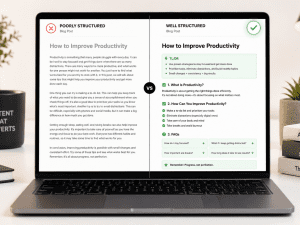
Content that answers the query directly within the first 200 words is significantly more likely to be cited than content that buries the answer after a lengthy introduction.
Content structured with clear headings that match the logical structure of the question gets extracted more reliably than content with vague or promotional headings.
And Content that includes verifiable statistics, named sources, specific dates, and clear factual claims scores higher on the AI’s assessment of trustworthiness than content with only general assertions.
Critically, less than 20 percent of content that ranks well in traditional Google results also gets cited by AI tools — down from about 70 percent two years ago.
This means that ranking on Google page one for a topic is no longer sufficient to guarantee AI visibility on the same topic.
The signals are different enough that content specifically structured for AI citation performs significantly better in that context than content optimised purely for traditional keyword ranking.
The Practical Changes That Actually Increase AI Citation Rates
Every strategy below is grounded in documented research or in direct experience of what produces citation results. None of them require technical expertise or paid tools to implement. They require a different way of structuring the content you are already writing.
Lead Every Post With a Direct Answer
The single most impactful structural change you can make is answering the post’s core question in the first two to three paragraphs — before the context, before the backstory, before the explanation of why the topic matters.
AI tools evaluate the beginning of your content first. If the direct answer is in the opening section, it gets extracted. If it is saved for the conclusion after 2,000 words of buildup, it frequently does not.
This does not mean eliminating the human story and context that makes your content worth reading. It means putting a clear, direct answer early — a concise statement of what the reader needs to know — and then using the rest of the post to explain, illustrate, and deepen that answer with the narrative and experience that distinguishes your content from a generic information summary.
Think of the opening as a TL;DR that exists at the top rather than the bottom, followed by the full human treatment of the topic.
Add a TL;DR Summary Block
A brief TL;DR — Too Long; Didn’t Read — summary at the top of longer posts gives AI tools a pre-structured, extractable version of your content’s most important points.
Research on AI citation patterns consistently identifies TL;DR sections as one of the highest-impact additions to a page, because they create a concentrated, structured block of extractable content that the AI can incorporate directly without needing to parse several thousand words to find the key claims.
A TL;DR for this post would look something like: “AI tools cite content based on clarity, structure, and credibility signals — not traditional keyword optimisation.
To get cited, answer questions directly in the first 200 words, add TL;DR summaries, use FAQ sections with schema markup, include verifiable statistics, and submit your sitemap to Bing Webmaster Tools for ChatGPT visibility.”
That summary takes thirty seconds to read and gives an AI tool everything it needs to incorporate your key points into a generated answer — with your site credited as the source.
Structure Your FAQ Section for Extraction
FAQ sections are among the highest-citation-rate elements in any blog post. AI tools actively look for question-and-answer formatted content because it directly mirrors the query format of the user’s question.
A well-structured FAQ at the bottom of a post that covers the natural follow-up questions around your topic dramatically increases the surface area of your content that can be extracted for different query variations.
Adding FAQ schema markup to these sections — either through Yoast’s FAQ block or manually via JSON-LD structured data — signals to both Google and AI tools that your content contains structured, verified question-and-answer information.
Google Search Console now tracks AI Overview impressions, and FAQ schema is one of the clearest signals that your content is formatted for extraction. If you have not yet added FAQ schema to your highest-traffic posts, it is the highest-leverage technical change available at no cost.
Include Verifiable Statistics and Name Your Sources
AI tools treat content that includes specific, verifiable statistics and named sources as significantly more trustworthy than content with only general claims.
When your post states “ChatGPT handles over 800 million weekly active users as of February 2026, confirmed by OpenAI” rather than “ChatGPT is used by a huge number of people,” the AI’s credibility evaluation scores the first version higher — and is more likely to extract it as a reliable source.
This is directly connected to the E-E-A-T signals that Google has been emphasising for years. Experience, Expertise, Authoritativeness, and Trustworthiness are not just Google ranking signals anymore — they are the same signals AI tools use to evaluate whether a source is worth citing.
Named authors with visible bios, publication dates, updated dates, inline references, and specific verifiable claims all contribute to the credibility score that determines whether your content makes it into the answer or gets passed over.
Use Clear, Specific Headings That Match How People Ask Questions
Your H2 and H3 headings are the primary navigation tool AI tools use to understand the structure of your content and identify which sections are relevant to which queries.
Vague, creative headings — “The Real Story Behind Search” — give AI tools almost no usable information. Specific, question-reflective headings — “Why Does ChatGPT Cite Some Blog Posts and Not Others?” — tell the AI exactly what each section covers and allow it to extract the relevant section for a matching query without reading the entire post.
The practical approach is to write your headings as direct answers to the questions your target reader is likely to ask.
Not “Introduction to Voice Search” but “How Voice Search Works Differently From Typed Search in 2026.” Not “Benefits of AI Optimisation” but “What Happens to Your Traffic When ChatGPT Cites Your Blog.” The heading is an extractable element in itself — make it earn that status.
The Technical Side: What to Set Up Once and Benefit From Indefinitely
Beyond content structure, there are specific technical configurations that improve AI visibility at the infrastructure level. These are one-time setup tasks that compound in value across every piece of content you publish after doing them.
Submit Your Sitemap to Bing Webmaster Tools
This is one of the most actionable and most frequently missed steps for bloggers wanting ChatGPT citation visibility. ChatGPT’s web search function uses Bing’s index rather than Google’s.
If your site is not indexed in Bing, ChatGPT cannot find or cite it regardless of how well your content is structured.
Submitting your sitemap to Bing Webmaster Tools at bing.com/webmasters takes approximately ten minutes and immediately makes your content discoverable to ChatGPT, Microsoft Copilot, and every other tool that draws from Bing’s index.
Expect a four to eight week lag between submission and appearing in ChatGPT answers.
Create an llms.txt File
Following the pattern established by robots.txt for traditional search crawlers, llms.txt is an emerging standard that gives AI tools structured guidance about your site’s content.
It typically includes a brief description of what your site covers, links to your most important pages, and any specific guidance about how AI tools should interact with your content.
While not yet universally adopted, early evidence suggests that sites with llms.txt files experience better AI crawl coverage than comparable sites without one.
Ensure All AI Crawlers Are Allowed in Robots.txt
Several major AI tools use their own dedicated crawlers to index web content. GPTBot for OpenAI, ClaudeBot for Anthropic, and GoogleExtendedCrawler for Google AI features are among the most significant.
If your robots.txt file inadvertently blocks any of these crawlers, those AI tools cannot access your content regardless of how well it is structured.
Checking your robots.txt file to confirm these crawlers are allowed is a five-minute task that removes a potential barrier to AI visibility across multiple platforms simultaneously.
How Different AI Tools Cite Content — And What That Means for Your Strategy
Not all AI tools select sources using exactly the same criteria, and understanding the differences helps you prioritise which signals to focus on for the platforms your audience actually uses.
Perplexity tends to reward content that is explicit, structured, evidence-rich, and current. It frequently cites pages that provide concise definitions, numbered steps, comparison tables, and factual support with clear source attribution.
It surfaces content that is easy to trust at a glance — particularly for queries involving tools, strategic advice, and category comparisons.
If your post covers any AI tool — ChatGPT, Claude, Midjourney, NotebookLM, Perplexity itself — and is structured clearly with specific claims and current data, Perplexity is the AI tool most likely to cite it relatively quickly after publication.
ChatGPT citation requires the Bing index pathway described above. Once indexed, ChatGPT favours content from sources with established credibility signals — named authors, regular publishing history, external mentions from other sites, and consistent topical focus.
Only 11% of domains are cited by both ChatGPT and Perplexity, which means they are drawing from meaningfully different source pools.
Optimising for both requires the structural improvements described above combined with the Bing indexing step specifically for ChatGPT.
Google AI Overviews draws from Google’s existing search index and heavily weights E-E-A-T signals. The content that appears in AI Overviews is almost always content that already ranks reasonably well in traditional Google results — which reinforces the principle that SEO and GEO are sequential rather than competitive. Strong traditional SEO remains the foundation for AI Overview visibility.
The Honest Reality: How Long This Takes and What to Expect
GEO is not a quick-win strategy. It is a compounding one. Research tracking citation rates after implementing GEO improvements consistently documents the same timeline — measurable improvements begin appearing in weeks eight to ten after optimisation, with compounding gains continuing beyond that as the AI tools’ indexes update and your credibility signals accumulate.
Traditional organic search still sends approximately 345 times more traffic than ChatGPT, Gemini, and Perplexity combined as of late 2025. GEO does not replace the importance of ranking in Google.
What it does is add a growing additional distribution channel that converts at significantly higher rates than traditional organic traffic — and that is expanding faster than any other traffic source available to independent bloggers and content creators.
The bloggers who are best positioned for the next three years are not the ones abandoning SEO for AI optimisation or treating them as alternatives.
They are the ones building content that performs in both environments simultaneously — structured clearly enough for AI extraction, substantive and experience-based enough for human engagement, and credible enough for both Google and AI tools to trust as a reliable source.
That combination is exactly what every post on FaithfulBiz has been built toward from the beginning of this content strategy — real experience, clear structure, specific data, honest coverage.
The good news is that the qualities that make content worth reading for humans are almost exactly the same qualities that make content get cited by AI. You do not have to choose between writing for people and writing for AI tools. You have to write well enough that both find you worth citing.
Where to Go From Here in This Cluster
This post is the foundation of the AI search visibility cluster on FaithfulBiz. Each supporting post goes deeper on one specific aspect of getting found in the AI era.
1If you want to understand the specific, practical reasons why some blog posts appear in ChatGPT and Perplexity answers while others on identical topics do not — and the exact structural changes that move your existing content from invisible to cited — the next post in this cluster covers that directly with a checklist you can apply to any post you have already written.
If you want to understand how voice search through AI assistants like Siri, Google Assistant, and ChatGPT Voice is changing how freelancers and service businesses get discovered — and what a blogger in any niche can do to capture that traffic — the voice search guide in this cluster covers the freelancer and creator angle that the generic marketing guides completely miss.
And if you want to understand how to make your YouTube content discoverable by AI tools that are reading transcripts and indexing video descriptions — something that most YouTube creators are not yet doing deliberately — that guide covers the practical steps with specific examples of what works and why.
The Content Visibility Landscape
The content visibility landscape has changed more in the past eighteen months than in the previous ten years combined. But the underlying principle has not changed at all.
The content that gets found is the content that is most genuinely useful, most clearly structured, and most transparently credible.
AI tools are just becoming better at identifying which content actually meets that standard — and better at surfacing it to the people who need it, regardless of which platform they happen to be searching on.
That is not a threat to good content. It is the best possible news for people who have always been trying to write it.
If you want to understand the specific tools that help your content perform across both traditional and AI search simultaneously, this guide to AI tools that actually save time covers the ones worth building into your content creation workflow.
And if you want to understand the broader shift in how search and content discovery is evolving for bloggers specifically, this honest guide to why most new blogs get no traffic connects the traditional SEO foundation to where things are heading in 2026.














Join the discussion Tap to open the comment form +