
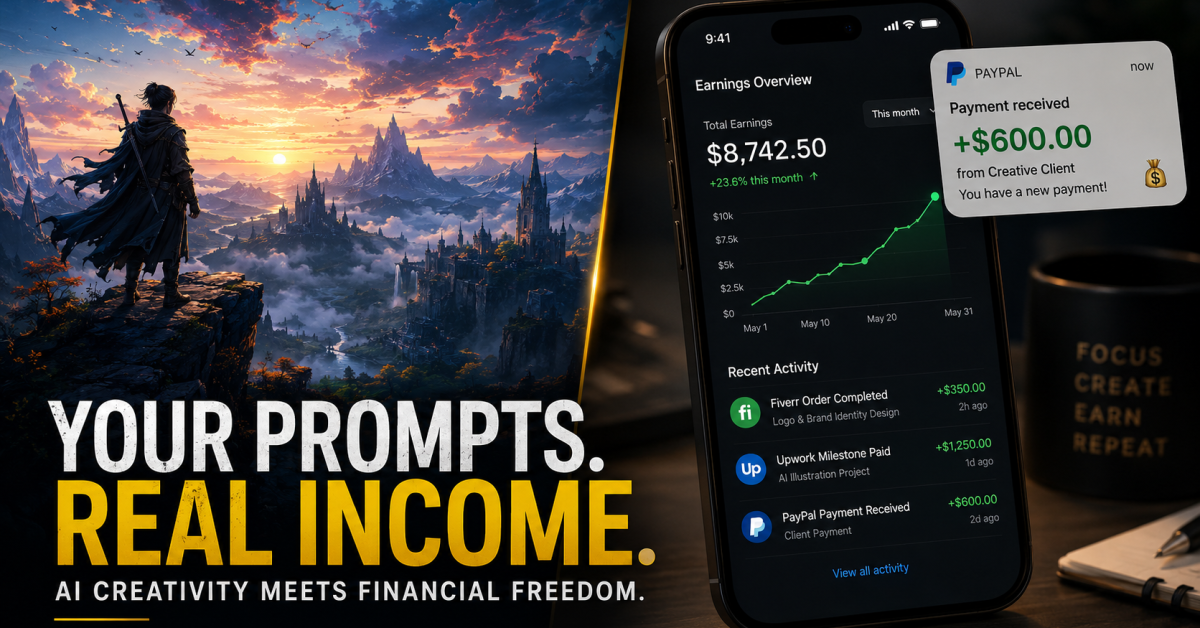
I want to be honest with you about something before we get into the ways people are making money with Midjourney.
Most of what you will find if you search this topic is either a recycled list of vague ideas — “sell prints,” “offer freelance services,” “create stock images” — or breathless claims about how someone made $10,000 in their first month by posting AI art on Etsy. The first category is too general to be actually useful. The second category is almost always missing the context that makes the income reproducible by anyone else.
This guide is neither of those things. What follows is a grounded, honest breakdown of how people are actually earning income with Midjourney in 2026 — what each method requires, what it realistically produces, and what the legal and practical realities are that most guides skip over because they make the answer more complicated.
The income is real. The opportunities are real. But they require specific skills, specific approaches, and a clear understanding of where the boundaries of commercial use actually sit. How to make money with Midjourney is a question with real answers — and this is the honest version of them.
Key Takeaway
Most people do not fail with Midjourney because the tool is weak. They fail because they never develop a commercial skill around it. The money is in solving real problems for real audiences.
The Legal Foundation You Must Understand First
Before any income method makes sense, the commercial rights situation needs to be clear. Most guides skip this entirely, which leads to people building income streams on a foundation they do not understand and discovering problems at the worst possible moment.
Midjourney’s Terms of Service, updated February 12, 2026, give paid subscribers general ownership of the assets they create, including the right to sell and use them commercially. Free plan users get no commercial rights — Midjourney retains ownership of images generated on the free tier. Companies generating over $1 million in annual revenue require the Corporate plan at $600 per year to use Midjourney output commercially.
The copyright situation is more nuanced and directly impacts how you can protect your commercial output. The US Supreme Court declined to hear the Thaler v. Perlmutter case in March 2026, letting stand the DC (District Court) ruling that pure AI-generated content without significant human creative input cannot be copyrighted. What this means practically is that a Midjourney image you generate and sell commercially is protected by Midjourney’s license — meaning you have the right to sell it — but may not be protectable as your own copyright — meaning someone who copies your AI-generated image may have limited legal exposure.
The practical response
The practical response to this, consistently recommended by legal practitioners who work in this space, is to add substantial human modification to AI outputs before commercial use. The more you edit, composite, recolour, and creatively transform the Midjourney output in Photoshop, Illustrator, or Canva, the stronger your copyright position on the resulting work. Using Midjourney as one stage in a creative process rather than the entire process is both better legally and better commercially — the output is more distinctive, more client-specific, and harder to replicate.
Platform rules vary by marketplace. Etsy allows AI-generated art with disclosure. Amazon Merch rejects obviously AI-generated images. Adobe Stock accepts Midjourney images with AI disclosure but has specific content guidelines. Redbubble requires confirmation that you have the right to sell the content. Knowing the rules of each platform before you list is essential, not optional.
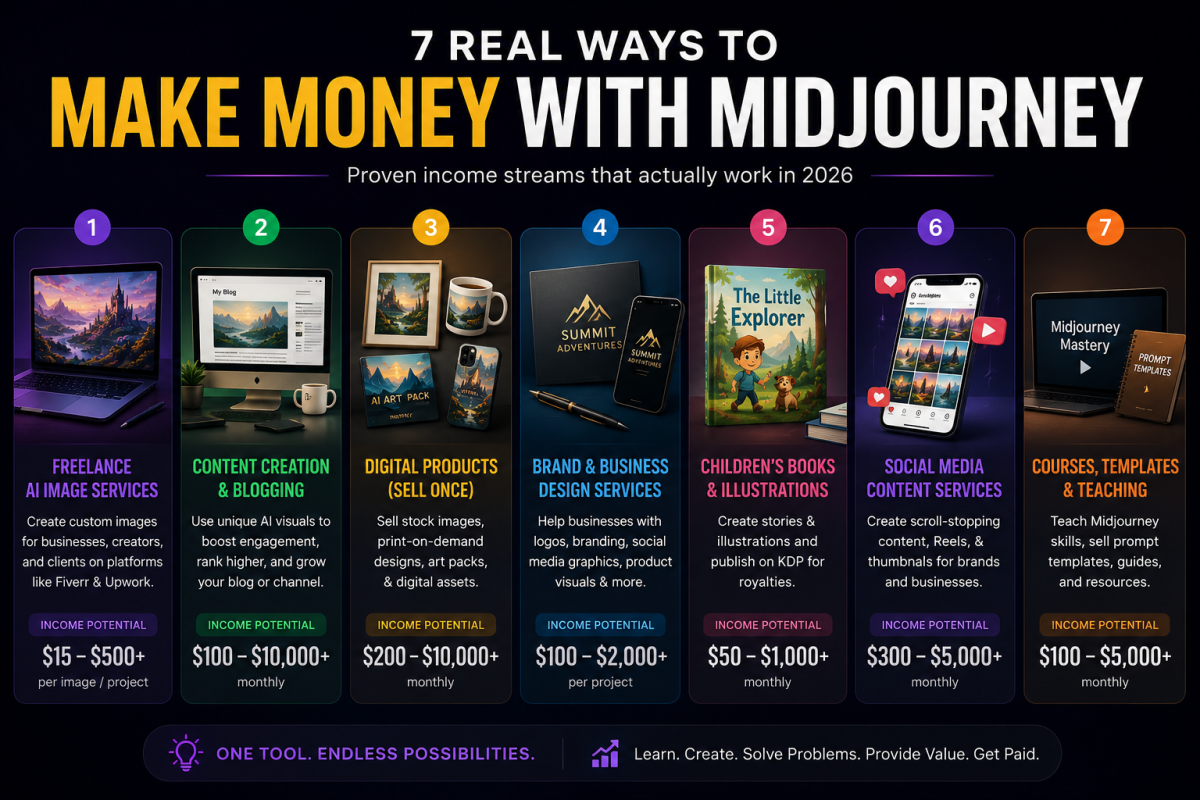
1. Freelance AI Image Creation Services
This is the income method with the lowest barrier to entry and the fastest path to first payment. If you can produce consistently high-quality, on-brief Midjourney output, businesses and individuals will pay for that skill — and the gap between what a skilled Midjourney user can produce and what a non-user can produce is large enough that the service has genuine market value.
The services with the strongest current demand on platforms like Fiverr and Upwork include custom illustrations for blog posts and digital content, social media visual content for brands and creators, book cover concepts and illustration, product visualization for e-commerce sellers who do not yet have professional photography, concept art for games and media projects, and character design for brands and content creators building mascots or visual identities.
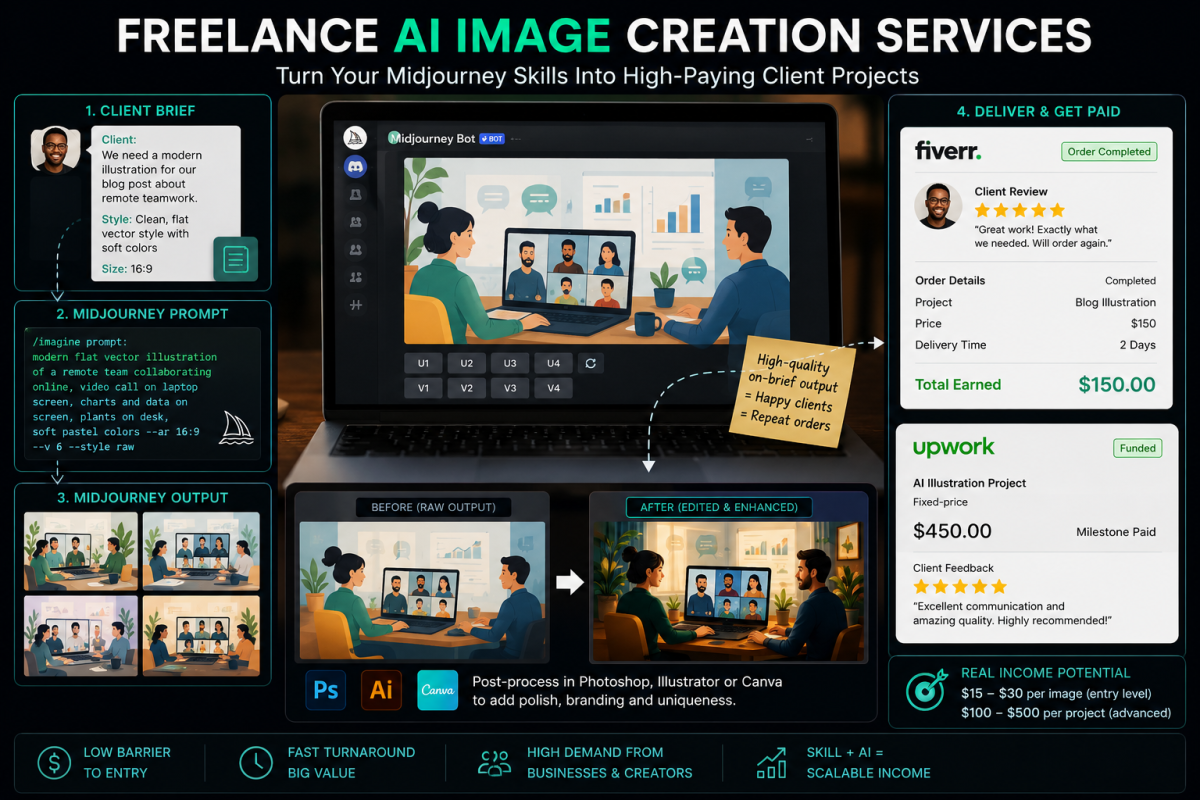
The critical distinction between freelancers who earn well from this and those who undercharge is positioning. Presenting yourself as “I use Midjourney to make images” is a commodity offering that competes on price. Presenting yourself as “I create custom visual content for [specific niche] businesses that increases engagement and saves them photography costs” is a service offering that competes on value. The underlying tool is the same. The income is not.
Key Takeaway
The highest-earning Midjourney creators are rarely just “AI artists.” They combine prompting with branding, editing, positioning, storytelling, marketing, or client communication.
The Real income from Midjourney freelancing
Real income from Midjourney freelancing in 2026 ranges from $15 to $30 per image for entry-level work with limited brief specificity, to $100 to $500 per project for client-specific commercial work with multiple revisions and professional post-processing. The upper end of that range requires combining Midjourney with post-processing skills in Photoshop or similar tools — clients paying premium rates expect more than raw Midjourney output delivered unchanged.
One forum thread tracking a creator’s AI-assisted design freelancing business documented over $50,000 in revenue from AI-assisted design work with no legal issues — specifically crediting the approach of using paid plan commercial rights, adding substantial human modification, disclosing AI use to clients, and avoiding prompts referencing specific named artists.
2. Content Creation and Blogging With AI Visuals
This is the income method that fits most naturally with what FaithfulBiz already does, which is why it is worth covering with specific practical detail rather than a generic mention.
Blogs that use custom AI-generated imagery have a meaningful visual advantage over blogs relying on generic stock photography. The images are unique — they will not appear on fifty other websites simultaneously. They can be made specific to the exact topic of each post rather than approximating it with whatever stock photo is available. And they can be generated quickly enough that illustrating every post with genuinely relevant custom imagery is practically achievable for a solo blogger in a way that commissioning custom illustration never was.
The income connection is indirect but compounding. Better visual content increases time on page. Better time on page signals content quality to Google, supporting better rankings. And Better rankings bring more traffic. More traffic increases ad revenue, affiliate conversion, and the authority that makes sponsored content opportunities possible. The Midjourney subscription essentially pays for itself through the cumulative improvement in content quality and its downstream effect on every monetization stream the blog runs.
For content creators building YouTube channels or social media brands, Midjourney solves the thumbnail and visual content problem specifically. High-CTR thumbnails require striking visual composition that most creators without design training struggle to produce consistently. A creator who can generate compelling, on-brand thumbnail concepts in Midjourney and refine them in Canva has a meaningful production advantage over creators who either accept generic visuals or spend hours in design software producing results that are technically inferior.
3. Digital Products — Selling What You Create Once
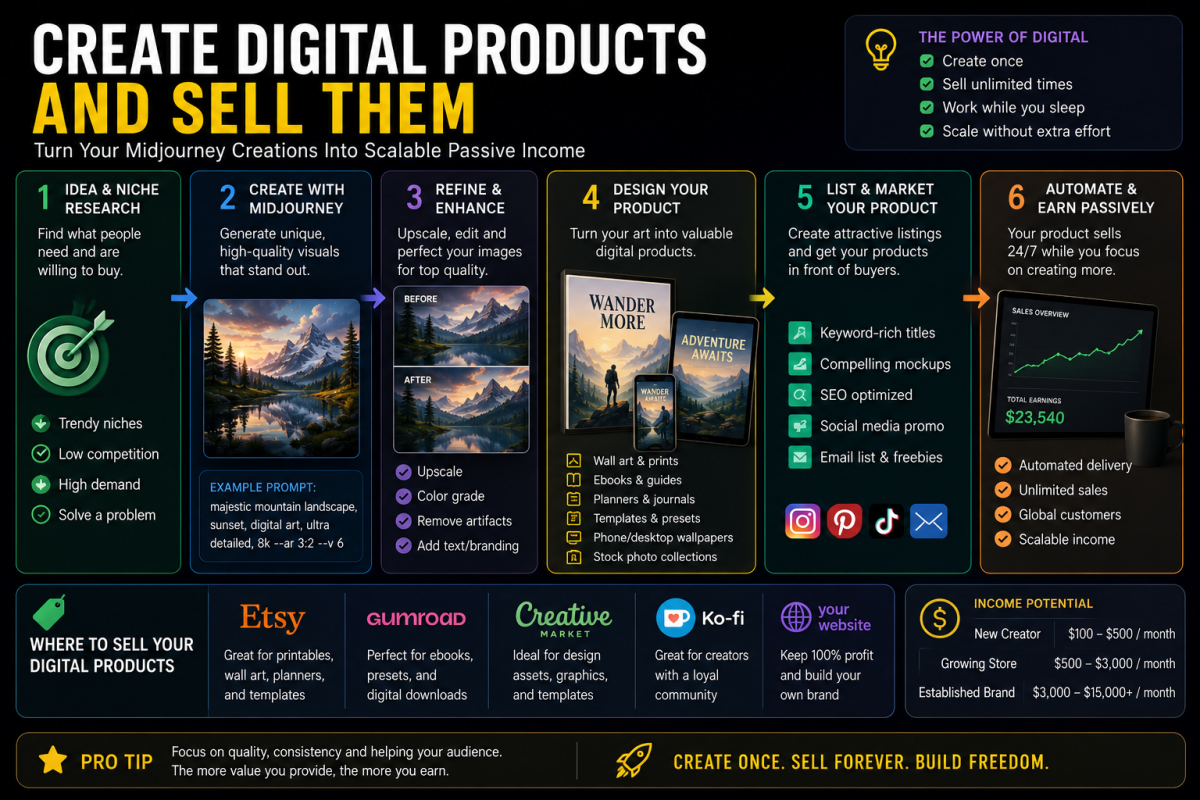
Digital products built from Midjourney-generated art represent the income stream with the highest passive income potential and the most significant upfront investment of creative and marketing effort. The fundamental appeal is straightforward: create something once, sell it repeatedly, earn income from it indefinitely without additional production cost per sale.
Stock Image Libraries
Adobe Stock explicitly accepts AI-generated images with disclosure, and it remains the most commercially significant stock platform for this use case. The income model is royalty-based — you earn a percentage each time your image is downloaded by a stock buyer. Building a library of hundreds of high-quality, niche-specific images takes significant time but creates a compounding passive income stream as the library grows and as individual images accumulate download history that improves their search visibility within the platform.
The images that perform best in stock libraries are not the most artistically ambitious ones. They are the images that solve specific commercial needs — clean lifestyle photography that brands can use in marketing, product mockups, conceptual business illustrations, diverse people in professional settings. Understanding what stock buyers actually need, rather than generating what looks impressive as a portfolio piece, is the difference between a stock library that earns and one that does not.
Print-on-Demand Products
Platforms like Printify and Redbubble allow you to upload designs and sell them on physical products — t-shirts, mugs, phone cases, tote bags, posters, puzzle sets — without holding any inventory. When a customer orders, the platform prints and ships directly. Your margin is the difference between the retail price you set and the platform’s base cost.
The print-on-demand market is more competitive than it was two years ago, which means generic AI art designs uploaded without any targeting or differentiation rarely produce meaningful income. The stores that earn consistently in 2026 are the ones targeting specific niches with high purchase intent — specific fandoms, professional identities, local pride markets, hobby communities — with designs that feel like they were made specifically for that audience rather than generated generically and listed everywhere.
Key Takeaway
Passive income with Midjourney is possible, but only after you build something people genuinely want. Uploading random AI art and hoping it sells is not a business model.
Digital Art Packs and Design Assets
Selling curated Midjourney image packs, texture libraries, background collections, or prompt template packs on platforms like Gumroad or Etsy represents a different model — you are selling the creative work of curating and producing a specific, useful collection rather than individual images. A pack of fifty seamlessly tiling textures for game developers, a collection of a hundred diverse professional portrait backgrounds, a set of thirty consistent product photography backgrounds for e-commerce sellers — these are collections with specific, identifiable buyers willing to pay for the convenience of having the right visual resources ready to use.
4. Brand and Business Design Services
Small businesses consistently need visual assets they cannot afford at professional agency rates. Logo concepts, brand identity exploration, social media visual templates, marketing imagery, product visualization, and presentation graphics are all categories of commercial design work where Midjourney dramatically reduces the time and cost of production for someone with the prompting skill to direct it effectively.
The service model that works best for Midjourney-assisted brand design is not presenting Midjourney as a replacement for design thinking — it is presenting a faster, more affordable path to professional-quality concept exploration. A designer or creative consultant who uses Midjourney to generate ten logo concepts in two hours, presents them to a client for feedback, and then refines the chosen direction using Illustrator or Canva is offering something genuinely more valuable than a designer who spends two days producing three concepts manually at higher cost.
The Local Businesses
Nigerian and African small businesses represent a particularly strong market for this service. The gap between the visual quality many local businesses are currently using and the quality achievable with Midjourney assistance is significant. A food brand whose marketing currently uses phone photos on a plain background can be transformed visually with professional product imagery generated through Midjourney — at a cost the business can afford and at a turnaround the business can work with. That transformation has a real, visible impact on how the business presents itself to customers, which creates genuine referral value for the service provider.
Understanding how to build a service offering around AI tools and position it for the right clients is something the broader guides on this blog cover in depth. This breakdown of what actually pays with AI right now gives you the framework for positioning any AI-assisted service effectively — the same principles that apply to writing and content services apply directly to Midjourney-assisted design.
5. Children’s Books and Illustrated Content
Self-published children’s books have become one of the most discussed Midjourney income opportunities in creator communities, and for understandable reasons. The combination of Amazon’s Kindle Direct Publishing platform, Midjourney’s illustration capability, and the relatively low word count requirements of children’s books creates a genuinely accessible path to a published product with ongoing royalty income.
The reality is more nuanced than the viral success stories suggest. The children’s book market on KDP is significantly more competitive in 2026 than it was in 2022 when the first wave of AI-illustrated books flooded the platform. Books that sell consistently are those with genuinely engaging stories, visual consistency across all illustrations, professional editing and formatting, and targeted marketing to specific audiences — not books that were generated, formatted minimally, and listed without a promotion strategy.
Character consistency across multiple pages was historically one of Midjourney’s weakest points, making children’s book illustration genuinely difficult because the same character needs to appear recognisably across twenty or more distinct scene illustrations. The –cref character reference parameter introduced in recent versions significantly improves this, though maintaining perfect consistency still requires careful prompting and some manual refinement in post-processing. The result is achievable but requires more skill and effort than most introductory tutorials acknowledge.
The income potential for a well-executed, well-marketed children’s book on KDP ranges from a few dollars a month for books with no promotion strategy to several hundred dollars monthly for books that rank well in specific niche categories and receive consistent positive reviews. Building a series of related books in the same visual style and with consistent characters multiplies this — readers who liked the first book will buy the second, creating compounding income from a single creative investment in establishing the visual identity.
6. Social Media Content Creation as a Service
Social media managers who can produce visually distinctive, on-brand content consistently are in significant demand, and Midjourney is changing what one person can produce in a working day. A social media manager who previously could produce ten manually designed posts per day — limited by the time required to work in design software — can produce thirty or more Midjourney-assisted posts in the same time, with higher visual quality and more creative variety than the manual process allowed.
This productivity multiplier has a direct income implication. A social media content creator charging a flat monthly rate per client can profitably manage more clients simultaneously without proportional increase in working hours. Alternatively, the same quality of service can be offered at a more competitive price point — which expands the accessible client base to include smaller businesses that previously could not afford professional visual content at scale.
The services that command the strongest rates in this category are video-adjacent ones — short-form video content creation that uses Midjourney images as visual elements in Reels, TikToks, and YouTube Shorts, combined with CapCut or similar editing tools. A creator who can take a brand’s message and turn it into a visually compelling thirty-second piece of content using AI-generated imagery is solving a problem that most small business owners find genuinely difficult, and is doing it at a production cost that makes the service economically viable for both parties.
7. Courses, Templates, and Teaching
As Midjourney becomes more mainstream, the demand for education around using it effectively is growing alongside the tool itself. People who develop genuine expertise — who understand prompt structure, parameter control, style reference techniques, and professional application across specific industries — have a teachable body of knowledge that other people will pay to access faster than they could develop it through independent experimentation.
The formats that work best for Midjourney education are not long-form video courses on YouTube, where the competition is extremely high and the monetization model is slow. They are specific, practical resources — prompt template packs for specific use cases, workflow guides for specific professional applications, short-form tutorials that solve specific problems — sold directly through Gumroad, Payhip, or similar platforms at price points between $10 and $50.
A prompt template pack specifically designed for Nigerian food businesses, covering restaurant menu photography, promotional social content, and brand visual assets — all with prompts tested to produce culturally appropriate and locally resonant visual output — would be a genuinely useful product with a specific, identifiable buyer that no generic Midjourney guide currently serves well. The specificity of the niche is what creates the product’s value. Generic prompt collections are everywhere. Specific, tested, professionally relevant prompt systems for defined audiences are not.
Teaching through blog content is also a legitimate path, and one that fits naturally into what you are already building. The Midjourney cluster on FaithfulBiz is itself an asset that will attract the audience interested in using these tools effectively — and once that audience trusts your guidance on the free content, a paid resource that goes deeper or solves a more specific problem has a warm, qualified audience already.
Key Takeaway
One Midjourney image can become multiple income streams at once — a stock image, a thumbnail, a digital product, a social media asset, or part of a client project. The leverage is in repurposing creatively.
The Honest Income Reality
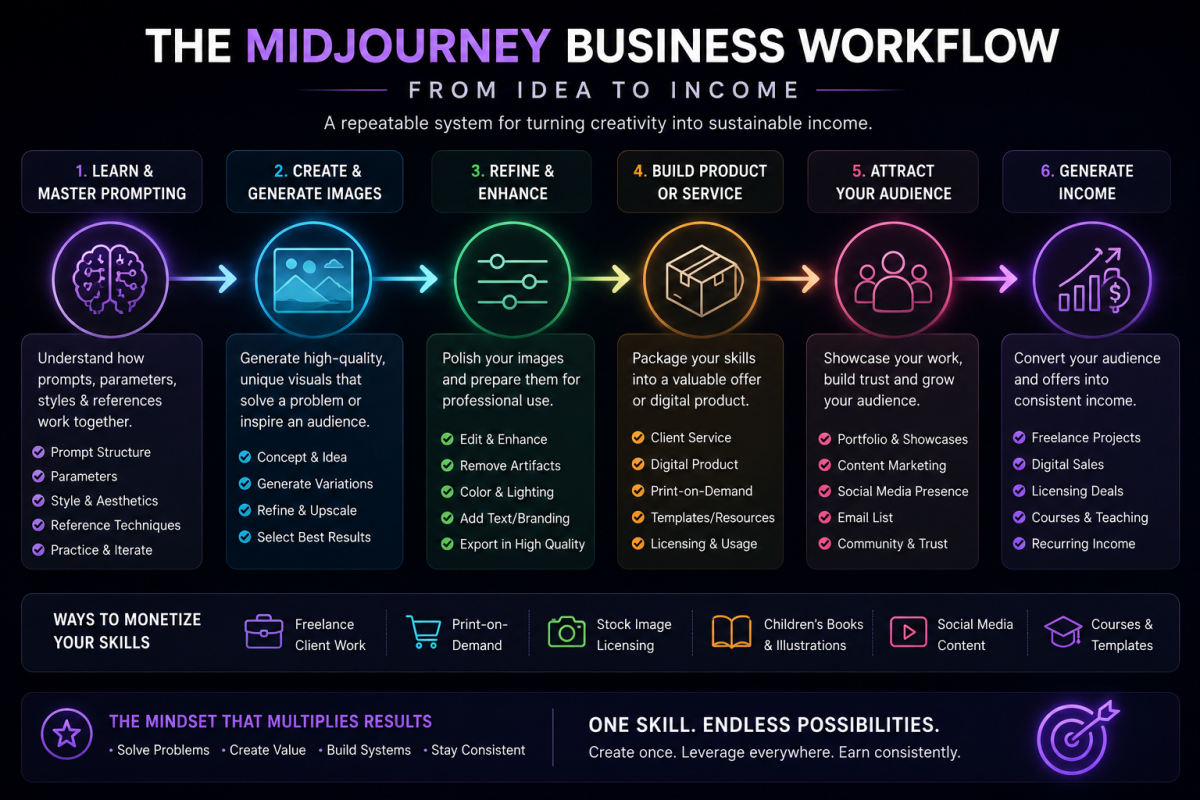
Most people who try to make money with Midjourney make very little in their first month. This is not because the opportunity is not real. It is because the approach most beginners take — generate some images, list them on Etsy or Redbubble, and expect passive income to arrive — is not a strategy. It is an experiment without a hypothesis.
The people who earn consistently from Midjourney in 2026 are the ones who treated it as a skill to develop rather than a shortcut to passive income. They spent time learning prompt structure and parameter control deeply enough to produce reliably on-brief output. They identified a specific audience with a specific visual need that Midjourney could serve better or more affordably than existing alternatives. And They built a service or product offering around that specific intersection. And they marketed it directly to the audience who needed it rather than listing it somewhere and hoping discovery would happen on its own.
That path is more work than the passive income framing suggests. It is also more durable, more defensible, and more scalable than any approach built on the idea that the tool alone does the commercial work. Midjourney is powerful. Combined with a clear service proposition, a specific audience, and the prompt and parameter skills to deliver consistently, it becomes something genuinely worth building a business around.
Understanding The Range Of Skills
If you want to understand the full range of skills that compound well with Midjourney income in the current market, this guide on skills that pay well online covers the broader landscape of what commands consistent income in 2026 and where AI visual skills fit within it. And if you are still building the Midjourney foundation — understanding what it is, how it works, and which version to use — the complete beginner’s guide to Midjourney covers everything before the income strategy makes sense to build on top of it.
The subscription costs $10 per month at the entry level. The prompting skills take two to four weeks of deliberate practice to develop to a usable commercial standard. The income potential beyond that investment depends entirely on how specifically you identify the problem you are solving and how consistently you solve it. That equation is not unique to Midjourney — it is the equation behind every legitimate skill-based income stream. Midjourney just makes the creative production side of it dramatically more accessible than it has ever been before.













Join the discussion Tap to open the comment form +