
If you use ChatGPT, something got noticeably cheaper and more generous this summer, and there is a decent chance nobody told you about it.
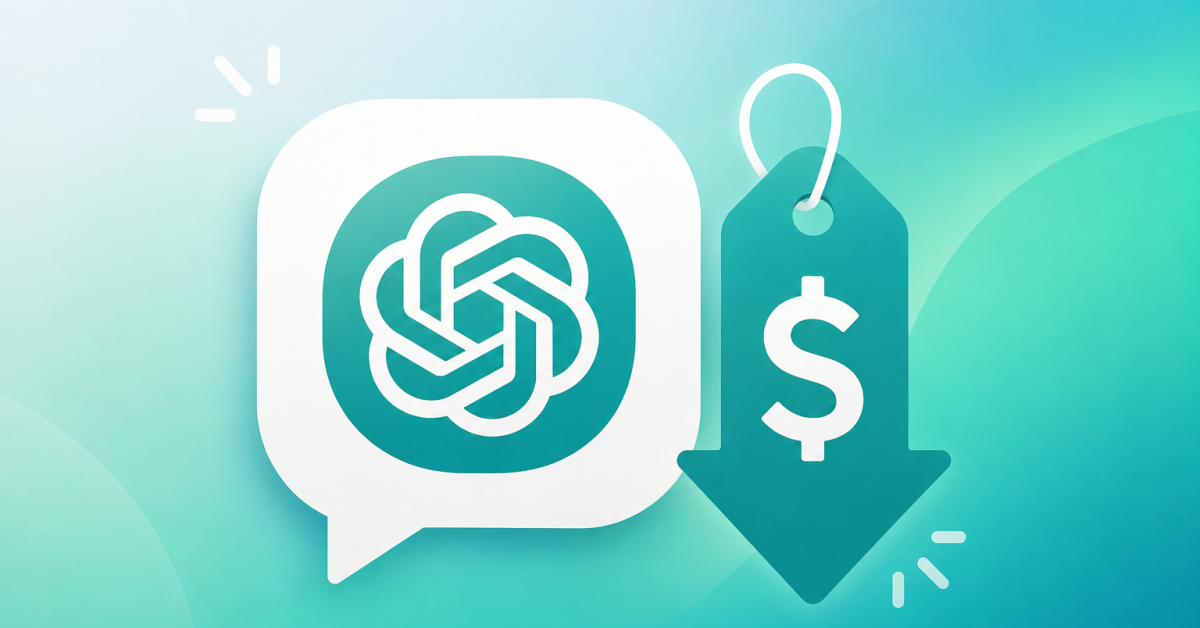
OpenAI cut the price of one of its models by 80%, then quietly made that same model unlimited for free users a week later.
None of this happened because OpenAI woke up feeling generous.
It happened because the AI industry is in the middle of a real price war, and the company that used to set the price is now the one reacting to competitors instead of the other way around.
Key Takeaway
OpenAI cut the price of its fastest model, GPT-5.6 Luna, by 80% on July 30, 2026, then made it unlimited for text chat on the Free and Go plans about a week later. The real driver behind the cut is competition from cheaper rival models, not generosity. If you use ChatGPT on a free or lower-cost plan, this likely already changed what you can do without hitting a limit.
What Actually Launched, and What Changed
OpenAI released its GPT-5.6 family of models on July 9, 2026, split into three tiers built for different jobs. Sol is the flagship, built for the hardest reasoning and coding tasks.
Terra is the everyday middle option. Luna is the fastest and cheapest, described by OpenAI as delivering roughly 85% of Sol’s quality at a fraction of the cost and speed.
Three weeks later, on July 30, OpenAI cut prices on two of the three models. AI companies charge developers by the token, which is roughly a small chunk of a word, and prices are usually quoted per one million tokens processed.
Here is what changed, per million tokens:
- Luna: input price dropped from $1.00 to $0.20, an 8%t cut. Output dropped from $6.00 to $1.20, also 80%
- Terra: input dropped from $2.50 to $2.00, a 20% cut. Output dropped from $15.00 to $12.00.
- Sol: left completely unchanged, still $5.00 input and $30.00 output.
A task that used to cost about $7 in Luna tokens now costs roughly $1.40. If you are not a developer, none of those exact numbers matter much on their own. What matters is what OpenAI did with that cheaper model next.
The Part That Actually Affects You
On August 7, 2026, about a week after the price cut, OpenAI made a quieter but arguably more important change. GPT-5.6 Luna became unlimited for text chat on both the Free plan and the cheaper regional ChatGPT Go plan, the same naira-billed plan covered in our guide on paying for AI tools from Nigeria.
At the same time, GPT-5.6 Sol took over handling both quick replies and deeper reasoning for Plus and Pro subscribers, instead of forcing users to switch models manually.
In plain terms, if you have been using ChatGPT on the free tier or on Go, you may already be getting noticeably more usage out of it than you were a month ago, without OpenAI making a big announcement about it.
This is worth checking for yourself inside the app rather than assuming it applies exactly the same way to your account, since rollouts like this do not always land identically for everyone at once.
Why OpenAI Actually Did This
OpenAI’s official explanation is that the cuts pass along genuine efficiency gains. The company said GPT-5.6 itself helped rewrite and optimize the code running its own servers, which lowered the actual cost of serving each response. That explanation is true, but it is not the whole story.
A price cut this deep, on a model barely three weeks old, does not happen purely out of internal efficiency. Multiple industry reports point to competitive pressure from a wave of cheaper, capable open-source models, alongside aggressive pricing from labs in China.
When a rival releases something nearly as good for a fraction of the price, the pressure to match it shows up fast, whether or not a company says so directly.
OpenAI is not the only lab feeling this pressure. Anthropic’s Claude Sonnet 5 is currently priced at an introductory $2 input and $10 output per million tokens, rising to $3 and $15 after August 31, 2026.
That kind of time-limited introductory pricing is itself a sign of how competitive this market has become. Every major lab is now fighting to offer the best intelligence per dollar, not just the smartest model on paper.
What This Means Going Forward
For anyone using these tools rather than building on top of them, a price war is mostly good news in the short term. Free and lower-cost plans stretch further, and the gap between what you get for free and what you pay for narrows a little each time this happens.
The honest caveat is the same one that applies to Gemini’s user growth and Nvidia’s massive AI financing plan. None of these companies are running a charity.
Cutting prices to win a usage war only makes sense if the company believes it can make that back later, through scale, through paid upgrades, or through infrastructure deals like the one Nvidia is building. Cheaper AI right now is real and worth taking advantage of.
Whether it stays that cheap once the competition settles down is a separate question, and one nobody in this industry has actually answered yet.





Join the discussion Tap to open the comment form +